The Character of Hospitality

Authors Pat Ennis and Lisa Tatlock, in their wonderful book Practicing Hospitality, surveyed the Scriptures and created a word collage of what a person of character who desires to practice hospitality might look like. Here’s their summary version:

H – Humble

Humility is the opposite of self-sufficiency and is a necessary prerequisite if I am going to be of service to my heavenly Father. I can exercise humility by choosing to step out of my comfort zone and invite individual into my home with whom I may not be totally at ease, or those who may have unrealistic expectations about the event.

O – Obedient

The primary evidence that individuals are Christians is their choice to obey all of their Father’s command. I demonstrate obedience by obeying all of my Father’s commands that focus on hospitality.

S – Sincere

Genuine, as well as absence of deceit or hypocrisy, describes sincere actions. I will “stay on my knees” until I can extend sincere invitations.

P – Prayerful

Prayer – that is, communicating with my heavenly Father – shows my desire for His direction about and dependence on Him for the event. I resolve to pray about all aspects of the events that I play.

I – Interested in Integrity

Integrity is choosing to dow hat is right when given a choice between right and wrong, even when it is unpopular. I will choose to adhere to my heavenly Father’s standards, regardless of what the mainstream of society is doing.

T – Trustworthy

A trustworthy home provides an ambience of trust and confidence. I will study Elizabeth’s life in Luke 1:39-56 as a model for my life.

A – Adopted into God’s Family

Adoption is choosing to legally integrate an individual into one’s home and nurturing that individual as one’s very own child. I will choose, through the strength of the Holy Spirit, to behave in a way that reflects my royal heritage, so that my guests will observe a bit of “heaven on earth” in my home.

L – Led by the Spirit

Walking in the Spirit literally mens keeping in step with the Holy Spirit. I will propose to walk tin the Spirit so I will not carry out the desire of my flesh (Galatians 5:16).

I – Instrumental in Producing Righteousness

An instrument of righteousness brings “every through captive to obey Christ” (2 Corinthians 10:5) and refuses to fret or worry about anything (Philippians 4:6-8). I must control what I think about and purpose to be spiritually renewed by humble presenting my concerns to my loving heavenly Father – even when the hospitality event appears to be beyond my capabilities.

T – Thankful

Being thankful is an act of the will that generates the giving of thanks to God – regardless of the circumstances. I choose t learn to be content regardless of my circumstances. (Philippians 2:11).

Y – Yielded

We are to possess a willingness to yield to our heavenly Father’s specific instructions in relation to practicing hospitality. I demonstrate my love to Him by choosing to embrace His instructions with my whole heart – and that is when my joy is complete (1 John 1:4; 2 John 12).

With the summary of the word collage above, you can create your own personal version. Click here to download the image below. Use it to personalize your own ideas in developing a character of hospitality.


I hope you have been intrigued enough by the information above to pick up a copy of Practicing Hospitality and explore the many other useful tools the authors have created.

25 Days and 101 Ways to Move from Façade to Family

Today’s post introduces you to Ben Connelly’s book, A Field Guide for Genuine Community. The excellent subtitle of his book is the title of this post.

Here’s the big picture:

  • Week One: WHY Should I Even Care?
  • Week Two: WHO is My Spiritual Family?
  • Week Three: WHAT Does a Spiritual Family Do?
  • Week Four: WHEN and WHERE Does a Spiritual Family Interact?
  • Week Five: HOW do we Start?

Most of the Bible’s commands that translate into English as “you” are plural in their original language: they are written to people together, not to individuals alone.

Ben Connelly

You get all kind of “community” at church…

…so why do you feel so ALONE?

You show up at church every Sunday. You see people you know. You listen to a sermon together. And then you go home feeling just as isolated as you did before. What’s going on?

We all know that a church is supposed to be a community. The trick is to actually make it one. 

Communities don’t happen by chance – certainly not in our Lone Ranger culture that values independence and individualism. A truly Christian community must be built by intentional practices that allow for deeper connections, centered on the unity that can only be found in Christ.

In A Field Guide for Genuine Community, longtime pastor and discipleship trainer Ben Connelly shows you that the biblical model for community is the family of God. In twenty-five short, practical readings, he takes you beyond the surface and helps you learn to connect with your brothers and sisters as true family members. The church isn’t meant to be a collection of strangers. God intends for you to find a unified and purposeful household where you truly belong.

Here’s the author’s brief outline of the book:

Week One (Why) dives deeper into the need for true and genuine community. Connelly considers the depth of Christian relations seen the the Bible compared to what we see today, and why we must move from façade to family.

During the first week, the focus is on opening up your home and your heart to welcome others. This involves creating a warm and inviting environment where people feel comfortable and welcomed. It can include simple gestures like hosting a casual gathering, coffee morning, or potluck dinner to encourage initial connections.


Week Two (Who) looks at the different elements of God’s Church. The author looks at realistic expectations about interactions within God’s family, from the historical and global Church to the diverse, unified Christians we interact with most regularly.

In this week, the emphasis is on building trust among community members. It involves actively listening, showing empathy, and fostering open and honest communication. Trust is the foundation of any strong community, so this week may involve activities and conversations aimed at deepening those bonds.


Week Three (What) examines various biblical commands and examples of discipleship together and helps readers apply them to their own lives and groups.

Week three is about personal growth and development within the community. This may include shared learning experiences, workshops, or discussions on topics of mutual interest. The goal is to create opportunities for community members to learn and grow together.


Week Four (When and Where) shows how the moments and places that we already interact in can be used for these kinds of relationships, even in our busy lives.

During this week, the focus shifts towards service and giving back to the community. Members are encouraged to identify ways they can contribute to the well-being of others in the group. This can involve acts of kindness, volunteering together, or supporting one another in times of need.


Week Five (How) combines the previous weeks’ content in to accessible “first steps,” while acknowledging that even the best families are messy.

The final week centers on sustainability and growth. It involves discussing how to ensure the community remains vibrant and how to expand its reach. This may include planning for future gatherings, welcoming new members, and setting goals for the continued development of the community.


These five weeks of actions aim to guide individuals and groups in the process of building and nurturing a genuine and supportive community in the context of hospitality in the home. Each week’s activities are designed to strengthen connections, trust, and shared values among community members.


A Field Guide for Genuine Community

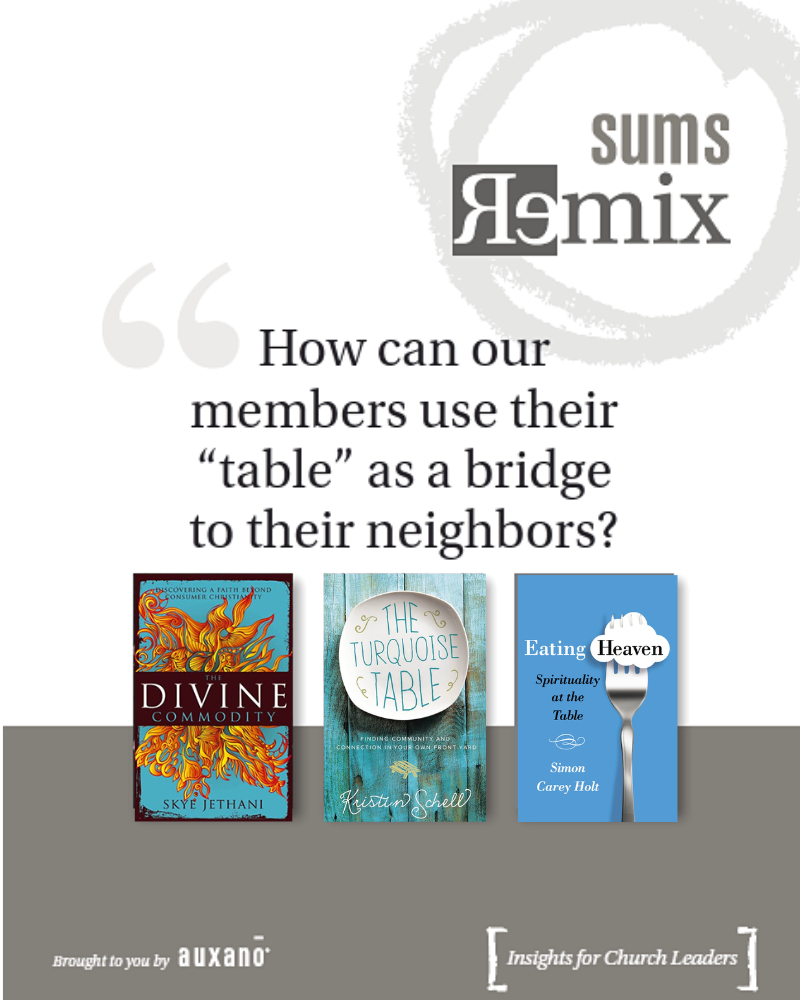
How Your Members Can Use Their “Table” as a Bridge to Their Neighbors

Breaking bread together has been shown to connect us deeply in ways that no other experience can. A study from the University of Oxford showed that when we eat and drink together, our bonds are strengthened, we become increasingly content, and we experience a more intensified connection to the larger community.

According to author Leonard Sweet (From Tablet to Table), if we really want to learn someone’s story, sitting down at the table and breaking bread together is the best way to start. The story of Christianity didn’t take shape behind pulpits or on altars or in books. The story of Christianity takes shape around tables, as people face one another as equals, telling stories, memories, enjoying food, with one another.

In other words, as author Hugh Halter (Happy Hour Etiquette) states, “The Gospel will not be heard until our front doors open, our tables are set, and we practice the art of hospitality, celebration, and party.”

This issue of SUMS Remix looks at solutions that will help your members learn to use their “tables” as a bridge to their neighbors. The solutions include: 

Jesus ate all kinds of food around all kinds of tables in all kinds of places with all kinds of people. To be a disciple of Jesus (then and now) is to love to eat, no matter what Jesus cooks and no matter where he sets the table. Even when only two are gathered, three are always present. Wherever we break bread together, Jesus is always at the table.

Leonard Sweet, From Tablet to Table

A Simple and Sustainable Vision for Loving Your Next-Door Neighbors

We seek to provide a sustainable vision for the “low and slow” lifestyle of neighboring and supply practical tools that help people invest in their communities, value each step in the process, and build meaningful, gospel-motivated relationships with their fellow image-bearers right next door.

Chris and Elizabeth McKinney

In a culture where most people don’t know their neighbors’ names, where we are lonelier than ever, where we don’t know how to talk to people who are different from us, Chris and Elizabeth discovered that they couldn’t live without their neighbors.

It was on this journey of discovery that the McKinneys wrote Placed for a Purpose for those who want to grow in what Jesus Christ said was the most important thing we could ever do with our lives – to love God and love our neighbors.

They’re inviting you to grab some friends and go love your neighbors together.

Drop over to their website for a full introduction to Chris and Elizabeth and their journey to neighboring.

You will also want to listen to their podcast.

Along the way, be sure to check out their book, as well as other connections they can make with like-minded churches and leaders.


How Can We Serve Our Neighbors If We Haven’t Paid Attention to Them?

Welcome to the age of white noise.

We live our lives in a constant tether to phones, to apps, and to social media – mostly acquiescing to FOMO.

In this age of distraction, the ability to experience and be present is often lost, as is our capacity to think and to see and to listen.

Rob Walker, The Art of Noticing

At a basic level, paying attention is simply making a selection among all the stimuli bombarding you at any moment.

Even if we ignore most of what is going on around us, we can only take in so much of the world at a time. Our sensory system has a limited capacity, both in range and in speed of processing.

I was paying so little attention to most of what was right before me that I had become a sleepwalker on the sidewalk. What I saw and attended to was exactly what I expected to see. That attention invited attention’s companion: inattention to everything else.

Alexandra Horowitz, On Looking

Questions to Ponder

  • How do you observe the all-too-familiar in order to discover new meaning and discern the activity of God that others miss?
  • What do you look for?
  • How can you learn to scrutinize the obvious?
  • What does it mean to look for the extraordinary in the ordinary?

I would like to suggest the answer to these questions begins with seeing through the lens of love.

Download the tool below to begin a ten-day journey in looking at your neighbors through the lens of love, specifically with the Fruit of the Spirit in mind.


The fruit of the Spirit are not merely characteristics that we aspire to own. They are glorious graces that characterize all those who pursue a Christlike character.

In order to “pay attention” by following the Holy Spirit, use the nine fruit of the spirit as described by pastor, professor, and storyteller, Calvin Miller as a framework for incorporating them into your life.

Lead a Church that Knows, and Loves, Its Neighbors

Let’s play a word game – read the word at the end of this sentence, then jot down the first three things that come to your mind in the space below: Neighbor.

What was on your list? Was it Mr. Rogers, or the latest mobile game “Hello Neighbor,” or maybe a generic group of people?

What about a specific person or family? Someone whom you know more than just a first name – someone whom you have established some sort of relationship that goes beyond the surface.

“Neighbor” is one of those words that can encompass dozens of meanings, good and bad experiences, and warm memories or frightful nightmares.

Neighbor certainly has connotations beyond someone who lives near or next door to you – and rightfully so. But let’s start there – the person who lives in close proximity to you.

Do you understand who your neighbor is? Even better are you leading a church full of people who understand who their neighbors are?

This SUMS Remix will help you answer these two vital questions, for the health of your church, and your ministry. The solutions include: 


5 Everyday Ways to Love Your Neighbor and Change the World

What would you call someone who listens without judgment, offers you wise counsel but helps you make your own decision, and loves you no matter what?

That’s a friend!

Jesus had a nickname given to him by the religious leaders of His day – Friend of Sinners (Matthew 11:16-19).

Jesus’ simple strategy to reach the world was friendship and blessing.

There is no better model for what it looks like to “go and bless” than Jesus. His entire life was a blessing. The Gospels give us numerous examples of how Jesus blessed the people He encountered.

Dave Ferguson and Jon Ferguson

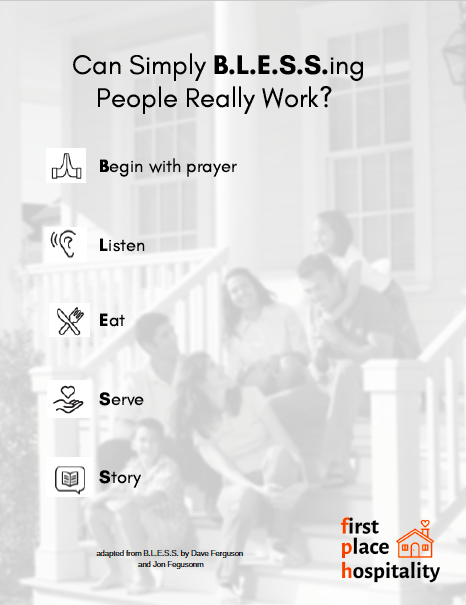
B.L.E.S.S. authors Dave Ferguson and Jon Ferguson made a list of all the ways Jesus practiced being a blessing to people, and narrowed it down to the top five. The resulting B.L.E.S.S. practices are five everyday ways that Jesus loved his neighbors.

B: Begin with prayer

When Jesus started His earthly mission, Luke 6 tells us that He went out on a mountain and prayed. Prayer is both how you discover your mission and how you live out your mission.

L: Listen

Asking questions and then listening was central to Jesus’ life and teachings. Any relationship starts with listening to someone’s words and life. True listening may be the kindest and most loving gift you can give someone.

E: Eat

Jesus liked to eat! Over and over, as in Matthew 9, we find Jesus with tax collectors and sinners…doing what? Eating! There is something about sharing a meal together that moves any relationship past acquaintance toward friendship.

S: Serve

Jesus told us straight up, “The Son of Man did not come to be served, but to serve…” (Matthew 20:28). He modeled for us that once you begin with prayer, listen, and eat with someone, there is a good chance that you’ll discover how you can best serve the person God is asking you to bless.

S: Story

When people were ready to listen, Jesus would share his story, as in John 14 with Thomas. When you befriend and bless people, they feel relationally safe and want to know your story. Then, and only then, can you tell them how the love of God and Jesus’ life, death, and resurrection have changed you.

Using the brief descriptions above, and downloading the PDF tool below, write out practices in each of the five B.L.E.S.S. categories.

How will you use one of these practices each day?

Remember, though: B.L.E.S.S. is not a checklist.

Many well-intentioned people have taken these missional rhythms and turned them into a set of linear steps to be performed one at a time. The B.L.E.S.S. practices are NOT a checklist or another church program you graduate from. They are simple, everyday ways to bless the people around you. Never focus more on the practices than on the people you are seeking to bless!


inspired by B.L.E.S.S. by Dave Ferguson and Jon Ferguson

Learn to See God at Work in Your Neighborhood

Note: As the original issue of this SUMS Remix was being prepared in March 2020, most of the United States was under some type of mandate restricting movement. Typically called “physical distancing,” the intent is to minimize the chances of the coronavirus being spread by maintaining a distance of at least six feet when you are in public settings.

However, even if “physical distancing” (the more correct term) is no longer required, “social interaction” is needed more now than ever before. 

Efforts taken to slow the spread of the coronavirus should encourage strengthening social ties while maintaining that physical distancing.

Therefore, some of this content may not be applicable under current restrictions in your community; however, the intent is critical in moving forward as we demonstrate hospitality to our neighborhoods, in every season

According to Rosaria Butterfield, 

Christians are called to live in the world but not live like the world. Christians are called to dine with sinners but not sin with sinners. 

She adds,

We live in a world awash with counterfeit hospitality. Knowing the difference between the grace of God and its counterfeit is crucial to Christian living.

Hospitality shares what there is; that’s all. It’s not entertainment. It’s not supposed to be.

This issue of SUMS Remix looks at solutions that will help you understand and practice hospitality in and through your home. The solutions include: 


How to Help Your Church See Biblical Hospitality – Specifically the “Table” – as a Way of Life

In December 2019, the motion picture, “A Beautiful Day in the Neighborhood,” staring Tom Hanks as beloved television icon Fred Rogers made its debut. Rogers was the creator, showrunner, and host of the preschool television series Mister Rogers’ Neighborhood, which ran from 1968-2001.

As a musician, puppeteer, writer, and producer, Fred Rogers’ gentle demeanor brought beautiful simplicity through nurturing interactions with young children to over 30 years of viewers. His enigmatic theme song, from which the motion picture takes its title, includes the following lines, which many adults can recall:

It’s a beautiful day in this neighborhood, 

A beautiful day for a neighbor,

Would you be mine?

Could you be mine?

Fred Rogers was also a Presbyterian minister, and it’s likely those lines were inspired by another story of a neighbor.

In the Parable of the Good Samaritan (Luke 10:25-37), Jesus asked the expert in law, in effect, “Who is your neighbor?”

It’s almost 2020, and the question remains, “Who is our neighbor?”

From the television neighborhoods of Beaver Cleaver and Andy Taylor, to Mr. Rogers, to Sam and Diane, to Jerry and Kramer, to Rachel and Monica and Phoebe and Chandler and Joey, to Phil and Claire, to Jack and Rebecca and Randall and Kate, it’s a question that mainly depicts an unfulfilled longing for a neighborhood that actually works.

It occurs to me that this is not a neighborhood;

It is only a collection of unconnected individuals.

Philip Langdon, A Better Place to Live

Long gone are the days where kids played in the yards and streets all day “till the street lights came on” and where neighbors talked across fences or on front porches.

It seems as if the people we live closest to appear only briefly when the car leaves the garage in the morning and comes back in the evening. 

It seems as if the idea of “neighborhood” has disappeared in reality if not actuality, and with it the idea of knowing for, and caring for, neighbors.

As Lance Ford and Brad Brisco write in Next Door as in Heaven:

What does all this neighborhood business have to do with the gospel? As Jesus followers – people of the Good News – we follow the one who said the most important commandment is to love God with all our heart, soul, and strength, and to love our neighbors as ourselves. We have a tremendous opportunity before us: to take notice and help resurrect rich relationship in our neighborhoods.

If anyone should “neighbor” differently, it should be us.

According to Leonard Sweet, if we really want to learn someone’s story, sitting down at the table and breaking bread together is the best way to start.

This issue of SUMS Remix looks at solutions that will help you see the importance of your “table” as a place of disciplemaking. The solutions include: 

A closing quote, by Rosaria Butterfield, author of The Gospel Comes with a House Key, seems most appropriate:

Radical, ordinary hospitality brings the gospel to our lost friends and neighbors. Such hospitality sees our homes as not our own, but as God’s tools for the furtherance of his kingdom as we welcome those who look, think believe, and act differently from us into our everyday, sometimes messy lives – helping them see what true Christian faith really looks like.  

SUMS Remix 134, released December 2019


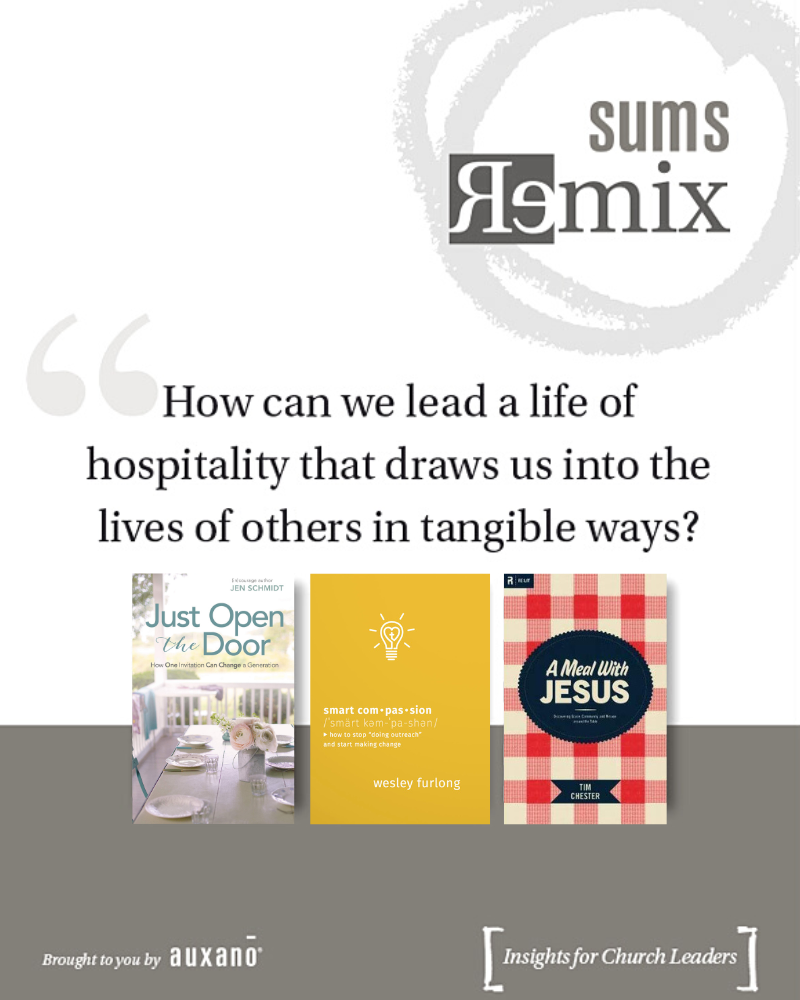
How to Lead a Life of Hospitality that Draws You into the Lives of Others in Tangible Ways

The heart of God’s purpose for humankind is relationships – first, with God Himself; then, with one another. Arguably, there is no better place to build relationships than at the table with good food and great conversation.

Len Sweet, in his book From Tablet to Table states it eloquently:

Remember God’s first command in the Bible? Eat.

Remember God’s last command in the Bible? Drink.

And everything in between is a table – a life-course meal on which is served the very bread of life and cup of salvation.

It’s time to bring back the table to our homes, to our churches, and to our neighborhoods and the world.

The table is a recurring biblical theme, one that our fast-paced, drive-through, Instant Pot culture finds unfamiliar.

What would happen if we brought back the table as a sacred object of furniture in every home, church, and community?

Are we truly hungry to accept Jesus’ invitation –  “Come and follow” – and to go wherever He leads, even if it means next door?

Especially if it means following Him next door!

What would it take for the table to return to the center of our family lives – and by extension, to those God has placed in our circle and situations?

This issue of SUMS Remix looks at solutions that will help you learn how to engage with your neighbors, establishing and deepening your relationships through hospitality. The solutions include: 

SUMS Remix 103, released October 2018