
As I began my job transition several months ago, and as it continues today, I am guided by a Transition Tool Kit. Consisting of 7 “tools” that were developed from the work of Bruce Feiler’s Life is in the Transitions and other noted transition guides, the Tool Kit contains concepts and action plans that I have been working through.
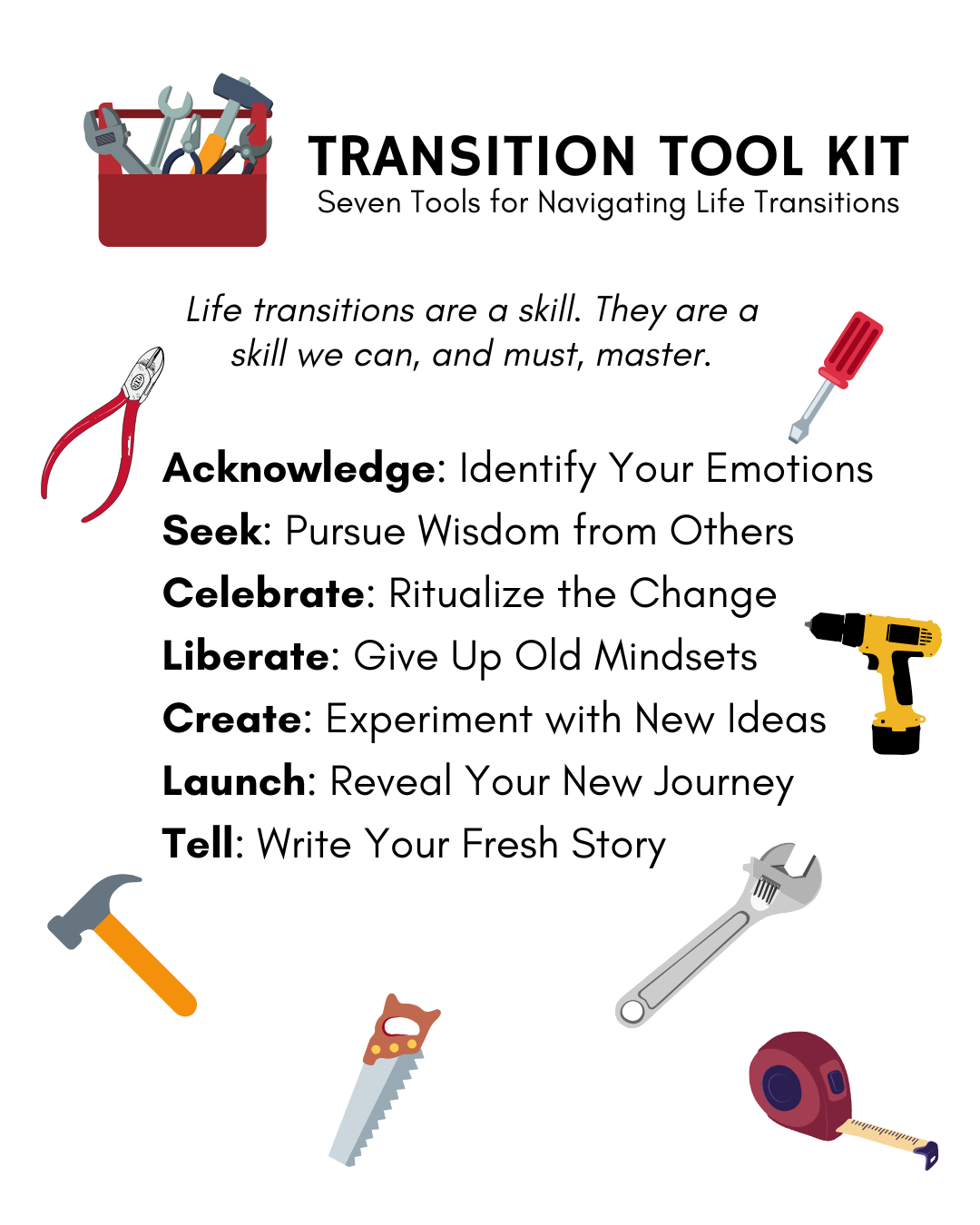
Here are first three:
- Acknowledge: Identify Your Emotions
- Seek: Pursue Wisdom from Others
- Celebrate: Ritualize the Change
While the tools are not designed to be linear and can be picked up at any time, I’ve been comfortable with moving through the sequence of the three above to this date.
Now, it’s on to Liberate: Give Up Old Mindsets.
The mindsets that served me in my previous stage may no longer be useful – or even hinder me – in this next phase. Shedding outdated beliefs and self-limiting narratives requires courage, but it opens doors to growth.
What assumptions am I carrying that no longer align with who I are or who I want to become? Moving through transition often means letting go of familiar but outdated notions of success, identity, or purpose.
The deleting of my work calendar and schedules was the first part of using this tool. But having a blank calendar is not a plan for transition – it will only lead to listless drifting. Along with this tool, it’s also time to pick up another one – Create: Experiment with New Ideas.
With old mindsets cleared, I’m giving myself permission to explore new ways of thinking and doing. I’m going to try activities, roles, or ideas that resonate with where I’m headed. This stage is about experimenting without the fear of failure. As I explore, I will stay open to discovering passions, skills, or career paths that I may not have previously considered.
And that brings me to a mindset that’s been dropping into my life in increasing measures over the last few months. It began with reading and study I had been doing related to following Jesus. It continued with the passages of Matthew we are studying in our church’s current sermon series and community group that deal with rest and the Sabbath.
So picture this: on the one hand, I’m at Day One of a new chapter in my life – one with a literal blank calendar. On the other hand, I’ve got the tools of Liberate and Create ready to use.
What’s next?
Finding Purpose Through Pattern: The Modern Rule of Life
In our fast-paced world of constant activity, many people are rediscovering an ancient wisdom practice: the rule of life. This concept, far from being a rigid set of regulations, offers a framework for intentional living that modern seekers find increasingly relevant.
Origins in Spiritual Tradition
The “rule of life” traces its origins to early spiritual leaders like St. Augustine and St. Benedict. These church fathers developed communal patterns that spiritual communities have utilized for thousands of years as formation tools. Despite the constraining connotations of the word “rule,” these frameworks were never about blind obedience but rather about establishing communal purpose.
Both Augustine and Benedict shared a singular focus: love. They meticulously designed daily patterns with the explicit goal of orienting life toward loving God and neighbor. Augustine began his rule declaring, “Before all things, most dear brothers, we must love God and after Him our neighbor; for these are the principal commands which have been given to us.” Similarly, Benedict aimed to create nothing “harsh” or “burdensome,” but instead sought to guide followers toward the “ineffable sweetness of love.”
The Latin root of “rule” – regula – reveals its true intent. Rather than restriction, it refers to a trellis or supporting structure that guides growth. Like plants that thrive with proper support, human growth benefits from thoughtful direction to prevent twisted, chaotic development.

The Scaffolding of Our Days
Our lives take shape through the cumulative effect of small, repeated actions. As Annie Dillard insightfully noted, “How we spend our days is, of course, how we spend our lives.” Our schedules serve as “scaffolding” that allow us to intentionally engage with time itself.
This scaffolding concept perfectly illustrates the rule of life’s purpose. Habits are how we interact with time, and since time is the currency of purpose, habits become the means through which we access and fulfill our deeper callings. If knowledge requires the right words, character formation requires the right habits. The rule of life provides the framework for cultivating these transformative patterns.
For centuries, monastic communities have understood this profound connection between daily practice and spiritual development. Their insight reveals that meaningful formation begins with a framework of habits – a truth that deserves wider recognition in our contemporary context.
Integrating Belief and Practice
While understanding theological truths about God and neighbor is essential, equally important is putting those truths into practice through a deliberate rule of life. Belief without practice remains incomplete, just as education without formation falls short. Knowing Jesus without following Jesus creates a dissonance that diminishes our humanity.
Only when our habits align with our worldview do we become people who truly love rather than merely understand concepts of love. This integration transforms abstract knowledge into embodied wisdom.
The Challenge of Default Formation
Many of us have unknowingly adopted what might be called “the American rule of life” – an unconscious program of habits that shapes us toward anxiety, depression, consumerism, and self-absorption. These default patterns form us in ways contrary to our stated values.
The urgency of developing an intentional, gospel-based rule of life becomes clear when we recognize how powerfully these cultural currents influence us. We need counter-formative practices to become the loving people we aspire to be.
This issue extends beyond personal well-being to our public witness. American Christianity often emphasizes the message of Jesus while neglecting his practices, creating a troubling disconnect between proclaimed faith and lived reality. How else can we explain professed followers of a radical gospel who conform so seamlessly to prevailing cultural norms?
Embracing the Trellis
The path forward requires acknowledging how habits shape the heart. Rather than viewing limitations as threats to freedom, we must recognize that thoughtful boundaries create space for meaningful growth. The trellis doesn’t restrict the vine – it enables it to flourish in its intended direction.
By crafting a common rule of life suited to our time, we can unite our intellectual understanding with our daily practices. This integration allows us to grow into the lovers of God and neighbor we were created to be, following not just the teachings but the way of Jesus.
In rediscovering this ancient wisdom, we find a surprisingly relevant answer to modern challenges – not through more information or stronger willpower, but through the patient cultivation of life-giving habits that transform us from the inside out.
Up Next: Exploring The Common Rule

 27gen.com