
THE QUICK SUMMARY
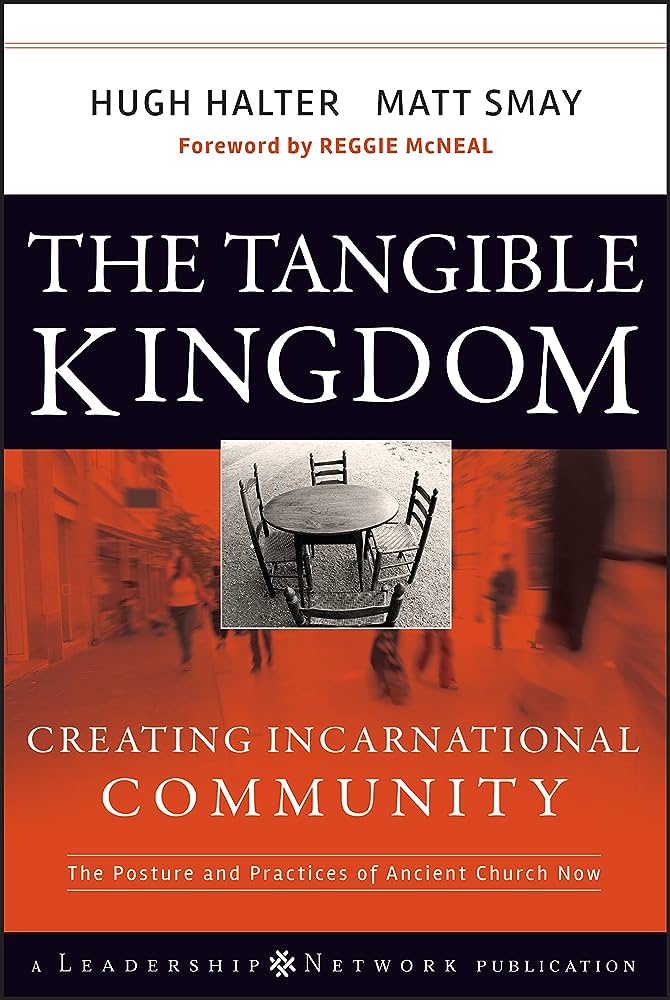
Written for those who are trying to nurture authentic faith communities and for those who have struggled to retain their faith, The Tangible Kingdom offers theological answers and real-life stories that demonstrate how the best ancient church practices can re-emerge in today’s culture, through any church of any size.
In this remarkable book, Hugh Halter and Matt Smay “two missional leaders and church planters” outline an innovative model for creating thriving grass-roots faith communities.
A SIMPLE SOLUTION
You may have watched it in person in the early 80s-early 90s, or you may have binge-watched it last weekend, but there’s no doubt the sitcom “Cheers” depicted a fictional, but aspirational setting where “everybody knows your name.”
Authors Hugh Halter and Matt Smay remind us of another similar setting from the same time period, what sociologist Ray Oldenburg called “the third place.” Different from home and work (the first and second places, respectfully, “the third place” is somewhere people can relax, in good company, on a regular basis. They are places of familiarity, where people can find and make friends.
Following the concepts that Starbucks introduced at about the same time, many churches tried to make “third places” out of their programs or spaces on campus – mostly without great success.
What if we turned our thoughts and actions from church-campus based instead to a neutral, public place, or our homes?
As the authors say, “Good things just seem to happen when we share spontaneously.”
I’ve concluded that, almost without exception, relationships are formed, important dialogue and conversation begin, and powerful moments of ministry occur during spontaneous, unplanned moments while we are sharing our lives together.
What’s the big deal with food? Go through the Gospels and note how many stories include sharing food. This is a great opportunity to see something that is so often missed when we look at God’s mission in the world.
The fact that there’s almost always food around isn’t surprising, since our scriptures are written in an entirely Eastern context. In Eastern cultures, food, the home, and hospitality are the center of culture, life, and relationships. Gook, like music, is something anyone can share and enjoy with others, even if they can’t speak the same language. Food is tangible and gives you something to do when you’re socially nervous. Food relieves tension. It brings complete strangers to the same table without any instructions or barriers. Food satisfies our greatest physical need and allows people to show creativity and thoughtfulness. It invites participation and is welcome in any setting.
Furthermore, God uses the banquet table analogy to speak about heaven, salvation, and evangelism. Christ uses the phrase “bread of life” to refer to himself. God even brings back the tree of life found in Genesis and plants it right in the middle of heaven and causes it to produce a different fruit every month!
I’m not sure what definition you use for evangelism, but my favorite has to do with “changing people’s assumptions.” To me, if we can dismantle their stereotypes of Christians, we’re on our way to helping them see the Kingdom in a new light. This is why having fun, enjoying life, and celebrating people, food, art, music, recreation, and rest become so critical in seeing friends find God.
Hugh Halter and Matt Smay, The Tangible Kingdom: Creating Incarnational Community
A NEXT STEP
According to authors Hugh Halter and Matt Smay, it’s normal to feel some tension related to “living out.” Living on mission can be challenging. It isn’t always immediately clear what we’re supposed to do.
For some of that tension, it’s important to remind ourselves that keeping track of the results is not our job. In fact, the only tension we should carry is the tension of responsibility.
Use the following ideas from the authors to get out of your house with the purpose of connecting someone.
- Spend some time with a friend who is having a rough week.
- Take your kids to a park or playground where there are other families to build relationships with.
- Help a neighbor with a project or chore.
- Using a hobby or personal interest, find a way to make new relationships with sojourners.
- Invite others to join a personal or family meal.
- Respond willingly to at least one interruption that comes along this week.
 27gen.com