
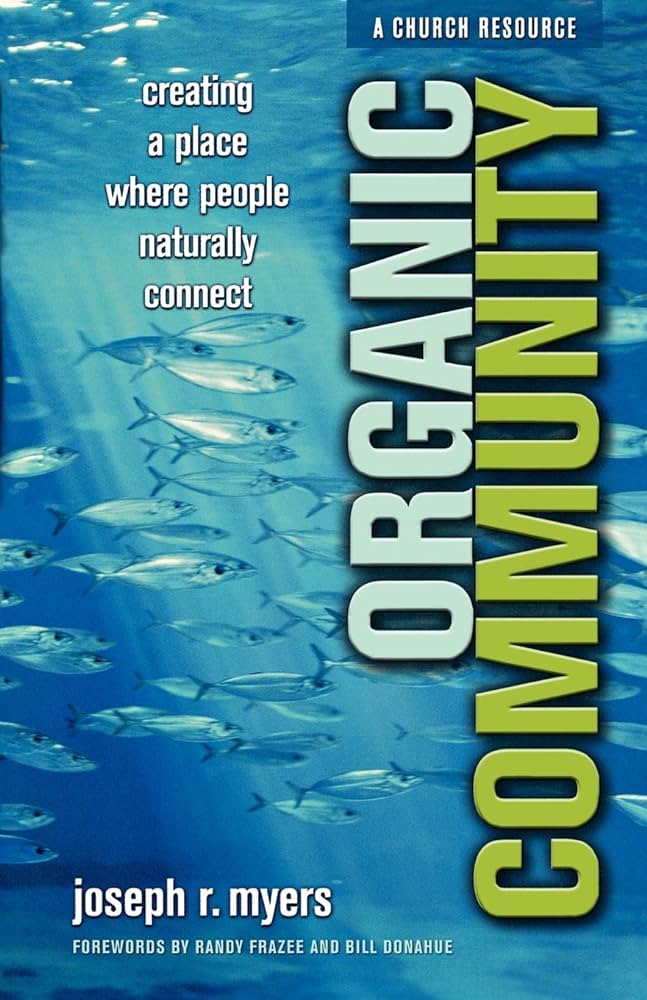
THE QUICK SUMMARY
The bestselling author of The Search to Belong helps church leaders create more natural congregational communities by becoming environmentalists–people who create or shape environments.
Can you really create community through master plans and elaborate strategies? Sometimes, says Joseph Myers – but more often, lasting authentic connections occur organically within healthy environments. Organic Community offers you practical guidance for helping your church or organization create spaces where community naturally comes into being.
A SIMPLE SOLUTION
According to author Joseph Myers, people long to participate. They are looking for a place that feels like “home.” However, many times there’s a disconnect between longing to participate and actually participating.
An honest evaluation of leadership intention would reveal excitement about all the thinking and hard work that has gone into the structures and strategies produced, all the ways people can be involved.
However, people want to participate in organic ways, not in “strategic” ways. Often, they don’t care about the structures and strategies of participation – they are interested in the participation itself.
People look for place before purpose, which is to say they seek first to belong before helping to meet a goal.
Many church leaders have spent too much time on the art of getting people to participate and too little time trying to understand how people participate.
In observations of healthy, organic environments, there are five elements in which healthy participation emerges:
People participate as individuals, not as teams or groups. Organic order invites participation in an individual way, not a representative way. The invitation is to act as an individual, with the good of the group in mind. Organic order is concerned with the health of the individual before the health of the organization or the plan.
People participate in a decentralized, local way. People want to participate with some autonomy. In particular, people want to contribute specifically in the way they uniquely can, as individuals. They are looking to find their place to connect and contribute with others – just not at the cost of losing their individuality.
People participate with the whole of their lives. No one participates from a blank slate. Look forward to people bringing the wealth of the whole of their lives with them. People also want what they are doing now to fit into the whole of their lives. Participation is now and will be forever part of the story of their life.
People participate in a way that is congruous with the way they are asked. People participate as individuals. They are interred in why they – specifically – are being asked. They want to know that you have chosen them first and foremost because of who they are, not to fulfill a strategic master plan.
The aggregate of participation becomes “known” as the team or group acts, thinks, and makes decisions. People want their contribution to be part of the contribution of the entire group. They want to know that their individual participation will be accumulated with all the other members’ contributions to provide something more robust than they could give by themselves.
Joseph R. Meyers, Organic Community: Creating a Place Where People Naturally Connect
A NEXT STEP
There is a caution to the five elements above, according to author Joseph Myers. They are not intended to be a prescription for participation, and should not be used as “tricks” to get people to participate. They merely describe environments in which healthy participation naturally emerges.
With his warning in mind, consider each of the five elements above in terms of the environment your church is communicating.
Your focus should be on the journey, not the destination. When considering the elements of participation, the question that will help you move forward is, “What are we hoping for?” not “Where are we headed?”
List each of the five elements above on a chart tablet. Allocate ten minutes to each of the elements, and use the time to list as many words, phrase, or images that come to mind that would illustrate the element.
After you have gone through all five, go back and circle the three most important in each element.
Create a new chart tablet with the five elements and three most important descriptors, and use it as a framework for leading the next step on the journey of participation for your church.
 27gen.com