
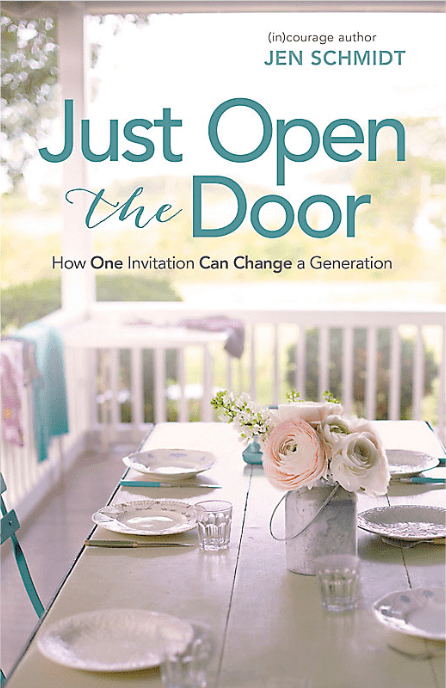
THE QUICK SUMMARY
For many of us, inviting people into our lives and homes feels more like inviting judgment on our entertaining skills and stress on our already maxed-out schedules. But what if you knew that opening your front door had the power to radically change the world? To make an impact and leave a legacy with everyday invitations?
Jen Schmidt has set out to reframe how we think about hospitality and to equip us to walk a road of welcome in our daily lives. Jen knows that every time we choose open-door living—whether in our homes or by taking hospitality on the road just like Jesus—those we invite in get to experience the lived-out Gospel, our kids grow up in a life-lab of generosity, and we trade insecurity for connection.
Just Open the Door is a personal yes-you-can guide to offering the life-changing gift of invitation. Whether you’re a seasoned host looking for renewed inspiration or a nervous newbie not sure where to begin, these personal stories, practical ideas, and poignant insights will give you the confidence you need to see your home as the most likely location for changing the world around you, one open door at a time.
A SIMPLE SOLUTION
Just what is hospitality, anyway? For many, it’s all about a clean house, amazing food, and perfectly planned and executed evening with friends.
Unfortunately, that image has been engrained into our minds through television shows, glossy magazine articles, and untold Pinterest pins.
In reality, when we overstress, overplan, and overthink inviting others into our lives and homes, hospitality becomes overwhelming to our souls. We become slaves to the expectations of others.
Taken to its extreme, we freeze at the thought of asking others to come to our homes. Afraid that we cannot live up to the expectations of HGTV, the Food Network, Southern Living, Martha Stewart’s Living, or any of dozens more – we find ourselves slaves to the expectations of others.
Where do we find the balance?
It really comes down to knowing the difference between entertaining and hospitality.
That’s the heart of hospitality: to point others to Him, to love on one another while affirming His goodness.
Biblical hospitality is different from modern entertaining. Biblical hospitality offers our best to Him first, understanding that our best to others will then fall into place. It transforms our selfish motives and elevates our guest.
When the hospitable hostess swings wide the door, all her attention focuses outward: “You’re here! I’ve been waiting for you. No one is more important today than you, and I’m thrilled you’ve come.”
The posture we assume in hospitality is one that bends low, generously offering our heart to one another despite whatever interruption to our own plans or comfort. Extending hospitality is about freely giving of ourselves while granting others the freedom to be themselves. Shifting our focus from us to them removes all unnecessary expectations. No need to worry about what to say or how to act. Just come as you are.
Hospitality, unlike entertaining, treats everyone as a guest of honor rather than grasping at honor for yourself. Opening your door has nothing to do with the actual setting, the guest list, or the food. The atmosphere can be exactly the same yet have very different results based on the heart attitude of the one who welcomes.
Status seeking versus servanthood
“Here I am” versus “here you are”
Self-serving to serving others
The deep-seated worrying, the excuses, and the overthinking of a simple invitation should be warning signs, telling us we’re confusing social entertaining with hospitality. When we use our lives exactly as they are, desiring only to create a sacred space for our guests, we turn entertaining upside down, and it becomes radical hospitality.
Jen Schmidt, Just Open the Door
A NEXT STEP
On a chart tablet, write the three bullet point phrases listed above. Leave plenty of space below each. Set aside a quiet hour of time to reflect on each. List words or phrases from your personal life under each, using a red marker for the first part of the phrase and a green marker for the second part of the phrase.
After filling out each of the three sections, review the comments in red. What actions must you take to eliminate those?
Review the comments in green. What actions can you take to expand these?
Ask yourself these questions by author Jen Schmidt:
- Can you think of one friend or family member you could invite for lunch this weekend? It doesn’t have to be at your home, but extend the invitation. Just start.
- Are you ready to elevate your neighborhood relationships? Pick one activity to begin connecting with those who live closest to you, and you may just begin to change the entire culture of how people neighbor.
 27gen.com