The Geometry of Choice

Take a look at almost any decision-making reference in a book or magazine and what do you see? Most likely a matrix with one desirable feature across the top and another down the side. Conventional wisdom says you read the matrix in straight lines – you have to choose which feature you’re going to favor.

What if you chose both?

I first came across this idea in Jim Collins’ classic book “Good to Great.” Since then, many writers have used the phrase “both/and” to refer to decision-making that references both issues in a choice. Alan Webber, writing in “Rules of Thumb” states it this way:

We’ve moved from an either/or past to a both/and future.

One of the skills that defines an entrepreneur and an innovator is the capacity to generate new lines of sight. That mean looking at problems along a new dimension. It means rejecting old either/or choices and finding new both/and combinations.

It’s like the game of chess. Most of the plays involve moving pieces forward or backward or sideways. But the bishop? It’s a game changer because it moves on the diagonal. Now you have the ability to move across and up on the board at the same time. You have changed the geometry of choice with one move.

How are you going to put into practice the skill of making “both/and” decisions in your organization today?

What is the Foundation of Design Thinking?

It’s the willing and even enthusiastic acceptance of competing constraints.

The first stage of the design process is often about discovering which constraints are important and establishing a framework for evaluating them. Constraints can best be visualized in terms of three overlapping criteria for successful ideas:

  • Feasibility – what is functionally possible within the foreseeable future
  • Viability – what is likely to become part of a sustainable business model
  • Desirability – what makes sense to people and for people

A competent designer will resolve each of these three constraints, but a design thinker will bring them into a harmonious balance.

This pursuit of peaceful coexistence does not imply that all constraints are created equal; a given project may be disproportionately by technology, budget, or a mix of human factors. Different types of organizations may push one or another of them to the forefront. Nor is it a simple linear process. Design teams will cycle back through all three considerations throughout the life of a project, but the emphasis is on fundamental human needs – as distinct from fleeting or artificially manipulated desires.

That’s what drives design thinking to depart from the status quo.

Questions for ChurchWorld leaders:

  1. What are the constraints facing you today?
  2. Can you classify them into the 3 categories listed above?
  3. How will you balance them?

inspired by and adapted from Change by Design, by Tim Brown

Change by Design

Reading Requires Deliberate Practice

Researchers are clear about this point: It doesn’t matter whether it’s in sports, music, medicine, computer programming, mathematics, or other fields. Talent is not the key that unlocks excellence.

You need a particular kind of practice – deliberate practice – to develop expertise.

In honor of SUMS Remix, the best-of-class book summaries for leaders, I want to paraphrase authors James Kouzes and Barry Posner’s discussions in their book The Truth About Leadership on deliberate practice and apply them to reading.

Five Elements in the Deliberate Practice of Reading

  • Design a reading discipline to specifically improve your performance – if you want to become an expert, you must have a methodology, a clear goal, a way to measure success, and a specific process for accomplishing the goal.
  • Reading has to be repeated a lot – sloppy execution is not acceptable to top performers. Read far and wide in your chosen field with sustained effort.
  • Feedback on your results must be continuously available – every learner needs feedback. As you are reading, make it a practice to share your insights, comments, and questions with a group of peers, a mentor, or some other third-party to help you analyze how you are doing.
  • Reading is highly demanding mentally – developing expertise requires intense concentration and focus. Reading sessions need to be free of those daily interruptions that are commonplace in everyone’s day-to-day routines.
  • Sometimes reading isn’t all that fun – while you should love what you do, deliberate reading practice is not designed to be fun. The knowledge that you are improving and getting closer to your dream of superior performance should outweigh the sacrifices you make.

The best leaders are the best learners.

The best learners are the best readers.

Want to join me on the “practice” field of reading?


 inspired by and adapted from The Truth About Leadership by James M. Kouzes and Barry Posner

The Truth About Leadership


>> Discover SUMS Remix, best-of-class book summary service for leaders here

Waiting is a Less Risky Form of Saying “No”

A few thoughts from the intersection of Seth Godin, George Harrison, Alice in Wonderland, Dr. Seuss, and Todd Henry…

Auxano’s Founder and Team Leader, Will Mancini posed the following question in a morning text to our team:

Where could you use breakthrough clarity on your leadership team? 

The question is intended to be asked by our Navigators to the leaders they are connecting with in churches – but it’s also appropriate for leaders everywhere. Most leaders can immediately identify a barrier or roadblock that stands in their way of moving forward to better future. Many leaders also have some idea about how to break that barrier.

It begs another question: What are you waiting for?

That question was on my mind as I began my day’s reading, researching, curating, and editing – and over a period of a few hours, the following came together:

Excellence isn’t about working extra hard to do what you’re told. It’s about taking the initiative to do work you decide is worth doing. It’s a personal, urgent, this-is-my-calling way to do your job. Please stop waiting for a map. We reward those who draw maps, not those who follow them.   – Seth Godin

Mapmakers are those who can effectively circumnavigate constraints in order to make things happen. We all deal with constraints, especially if we are working inside an organization. There will always be organizational charts, reporting structures, budgets, and defined career paths of some sort. The question isn’t whether constraints exist, but whether persist in finding our way around and through them.

Where in your life and work are you waiting for permission? Don’t anticipate that someone is going to hand you a map. You’ll probably have to make your own. The good news is that once you get moving, the terrain becomes more visible and navigable. It’s only when you’re standing still, unaware of what’s over the next hill, that the path of progress is opaque and frightening.

Say yes, then figure it out along the way.

Todd Henry, Die Empty

A quote often wrongly attributed to The Cheshire Cat:

If you don’t know where you’re going, any road will get you there.   – George Harrison, from his song “Any Road”

The actual conversation between Alice and The Cheshire Cate:

“Would you tell me, please, which way I ought to go from here?”

“That depends a good deal on where you want to get to,” said the Cat.

“I don’t much care where–” said Alice.

“Then it doesn’t matter which way you go,” said the Cat.

“–so long as I get SOMEWHERE,” Alice added as an explanation.

“Oh, you’re sure to do that,” said the Cat, “if you only walk long enough.”

And, from everyone’s favorite graduation gift book,

You have brains in your head. You have feet in your shoes. You can steer yourself any direction you choose. You’re on your own. And you know what you know. And YOU are the one who’ll decide where to go…

   – Dr. Seuss, Oh, the Places You’ll Go!

A closing challenge from Todd Henry:

When you look back on your life, the moments you will be most proud of will likely be the ones where you stepped out of your comfort zone in the pursuit of something you believed in. Don’t allow the lull of comfort to keep you trapped in a place of complacency and subpar engagement.

You must own your own growth and take responsibility for your own progress.

inspired by, and adapted from, Todd Henry’s Die Empty
 Die Empty

with a little help from Dr. Seuss, Seth Godin, George Harrison, and Lewis Carroll


Yield

…wrapping up this short throw-back series with the metaphor of a rockslide on I-40 on the NC/TN border that happened in 1997. That rockslide caused a lot of detours for months, and in the pre-GPS days, you had to pay attention to the road signs.

When a rockslide closes the highway, and you have to take a detour, you learn to rely a lot on road signs…

A “Yield” sign means I should stop and relinquish my progress to someone else. The last sign on this brief road trip is “yielding” our lives to God in worship.

courtesy highwaytrafficsupply.com

courtesy highwaytrafficsupply.com

Worship is any activity in which believers experience God in a meaningful, spiritually transforming way. True worship should lead worshipers to a deeper appreciation for God, a better understanding of His ways, and to a deeper commitment to Him. Encountering God in worship transforms us more and more into His likeness.

Worship begins with God, and not people. Worship is not something people do because they want to influence God. Worship is not something people do just out of gratitude, love, or fear. Emotions do not control worship; God controls worship. God instructs us how to worship and how not to worship.

God is sovereign and holy. Worship must not be done according to our small notions of Him, our limited conceptions of what He wants, or what might please us. God is above all, and we are to worship Him in the manner He desires.

God is in charge of worship. He created us and redeems us at His pleasure. He gave forms of worship in the Old Testament to direct Israel’s worship and has given His Holy Spirit in the New Testament to give us liberty and guidance in how to worship Him for who He is and what He has done. The Spirit brings liberty and freedom to worship.

The purpose of worship is to come before the Lord in obedience to praise Him, to hear from Him, to confess Him, and to commit our lives to Him. Every worship service is to be an encounter with the Lord, transcending our feelings, desires, and even our abilities to perform.

So that’s end of this quick trip, looking for road signs to guide us in the journey:

  • EvangelismOne Way
  • DiscipleshipSchool Zone
  • MinistryMen at Work
  • FellowshipMerging Traffic
  • WorshipYield

These five functions of the church are vital signs that must be followed in balance if we are to complete our journey.

When you come upon a rockslide, look to the signs to guide you to your destination.

part of a series taken from presentations 16 years ago, introducing the Purpose Driven Church principles to a church leadership team 

brought back today to connect to Auxano’s release of the first Team UP resource, featuring the Top 100 Quotes from Purpose Driven Church, with applications and exercises from Church Unique

100PDQ

Merging Traffic

…continuing this short throw-back series with the metaphor of a rockslide on I-40 on the NC/TN border that happened in 1997. That rockslide caused a lot of detours for months, and in the pre-GPS days, you had to pay attention to the road signs.

When a rockslide closes the highway, and you have to take a detour, you learn to rely a lot on road signs…

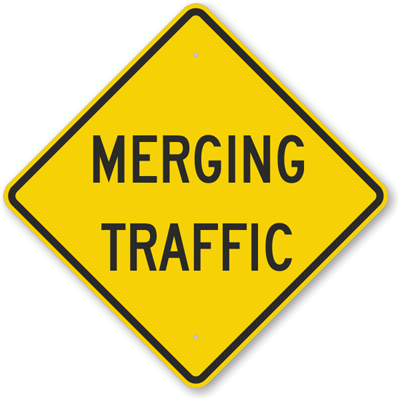
Merging Traffic” means look out and be alert to join in with the traffic around you. You are all heading toward a common destination – work together and you will arrive in one piece. Ignore each other, trying to  get ahead of someone else, and you will cause a wreck.

courtesy roadtrafficsigns.com

courtesy roadtrafficsigns.com

Fellowship does not happen by accident. It does not happen without the power of God working in individual believers and in the church body. As believers share with other their salvation experiences, practice Christ-like lives, and demonstrate their faith by serving others, fellowship flourishes as sure as summer follows spring.

Fellowship is more than just a feeling of goodwill in a congregation. Fellowship is a person-to-person relationship, and Christian fellowship also involves a relationship with God.

Fellowship is vital to a healthy church. Without warm, loving fellowship churches will not grow. People will not come where bickering , selfishness, coldness, and tensions prevail. People want to be where peace, love, joy and family relationships prevail.

A church whose fellowship is broken usually is a church that has lost sight of its other main functions: evangelism, discipleship, ministry and worship. Churches cannot have the kind of fellowship we want and our Lord expects unless they focus on evangelism, discipleship, ministry, and worship.

Fellowship follows naturally when a church heeds God’s call to practice the other four Kingdom functions.

Christ’s unity is a pattern for us to display and enjoy in the church. In John 17:21 we see the prayer of Jesus:

The goal is for all of them to become one heart and mind – just as you, Father are in me and I in you, so that they might be one heart and mind with us. Then the world might believe that you, in fact, sent me. (The Message)

The work of Christ and the Spirit in our lives gives us love for one another and a unity of purpose and vision. This results in fellowship.


part of a series taken from presentations 16 years ago, introducing the Purpose Driven Church principles to a church leadership team

brought back today to connect to Auxano’s release of the first Team UP resource, featuring the Top 100 Quotes from Purpose Driven Church, with applications and exercises from Church Unique

100PDQ


Men at Work

…continuing this short throw-back series with the metaphor of a rockslide on I-40 on the NC/TN border that happened in 1997. That rockslide caused a lot of detours for months, and in the pre-GPS days, you had to pay attention to the road signs.

When a rockslide closes the highway, and you have to take a detour, you learn to rely a lot on road signs…

“Men at Work” is a common sign on the road today. Actually, the signs should read “Men & Women at Work” because many road crews have several women on them.

courtesy roadtrafficsigns.com

courtesy roadtrafficsigns.com

Ministry is men and women at work, becoming ministers of God to His world.

Christian compassion and the principles of God’s Kingdom demands that we minister to all persons without regard to their race, religious affiliation, abilities, or circumstances. We meet the needs of others in response to the command of Christ. If we fail to minister, we fail to obey the Lord’s command. In eternity, we will find we have ministered to Jesus as we have ministered to needy, hurting, persons.

Whoever wants to be great must become a servant. Whosoever wants to be first among you must be your slave. That is what the Son of Man has done: He came to serve, not be served – and then to give his lie in exchange for the many who are held hostage. (Matthew 20:26-28, The Message)

Christians may view ministry as something they can do in their own power and with their own resources. We cannot save persons in our own power. Neither can we adequately meet their needs. Only God can provide the means to minister to the overwhelming needs of persons worldwide.

We desperately need God’s help and blessing in this huge task. We are to help the helpless and hurting persons and love them in the name of Christ with the resources He provides. The physical and spiritual needs of persons require our attention. God has chosen use us to meet those needs. With His help and power, we can do it.

The needs of churches and believers are constant and challenging. No one person can meet every need in the church alone, but serving together, with the power of the Holy Spirit, the needs can be met. The Lord will provide through His people and beyond His people the resources we need.

No church will be healthy unless it commits to minster as the Lord provides need and opportunities.


part of a series taken from presentations 16 years ago, introducing the Purpose Driven Church principles to a church leadership team

brought back today to connect to Auxano’s release of the first Team UP resource, featuring the Top 100 Quotes from Purpose Driven Church, with applications and exercises from Church Unique

100PDQ

School Zone

…continuing this short throw-back series using the metaphor of a rockslide on I-40 on the NC/TN border that happened in 1997. That rockslide caused a lot of detours for months, and in the pre-GPS days, you had to pay attention to the road signs.

When a rockslide closes the highway, and you have to take a detour, you learn to rely a lot on road signs…

The School Zone sign signifies learning. “Learning” in the Bible is discipleship. Discipleship is a process that begins after conversion and continues throughout a believer’s life. Discipleship calls for our undivided attention and commitment to follow the commands of our Lord. Discipleship is not an option for any church or believer. Christ mandated it in the Great Commission. To disciple others is to obey our Lord’s command; to do otherwise is to disobey Him.

SchoolZone

courtesy highwaytrafficsupply.com

To understand that discipleship is not an option for believers and that it involves taking up one’s cross daily to follow Christ is to begin to understand the work of each believer and the church.

Ephesians 4:11-13 perfectly expresses God’s will for every believer as He builds His kingdom:

He handed out gifts of apostle, prophet, evangelist, and pastor-teacher to train Christians in skilled servant work, working within Christ’s body, the church, until we’re all moving rhythmically and easily with each other, efficient and graceful in response to God’s Son, fully mature adults, fully developed within and without, fully alive like Christ. (The Message)

He calls and appoints persons with special gifts to equip the saints for their work in building up the body of Christ. Sadly, many churches do little to disciple believers when our Lord is ready and willing to guide and empower us to accomplish the task.

Maturing discipleship means that believers are living for the Lord in all areas of life. They take the Bible seriously and without question or compromise. The life of Christ is the center and focus of their lives.

Discipleship is God’s plan for maturing His children. We are saved by God through His grace and given to the church for care and obedience. Discipling believers requires commitment, patience, obedience, because growing and maturing believers requires time.


part of a series taken from presentations 16 years ago, introducing the Purpose Driven Church principles to a church leadership team

brought back today to connect to Auxano’s release of the first Team UP resource, featuring the Top 100 Quotes from Purpose Driven Church, with applications and exercises from Church Unique

100PDQ

One Way

Yesterday I introduced this short throw-back series with the story of a rock slide on I-40 on the NC/TN border that happened in 1997. That rock slide caused a lot of detours for months, and in the pre-GPS days, you had to pay attention to the road signs.

At the same time, the church I was serving was going through a “rock slide” of its own: the sudden resignation of the senior pastor, with practically no warning to anyone – including his staff! Our leadership teams had just begun working through Rick Warren’s Purpose Driven Church. I had just returned from a PDC seminar at Saddleback.

Isn’t it amazing how we think we are in control and have it all together with our plans – until we encounter a rock slide!

When a rock slide closes the highway, and you have to take a detour, you learn to rely a lot on road signs…

One Way is a most appropriate sign for evangelism. Christian evangelism is believers sharing the gospel with persons who aren’t believers. It is asking them to repent of their sins, to put their faith in Christ for the forgiveness of their sins and the free gift of eternal life, and to follow Him forever as Lord. Evangelism is the good news spoken by believers and lived out in their lives.

courtesy roadtrafficsigns.com

courtesy roadtrafficsigns.com

We must never replace evangelism with anything else. Everything we do individually and corporately in the church ultimately should b a witness to lost people and work toward making them disciples. When this is not the case, the church is not healthy, no matter how busy we are and how much we seem to accomplish.

Every Christian is responsible for declaring the good news of Christ’s coming and his death, burial, resurrection, and return. If we do not, we will give an account to the Father. The manner of delivering the message is not the crucial point. The responsibility for delivering the message is the decisive issue.

Evangelism under the lordship of Chris is the only way to make disciples. Whatever else churches do, they must make disciples. Evangelism is unique in that the need for the gospel is universal and the message is universal and effective in all cultures. Evangelism is believers sharing the gospel with a non-believer in ways both understand.

We are God’s method for evangelizing the world. He has no other. We are His plan, and our obedience means growth in the kingdom and the churches where we worship and serve. God save us to send us into the world to speak, live and show His good news of salvation to persons separated from Him.

That is what evangelism is all about. That is the “one way.”


part of a series taken from presentations 16 years ago, introducing the Purpose Driven Church principles to a church leadership team 

brought back today to connect to Auxano’s release of the first Team UP resource, featuring the Top 100 Quotes from Purpose Driven Church, with applications and exercises from Church Unique

100PDQ