The Value of Guest Experiences

You Are in The Guest Experience Business – Whether You Know It or Not

Guest Experiences should be fundamental to the success of your church.

For many churches, Guest experiences are the single greatest predictor of whether Guests will return – or go somewhere else.

A Guest Experience goes to the heart of everything you do – how you conduct your weekend services, the way your teams behave when they interact with Guests and each other, the sense of welcome you provide. You literally can’t afford to ignore it, because your Guests take it personally each and every time they touch your organization – be it services, people, or places.

If the above is true, why are so many church leaders seemingly blind to the importance of Guest experiences? Primarily, it’s because they don’t know what they don’t know – starting with what a Guest Experience actually means. While most church leaders have at least heard the term Guest Experience, they often believe it’s just another way welcoming “visitors” (more on this dreaded word here).

That misunderstanding is a disaster in the making. If you don’t understand what the Guest Experience is and why it’s important, you risk losing your Guests to organizations that do – and I don’t mean other churches.

Your church has competition…and it’s not the church down the street.

Like it or not, we live in a consumer-driven society, and the people who come to our church – you and me – and the people we are trying to reach are consumers.

With consumers comes competition.

If your church is going to be effective in its mission, you must beat the competition.

Mark Waltz, Granger Community Church

Pretty strong words…

But dead-on accurate.

The good news is that our “competition” is not the other churches in your town. As a matter of fact, most of them are on your team.

So who is your competition? Here is how Waltz sees it:

Your competition, the rival that will keep people away from your church, is any business, services, or experience your Guests have encountered in the past few weeks.

That competition includes restaurants, malls, golf courses, amusement parks, movie theaters, sporting events, and so on.

Bottom line: the competition for your Guests began when they were wowed in another environment. Your Guests have high expectations that are formed every day from new encounters with excellence and conscientious care.

Although too much of their world is merely adequate, they know excellence, and they return to place where they experience it.

Bottom bottom line: Will your Guests’ experience in your church be worth getting out of bed?

To appreciate what Guest Experience really means, let’s start by clearing up a few misconceptions about it. Here are a few things that the Guest Experience is not.

  • It’s not soft and fluffy – you love your Guests because you think your church offers them something they can’t get anywhere else. But loving your Guests won’t help you succeed unless you do something about it; like making it easy to find your building and then get inside; finding the right place for your family; providing opportunities for them to engage with others; encouraging them to take the next step – whatever that might be. All of these (and more, as you will see) are critical aspects of Guest experiences.
  • It’s not Guest Services – This is a subtle concept, but Guest Services is more of a reactionary term. People come to Guest Services when they have a problem or need help. It’s like saying that a safety net is a trapeze act. The net is important to the act, but if the performer has to use the net something has gone wrong with the show.
  • It’s not welcoming visitors – Do you have Visitor parking? Visitor packets? A Visitor’s Center? Do you welcome your visitors during the worship experience? And on and on…The first step in creating a WOW! Guest Experience is to remove the word visitor from your vocabulary, never to be used again.

If these are some of the things that the Guest Experience is not – what, then, is it?

Here’s the beginning of definition, which I hope you will customize to your own setting:

The Guest Experience is all the connections and services your organization offers to someone who comes to your campus, how they interact with the people and processes there, what your brand stands for. It’s what your Guests think happened when they tried to learn about you online or in person, or maybe over the phone. What’s more, it’s about how they felt about those interactions: excited, happy, and reassured, or nervous, disappointed, and frustrated.

Guest Experiences are how your Guests perceive their interactions with your organization.

Once you understand this, you can lead your organization from the outside in, bringing the perspective of your Guests to every decision you make.


Part 2 of a multi-part series based on the book Outside In

Outside In

These posts “translate” the world of customer service to the language and setting of Guest Experiences in the church.

>> Read Part 1

Take the Magnetic Test for Your Guest Experience Teams

Magnets have wonderful properties; one of the most amazing is they can both attract and repel.

In a previous post, I wrote about “Magnetic Personalities“. If you haven’t read it yet, I encourage you to jump over and take a look at it – it’s a quick read, and it will give some background to the rest of this post. Go ahead – I’ll wait…

What goes for magnetic persons also goes for magnetic teams – like the Guest Experience team at your church. Sometimes the very thing that makes you “attractive” may also be “repelling” to someone else. Your team may go by another name, you may have multiple teams, but I am willing to bet that if you are the leader of such a group, you are always looking for ways to improve how you do what you do. Are you ready?

Not so fast! Before you can improve, you need to know where you are – you need to establish a baseline measurement.

Here is a list of questions to assist you in identifying your present level of Guest Experiences. The list is adapted from a great book by Chip Bell entitled Magnetic Service. Answer “Yes” or “No” to each question:

  1. Do your Guests believe your church listens to them more deeply than almost any other organization they can think of?
  2. Do you anticipate Guests’ future needs so well that Guests feel you can practically read their minds?
  3. Are Guests given an opportunity to participate in a different way than they would have expected?
  4. Does your Guest Experience have such sufficient consistency such that Guests can trust it as being repeatable and not serendipitous?
  5. Do Guests see your church as rather daring or gallant in this approach?
  6. Do Guests think you and other team members in your church have more fun than most people?
  7. Are Guests given a chance to learn a lot simply through their encounter with your church?
  8. Do Guests witness you and others on your team perpetually improving service?
  9. Is the interpersonal engagement with you so unforgettable that Guests think positively about it again and again?
  10. Do Guests view their Guest Experience as special, distinctive, and not the usual “same old same old” approach?
  11. Do Guests comment on how the church is almost always super comfortable to be a part of?
  12. Do Guests feel completely free of dissonance and anxiety when dealing with your church?
  13. Does your Guest Experience reflect a deeper destiny, vision or commitment to serve?
  14. Is your Guest Experience delivered in a way that clearly reflects a wholesome and generous attitude?

How many honest “no’s” did you have? If you answered “no” more than three or four times, you have gaps to fill, holes to repair, and practices to start.

Congratulations! You now have a baseline measurement of your Guest Experience…

…where do you go from here?

Exceeding Guest Expectations Has a Unique Starting Point

There are 2 steps you must take in order to exceed your Guest’s Expectations.

Exceeding Guest Expectations

First, you have to meet their expectations. What you add from there will create experiences that are memorable. That’s the “easy” part!

Second, you have to become one of them – a guest.

Bet you haven’t thought about that one much – or at all!

As a matter of fact, it takes a lot of work to see through a Guest’s eyes. After all, everything to you is old hat, normal, and just fine.

But to a Guest? Maybe not so much.

When is the last time you talked to Guests – of all ages, backgrounds, and family situations? Have you asked them questions that reflect your interest in them, and give you insight into their thoughts and expectations?

Have you entered your campus for worship and considered what your expectations might be if this were your first time?

  • Where do I turn in?
  • Where do I park?
  • Which door do I enter?
  • Where do I take my kids?
  • How do I find out more information about anything?
  • Where do I go for worship?
  • What’s my next step?

Remember, your Guest hasn’t been to your campus before, so they don’t know anything about the questions above!

What about Guests in a wheelchair? Or a single mom carrying an infant in one arm with a diaper bag over her shoulder while holding on to a 4-year old? Or a hearing-impaired Guest? Or…

 You don’t know what the expectations of your Guests are until you understand who your Guests are.

If your Guests don’t have their expectations met, then you’ve missed the first step in exceeding those expectations. To first meet their expectations, you have to know and understand who your Guests are, and what they are expecting.


Vanderbilt University Medical Center: An Inside-Out Journey to Exceptional Patient Care

As told here, the exceptional guest services I recently encountered in a hospital Emergency Department at 1 AM in the morning were not normal…

…and here’s the reason why.

In 2004 Vanderbilt University Medical Center launched Elevate, a medical center-wide effort to improve the environment for patients, physicians, employees, trainees and students. Vanderbilt was already nationally recognized for excellence in many areas. But Dr. Harry Jacobson, at the time the Vice Chancellor for Health Affairs, had ambitious goals, including that Vanderbilt become one of the nation’s top 10 academic medical centers and a Fortune 100 employer – something that an academic medical center has never achieved. Elevate was designed to help achieve these and other goals by focusing on three important areas: Service, People and Quality.

Elevate was seen as a journey to establish a new culture of service – to patients, to colleagues and to the team members themselves.

Vision: Elevate builds a common culture based upon service excellence and credo behavior across Vanderbilt University Medical Center.

Mission: Establish a culture of excellence based on service to our patients, our colleagues and to each other. Strengthen VUMC leadership practices to recruit, retain and develop an engaged and committed workforce – the foundation for service excellence.

The leadership of VUMC saw Elevate as a marathon, not a sprint. It was a journey that will continue as they set new goals for excellence.

The results of that journey?

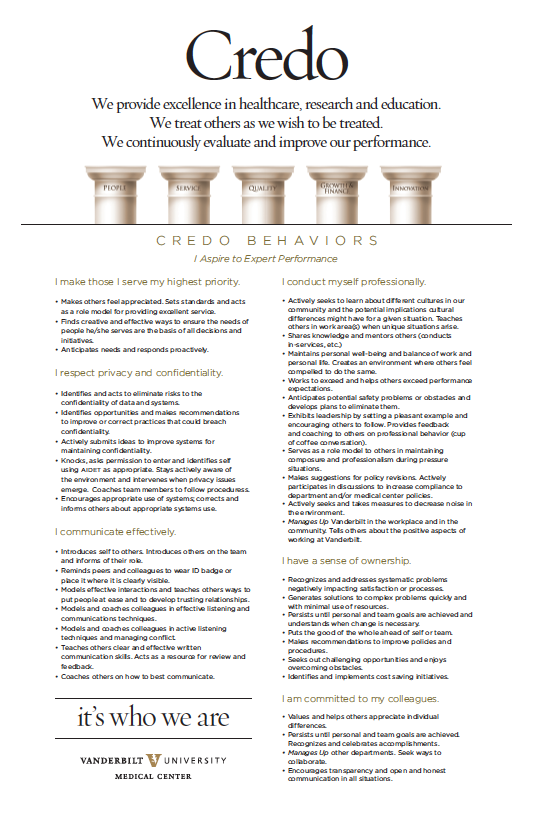
VUMCCredo

In order to help the VUMC team fulfill the Credo, a “Tackle Box” was created – but there’s nothing fishy about this tackle box.

The Tackle Box is an online team resource, comprised of ideas to help leaders and their teams “catch” the spirit of the VUMC Credo in some fun and engaging ways and “tackle” a shared understanding and use of core values in everyday work. It consists of a collection of activities, discussion starters and agendas to use with teams.

The Credo, as part of VUMC culture, is best taught by observation, by raising awareness through discussion, by example and with honest feedback. Leaders of Elevate feel that the Tackle Box and the experiences arising from it will help the VUMC team re-focus and re-energize around the basics of the Credo and the spirit of It’s Who We Are.

In addition to The Tackle Box, the following tactics were introduced by the Studer Group and are key to the Elevate journey towards excellence.

  • Rounding for Outcomes – The consistent practice of asking specific questions of key stakeholders—leaders, employees, physicians and patients—to obtain actionable information.
  • Recognition – Affirming words, hand written thank you notes and or other methods used to recognize, reward and reinforce good performance and behavior.
  • Employee Selection and the First 90 Days – A retention tool as well as a way of building individual accountability within employees. Hire your co-workers, train your co-workers, orient your co-workers and be a role model for your co-workers.
  • Discharge Phone Calls – A way for staff to reconnect with patient after their visit to our medical center.
  • Key Words at Key Times – Using specific words to use with patients, staff and physicians to let them know what we are doing and why we are doing it.

The Credo is an inward-focusing framework supporting the VUMC culture of service excellence. But what does the patient see?

PromiseAdult

The Vanderbilt Patient and Family Promise is the outward expression of the Credo and describes what patients and family should expect from VUMC.

Elevate 10 Years Later

Affirming that its people are Vanderbilt University Medical Center’s most important asset, 2015 will bring a renewed focus to Elevate. The Studer Group, a partner in the original cultural engagement and leadership development journey begun in 2004, will help facilitate this process.

“The purpose of renewing our commitment to the core principles of Elevate is to make the Medical Center a better place for all employees to work, for physicians to practice medicine and for our patients to receive care. Our goal is to have a workforce that feels more valued and satisfied, enjoys coming to work each day and believes they are making a difference,” said C. Wright Pinson, MBA, M.D., deputy vice-chancellor for Health Affairs.

“The Medical Center and the work we do to improve the lives of others is something we all care about deeply. Many of us have spent the majority of our careers here,” said Pinson.

“The best way to move forward in the current climate of change is to articulate our future vision and re-engage and recommit to our culture of service, to our patients and to each other.”

An essential ingredient for sustained success within leading organizations is maintaining a culture of high performance.

This year, the emphasis will be on reinforcing the Medical Center’s culture in ways that better equip all faculty and staff to thrive amidst the constant pace of change that is now part of the U.S. health care system.

“As we move into a new fiscal year, VUMC continues to excel by virtually every measure as a very high-performing organization, even after having faced unprecedented challenges,” said Jeff Balser, M.D., Ph.D., vice-chancellor for Health Affairs and dean of the School of Medicine. “Nevertheless, to maintain this trajectory after such a difficult year, it’s important to acknowledge what we’ve experienced and focus on our people.”

“The foundation for excellence is an engaged and committed workforce, not only in service to our patients but also demonstrating commitment to our colleagues and to professionalism,” said Pinson.

Through Elevate, teams will be working to implement greater alignment of the Medical Center’s Pillar goals to achieve improved service, quality, safety, innovation and financial performance through increased employee engagement.

“We are taking these steps to reinforce passion for the important work that we do. Every day that you take steps to improve yourself and to help those who surround you reach greater heights is a great day,” said Pinson.

Having been born and raised in the Nashville area, the excellent level of medical care provided by VUMC to my mother was no surprise to me.

What was surprising, however, was the systematic cultural emphasis on the total patient experience.

Elevate works.

It works when the Emergency Department admissions staff and nurses work quickly and efficiently, while at the same time have all the time in the world to talk with my mother.

It works when the Chief Resident, Dr. Oliver, exhibits the best bedside manner I have ever experienced, explaining what is going on, and what may have to happen.

It works when the nurses of the Critical Care unit immediately adopt an 86-year old as their favorite patient because of the stories she tells – and come by to see her even when she moves to another unit.

It works when Yana, a nurse on the 9th floor Step Down Unit, personalizes patient care in the most tender caring manner possible – consistently, efficiently, lovingly – throughout 3-day, 12-hour shifts with many other patients to care for. I have no doubt each patient thought they were her only patient.

It works in the late night and early morning hours as the always-cheerful housekeeping staff brings by new linens, cleans the room – and takes time to talk about family and life events.

It works when the nutrition staff drops off meals only to hear the patient complain about  them – even when it’s what the doctor ordered – and before they leave, the patient agrees it’s best for her.

It works when Dr. Putnam, Chairman of the Department of Thoracic Surgery and the Attending Physician, makes his daily rounds – taking time to talk with the patient in a genuine, caring attitude – not just someone “making the rounds.”

For the dozens of other individuals whose demonstrated exceptional patient care in my recent experience at Vanderbilt University Medical Center – Elevate works.


Information for this article came from personal observations, the VUMC Elevate website, and conversations with VUMC staff

Exceeding Expectations at Vanderbilt University Medical Center

Of all the places to encounter exceptional Guest Experiences, the last place I expected to find them was in the Emergency Department of a hospital at 1 AM in the morning.

But then, this was no ordinary hospital experience, because it was no ordinary hospital.

First, the backstory…

One week ago my mother experienced some medical problems requiring her to go to her local community hospital. After a couple of days, she was well enough to go home – or so she thought. Within an hour of being in her apartment, she was ill enough that the staff sent her back to the hospital. Additional tests the next day uncovered some new problems, so she was admitted into ICU and I began the 7 hour drive to be with her.

Arriving at the hospital, she seemed to be resting fine. After several hours of visiting, I left her in the capable hands of the staff and continued on my journey, another hour’s drive to visit my wife and her father, who coincidently was in another hospital for some surgery that had been scheduled for a month. After a couple of hour’s visit, my wife and I drove to her parent’s house to spend the night.

After being there for less than 10 minutes, I received a call from the ICU staff at my mother’s hospital, requesting that I come as soon as I could – some delayed tests had the doctors concerned, and they needed to discuss some treatment options.

It took just a few minutes to determine that the local hospital did not have the capability for the tests needed, nor the type of surgeon available should certain conditions be discovered by the tests. We quickly made the decision to transfer my mother to another hospital.

And that’s where I encountered an exceptional experience over the next three days – at Vanderbilt University Medical Center in Nashville, TN.

VUMChorizontal

From her admission just after midnight Friday 8/1 all the way through the Emergency Department, Intensive Care and then Step Down Care, through her discharge Sunday 8/3, she received care that exceeded my expectations.

In particular, Yana, a nurse on the 9th floor Step Down Unit, totally amazed me with her attention not only to my mother’s immediate medical concerns but also to her overall mental and emotional well-being. Yana exhibited all the skills one would expect of a skilled nurse, but it did not take me long to realize she was an exceptional nurse who was demonstrating personal individual characteristics that had been well-honed through a systematic cultural emphasis on the patient experience.

The entire VUMC staff – from doctors to residents to attending physicians to nurses to techs to nutrition to housekeeping – all demonstrated qualities that reflected values beyond their job description, a trait that is not often seen in our busy society.

I can state that unequivocally because my vocation and passion revolves a great extent around Guest Services, and I truly saw them at work over the past few days. These were not just surface level, but ingrained throughout the entire system at VUMC.

As one trained to note such values, I was curious about their origin, and spent part of my time during my mother’s hospital stay learning what was behind the unique experience I was observing.

Regarding my comment above about “exceeding expectations” I would note that while my primary focus is on Guest Experiences in churches across the U.S., part of my research has included health care facilities.

Remember also my opening paragraphs above: through an unusual set of circumstances not only did my mother spend 2 days, 2 different times last week in one hospital, my father-in-law was in another hospital. So I had experienced 3 hospitals in one week, both first-hand and through the observations and comments of my wife (who is also well-versed in Guest Services, as the Senior Property Manager of retail properties in NC, SC, and MD, totaling 1.7 million square feet).

It was very evident to us:

The patient experience at Vanderbilt Medical Center is exceptional in every way imaginable.

Now to find out why…

Next: The Inside-Out Journey of Vanderbilt University Medical Center to Exceptional Patient Care

First Impressions Last…

…but the Last Impression is Remembered!

Hellos and good-byes are beginning and ending points, the two highest positions in what memory researchers call the serial position curve. In a list of items or a series of events, they will be remembered most easily.

I have long been an advocate of a WOW! First Impression – there are literally dozens of posts on this blog that will speak to that. While I don’t intend to change that high opinion of your First Impression, I am increasing becoming aware of the power of the Last Impression.

Good-byes are often rushed – or skipped altogether – in ChurchWorld. Even the name for one of the most common Guest Experience positions – Greeter – is emphasizing the welcome. I’ve never heard of a “Good-Byer” and it’s probably not even a word, but the intent should be!

The goal should be to close your interaction with your Guest in a way that is memorable and sincere.

Never miss a chance to say good-bye without providing a warm smile, words of farewell (if possible), and an invitation to return.

The Last Impression will become a First Memory.

Guest Experience Survey Results Provide 4 Key Findings

In the fall of 2011, I collaborated with Worship Facilities Expo on a brief survey about guest services practices to its online audience. The survey was not intended to be a scientific survey, but instead sought baseline information to indicate trends in guest services in churches.

The 22 questions dealt in broad areas ranging from sanctuary size to number of worship services held weekly to the number of volunteers in guest services roles to training for guest services teams. From the responses, a snapshot of guest services practices in churches is beginning to take shape.

I’m in the process of preparing an updated survey, but I thought it would be helpful to look at the original results one more time: Here’s a look at some summary findings, four key points, and an invitation to continue the conversation.

Selected Survey Stats

  • Responses came from 33 states in the US and 9 countries around the world
  • Church attendance ranged from 100 to 19,000
  • The majority of churches responding offered multiple worship services
  • The majority of churches responding had only one location
  • About one-third of respondents had auditoriums seating 300 or less; almost one half had auditorium seating for 300-800
  • Guest service components include a wide range of services – from parking to greeting to ushers to information centers and more
  • The size of Guest Services teams ranges from a few to hundreds
  • Leadership of Guest Services teams is primarily voluntary
  • 1-3 hours of initial training is provided to Guest Services teams by a large majority of respondents
  • Almost half of the respondents offer no updated or ongoing refresher training
  • A large majority of respondents have no formal statement of expectations for Guest Services teams
  • Recruiting and retaining team members and developing leaders are the biggest needs of Guest Services teams
  • Respondents had great success stories and encouragement for other Guest Services teams

A more detailed review of the survey responses began to show a pattern – there were four key findings that a majority of the respondents identified:

1. Guest Services Components The survey identified the following eight areas of typical Guest Services teams: Prayer, Greeters, Ushers, VIP/First Time Guests, Resources, Next Steps, Set-up, and Parking. Additional responses included Kiosk check in, Hospitality time with Pastor, Gift for Guests, and Communion. The largest areas of service were Greeters and Ushers – every respondent had some level of service in these areas. Prayer was another large component, reported by majority of respondents. Areas on the low side were VIP/First Time Guest and Parking.

2. Expectations/Covenant Less than twenty percent of respondents indicated that their Guest Services teams had a formal statement of expectations or covenant agreement.

3. Greatest Need As with any mainly volunteer ministry, a wide range of needs were identified by the respondents.  After a closer review of individual responses, the following three areas began to emerge:

  • Training of existing volunteers
  • Recruitment of new volunteers
  • Organization and leadership of the volunteer teams and process

4. Success Stories Respondents were asked to list a brief success story of their Guest Services teams. The responses were able to be categorized into four areas:

  • Being known as a friendly church and/or providing a warm environment
  • No success story! (more below)
  • Commitment of the Guest Services team members
  • Follow-up by Guest Services team members

It’s beyond the scope of this post to go into detail on all the findings, but a review of the four summary findings above do provide a unique glimpse into what Guest Services teams are doing – and how they might be challenged to improve on their services. Here are a few that I see:

  • Guest Service teams are a very visible and important part of the experience on your church campus – no matter the size. From the street to the seat, your Guest Services team has an opportunity to provide a ministry to Guests and members so that they enter into worship ready to worship. Adjust the services you provide to the scale of your church, but make sure that your Guests and members have no doubt they are welcome
  • Guest Services teams – like all volunteer teams at your church – need a vision to serve, a target to aim at, and guide to serve by. A statement or expectations or covenant of service – common to all volunteer teams in your church but tailored to the specifics of Guest Services teams – is the best way to help them minister to the people they encounter every weekend.
  • Not surprisingly, Guest Services teams want to know what they are supposed to be doing – and given the tools and training to carry out their jobs. It’s critically important that your Guest Services teams – and all volunteer teams at your church – be a part of solid training at the initial training AND ongoing continuing education along the way.
  • Serving should mean celebrating – individuals serving on your Guest Services team provide the front line, first contact experience with Guests and members. They should be delivering and receiving powerful opportunities to pour into people’s lives. When the second largest category of responses to the survey’s “Success Story” question is “None,” something needs to change!

You’ve probably figured out by now that Guest Services is a big deal to me! It’s more than a big deal – it’s a passion of mine. I want churches to realize that they have a chance – usually a single chance – to make a WOW! first impression on Guests coming to their facility this weekend.

If you would like to be a part of the ongoing research and communication in the next Guest Services survey, just drop me a note at bob@auxano.com and I will send you the survey when it is available later this summer.

Starbucks, Customer Service Recovery, and What Happens at Your Church…

Even when it’s not really their fault, the baristas at my Starbucks know how to make things right.

Facing a writing deadline today, I needed a little caffeine boost and a change in venue. I headed over to my Starbucks for my favorite breakfast: Tall White Chocolate Mocha and an chocolate croissant. The barista told me that he was sorry, they were out of the White Chocolate syrup. That’s no big deal for me – there are plenty of other drinks to choose from. I paid and walked over to grab a table.

On the way, I ran into a couple of friends I hadn’t seen in a while, and we began catching up. Within a couple of minutes I heard my beverage being called, so I went to the counter and grabbed it from a different barista and headed back to my table.

As I sat down, I realized I had not received my croissant, so I went up to the counter to get it. With a horrified look on his face, the second barista said “I’m so sorry we forgot your pastry,” and handed me this:

IMG_1814

This voucher is Starbuck’s way of saying “we goofed, but we want to make it up to you.”

He explained that the voucher was good for any size beverage anytime at any Starbucks location. The first barista joined the conversation and added that he was sorry to disappoint me about having to choose another beverage, and but then to forget my pastry? “Unacceptable.” The other barista also apologized, and the pastry was brought out to my table when it was warmed less than a minute later – again with an apology.

Breakdowns in service are unavoidable, even in a well-run organization like Starbucks (and this is the first time in over 4 years at “my” Starbucks that a mistake has been made).  Service breakdowns, while unavoidable, are a great opportunity for an organization to show what they’re made of, an opportunity to bring a customer closer to you.

Starbucks practiced these four steps to service recovery (thanks Micah Solomon!):

  1. Apologize and ask forgiveness
  2. Review the complaint with the customer
  3. Fix the problem and then follow-up
  4. Document the problem to allow a permanent fix (later I heard the shift leader talking with the barista who took my order)

I was already a regular customer, and it was really no big deal.

But they (the whole staff at the time) made it a big deal…

…and reinforced my positive feelings and actions towards “my” Starbucks (and by extension, to the Starbucks brand) even more.

Here’s the lesson for ChurchWorld:

I’m willing to guess that things don’t always go peachy at your place every weekend. Shortage of volunteers, room assignments messed up, AVL problems in the worship experience, sermon that didn’t preach like you wrote it, etc.

It’s going to happen.

But what happens next is up to you, and might just make all the difference in the world in one of your Guests coming back again next week.


Great Guest Experience Teams Pay Attention to What’s Out of Sight

…at least, out of their line of sight.

Spatial awareness and quick reactions aren’t just characteristics of great athletes – they are absolutely necessary to exceeding your Guest’s expectations.

I recently read a great post by Micah Solomon on developing effective customer service leadership. Solomon always has great advice – both in a regular column at Forbes.com and his books Exceptional Service, Exceptional Profit and High-Tech, High-Touch Customer Service.

But it was a single phrase that caught my attention:

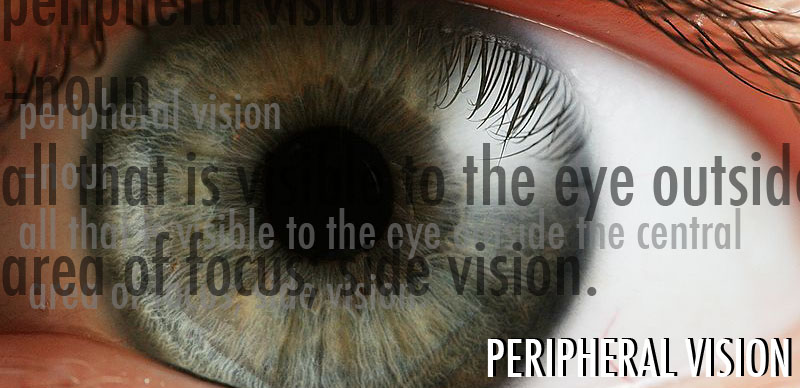
The waiter with no peripheral vision

PeripheralVision

Solomon goes on to explain that in comparing two team members with equal skills and service standards, the one who exhibits peripheral vision will be the more successful one, and, surprisingly, attributes peripheral vision to understanding the difference between Purpose and Function.

Could that be true in your Guest Experience Teams as well?

Here’s how Solomon differentiated the two:

Every team member has a job function, and a purpose in (and of) the organization. The function is what’s written, in detail, on the team member’s job description. It’s the technical side of the job.

A team member’s purpose is something different. The purpose is the reason you’re doing all the technical things, and sometimes stepping out of your technical role to do whatever it takes.

That’s peripheral vision – seeing beyond the obvious, noticing what’s outside the very center of your gaze.

  • It’s a Parking Team member noticing steam coming out from under the hood of a parked car – and volunteering to repair the cracked hose while the family attends the worship experience.
  • It’s a Greeter noticing a young mother struggling with an active toddler while trying to maneuver an infant stroller through the crowd – and asks if he can push the stroller for the mother.
  • It’s an Usher being sensitive to the unspoken request of a worship attender – and seating them to accommodate a special need.

When your Guest Experience Team members exhibit peripheral vision, they are going beyond their “job” and serving the people out of a sense of purpose and mission that undergirds all they do.

Is it time for your Guest Experience Teams to have a “vision check?”

Create a Culture of Extreme Guest Experience Focus

Here is a short checklist for how to create a culture of extreme Guest Experience focus.

1.    Create a Guest Experience vision. Much like creating a vision statement to direct the organization, you should also create a clear and compelling “Guest Experience vision” that describes the level of service your organization aspires to deliver.

2.    Infuse your entire organization with the Guest Experience journey. Create strong, trusting relationships with your Guests. Solicit feedback, communicate that feedback throughout the entire organization, and then be sure to take action on the feedback your Guests have given you.

3.    Become an expert on delivering superior Guest Experiences. Find out everything you can about how to deliver a great Guest Experience. Steal the best ideas, benchmark against the top performers, share that information across your organization and make learning about and working on improving Guest Experience a core competency of your organization.

4.    Turn every team member into a Guest Experience champion. Make serving the Guest the number one job of every team member in your organization.  Help them with the tools, training, equipment and support they must have to deliver excellence consistently.  Reward and praise those who deliver above and beyond the call of duty, deal quickly and effectively with anyone who does not embrace the Guest Experience values.

5.    Remove any barrier that stands in the way of delivering superior Guest Experiences. Look at all systems, policies, procedures, reports and rules. Wipe out anything that creates roadblocks or frustrations in the effort to delight and amaze the Guest.  Stupid rules that make it hard for team members to serve superbly impact your organization negatively.

6.    Measure, measure, measure, measure, measure & communicate. Create a clear, specific and extremely well thought out and over-communicated program for systematically collecting and quickly communicating the most important Guest Experience delivery measurements to the people who can then act on them.  Make it easy for your people to win.

7.    Walk the talk. Every level of the organization, starting at the very top, MUST be a living example of your Guest Experience strategy.  If the senior leadership team in your organization does not support and demonstrate the critical importance of Guest Experiences, there is absolutely no hope that your front-line people will deliver great Guest Experiences. All team members must demonstrate an obsession for delivering consistently Guest Experiences.

What would have to change in your organization to create a culture of extreme Guest Experience focus?

What are you waiting for?

AwesomelySimple

Adapted from Awesomely Simple by John Spence