What Can You Learn from Your Front-Line Team?

Cross-Utilization (Cross-U) is a Walt Disney World program that operates during the Spring and Winter holidays (their busiest seasons). It gives Cast Members from various parts of WDW a chance to work the front lines and interact with Guests.

With so many Cast Members of WDW working behind the scenes, Cross-U offers a wonderful opportunity for Cast Members to participate in one of the cornerstones of the Disney enterprise: Guest Services.

Participants in Cross-U witness the collective effort it takes to create the great Guest Experience. Regardless of where behind-the-scene (or off-stage) Cast Members work, there is no better way of understanding the impact of magical Guest Experiences than watching kids and their parents enjoying a favorite character or attraction.

According to Disney executives, getting ready for Cross-U takes months of planning, thousands of details to monitor and an untold number of checks and balances.

Is all this trouble worth it?

The answer for Disney is a resounding Yes! In addition to providing much-needed front-line help during busy times, the feedback from participants after their shifts is invaluable. They talk about making a difference with Guests and assisting Cast Members.

In other words, they get it – they understand the critical importance of front-line staff in Guest Experiences. And it’s just not head knowledge – it comes from direct interaction with Guests.

How valuable would that be in any organization that serves Guests?

More importantly, how important would a process like Cross-U be in ChurchWorld?

The Lineup at Elevation Uptown

It’s one thing to have a Credo, Three Steps of Service, and 12 Service Values like the Ritz-Carlton (see the post here for more details). Many businesses go through the exercise of defining key values or composing mission statements. They might even display them in their literature, or in imposing art displays on the corporate walls.

How many organizational leaders understand the importance of regular and repetitive presentation of the core aspects of their business – not only to management, but to their front-line staff?

Enter the “lineup” at Ritz-Carlton.

To truly appreciate the Ritz-Carlton leadership approach to repeated dissemination of the “Gold Standard” mentioned here, you would have to drop in on a section of the housekeeping staff as they prepare for their days work – or at the corporate headquarters – or in the kitchen of the fine restaurants that serve the hotel chain – or anywhere, and everywhere, throughout the entire organization.

You would observe that a meeting is taking place at the beginning of each shift. Not just any meeting, though: the leader in each group starts by sharing the Credo and talking about the importance of creating a unique guest experience. Another team member might share a guest story from a Ritz-Carlton hotel in another country. Another team member shares how what they do in their department helps create memorable guest experiences. Then a few quick announcements, special recognitions are given, and the meeting is closed with a motivational quote by another team member.

All in about 20 minutes.

Every day.

On every shift.

In every Ritz-Carlton hotel and office around the world.

The magic of the lineup involves the following:

  • Repetition of values – the core belief that values need to be discussed daily, and that values can’t be discussed enough
  • Common language – shared phrases across all tasks binds the team together
  • Visual symbols – The Credo is printed on a card that all team members carry at all times
  • Oral traditions – Personal, direct, and face-to-face communication makes a huge impact in a world increasingly dominated by e-mail, text, and voice messages
  • Positive storytelling – stories communicate life in a powerful and memorable way
  • Modeling by leaders – the active, daily presence of the leaders communicates the importance of the time together

What would “lineup” for each of your teams do to preserve the core values, communicate the importance of everyone on the team, and provide momentum for the day’s activities?

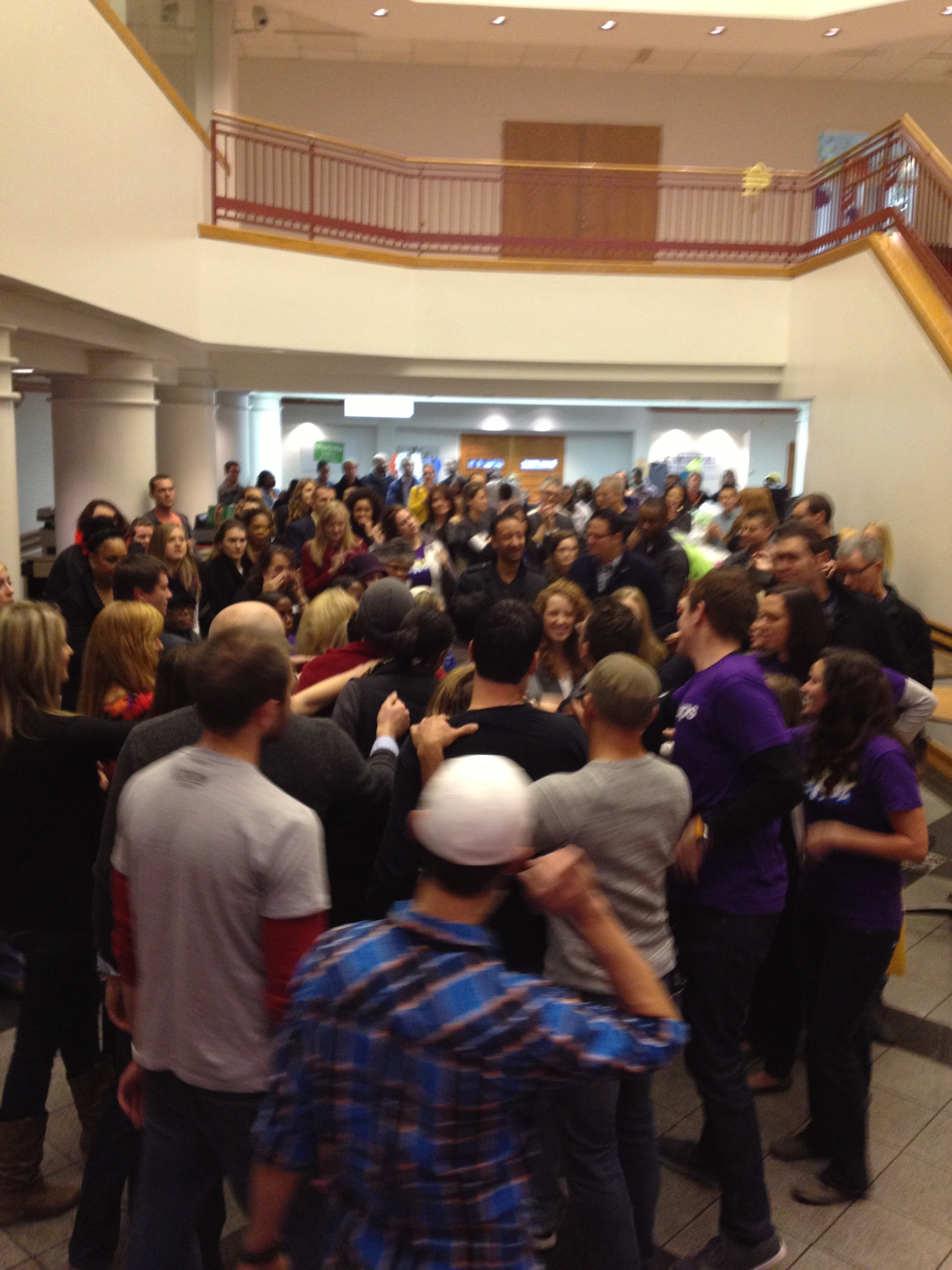
At Elevation Uptown, here’s what our ‘lineup’ looks like on Sunday mornings at 7:45 AM:

 Elevation Uptown 012013
Or how about this word for the process? Alignment.

That’s how we roll Uptown!

Seven Strategic Questions Critical to Improving Your Church’s Guest Experience

Closing out the week with some great strategic questions developed by Beyond Philosophy, one of the world’s foremost experts in the Customer Experience. As has been the case all week, I have adapted these for Guest Experiences in ChurchWorld.

1. What Guest experience do you want to deliver?

Ask yourself this question. In most cases, churches cannot provide a clear answer. Everyone has an opinion, but nobody can identify what it is. This causes overlaps, gaps, lost opportunities and cost. Most Guest experiences are accidental. They “just happen.” Guest experiences – both good and bad – frequently occur because a church makes decisions without considering the consequences. The main challenge is to identify the ideal experience you want to offer your Guest; a Guest Experience Statement (GES) is the first step. A GES puts the ideal Guest experience into words.

2. What are the emotions you are trying to evoke?

More than half of a typical Guest experience is rooted in emotion. Guests are people, and people are driven by emotions. Emotions are the bedrock of existence, yet most churches miss this fact, allowing for half of their experience to be left to chance.

3. What drives and destroys value for your organization?

What drives or destroys Guest retention and Guest loyalty? Which parts of the Guest experience drive or destroy the most value for your organization? The Emotional Signature technique (from Beyond Philosophy) aids this process because it determines the most efficient way to allocate resources.

4. What do Guests really want?

What Guests say they want can be vastly different from what they value. Other Guests don’t even know what they want. To understand this you must get into the head of the Guest. The subconscious mind is the key that unlocks the real drivers of value to the Guest. Most Guest desires reside below the surface of conscious experience. Paradoxically, while Guests often struggle to articulate their desires, the cost of misjudging Guest desire is extremely high. An accurate gauge of Guest desire is of paramount importance. Once this is discovered you will be able to determine where to put your resources.

5. How Guest-centric is your organization?

Guest experience is a manifestation of your organization. If your church is program-centric, then you will offer a functional Guest experience. If your church is Guest-centric, then you will offer an interactive Guest experience. Changing the Guest experience means reorienting your church’s ministry strategy in a way that translates to Guest loyalty and retention gains.

6. What is your subconscious experience?

The subconscious experience incorporates all the elements of the Guest experience that are seen, felt, heard and processed by your subconscious mind. Do you know what kind of unintentional signals your church sends to your Guests? The subconscious experience is every bit as important as the rational experience and the emotional experience.

7. Is your Guest experience deliberate?

Have you deliberated over the experience you are providing to your Guests? Most experiences “just happen.” They are a consequence of many different decisions the church has made without understanding the impact or implications to the Guest. Your experience should be deliberate.

The way you answer these seven questions will determine the future direction of your Guest Experience.

Read more about Beyond Philosophy on their website here.

Are the Guest Experiences a “Natural” in Your Church?

Part 4 of a 4-part series exploring Beyond Philosophy’s Customer Experience Orientation, as applied to Guest Experiences in Church World

Natural Orientation – a church where focus on the Guest is total. It is very proactive and is naturally focused on the complete Guest Experience. In order to produce memorable and captivating Guest Experiences it uses specific senses to evoke planned emotions. Research shows that only about 2% of organizations exhibit a Natural Orientation.

In this orientation, the Guest Experience is in the church’s DNA. It does not have to consider what to do as it does it naturally. It understands the critical role that senses play and had deliberately built these into its guest Experience. It understands that Guests have sensory expectations and then uses the senses to creae captivating and memorable experiences. It involve the Guest in the design of the Guest Experience and has defined its own Guest Experience “recipe.” It is totally proactive to Guest demands and undertakes many activities, which event the Guest does not see, to build a great Guest Experience.

The Natural oriented church recognizes the amazing power of “stories” and “storytelling,” both inside the organization and outside, and it uses these to great effect to build its unique Guest Experience. Its leadership, and everyone in the organization, has been selected to meet its deliberate Guest Experience.

The culture of a Natural oriented church is aligned to the Guest Experience and is seen as an enabling tool. It uses theater as a method of producing consistency of its Guest Experiences. It has aligned the brand and its Guest Experience and one supports the other. It has very sophisticated methods of collecting Guest data, which it constantly uses to improve its Guest Experience.

Natural churches are masters of details. Each part of the Natural church has a measured focus on achieving the Guest Experience, and these include measurement of emotions and senses. The high-level journey of a Guest has been plotted into an experience map and the sublevels have also been defined. For the Natural church, details matter.

Traits of a Natural church:

  • Complete focus on the Guest
  • Focuses so much of the Guest Experience that it is in the church’s DNA
  • Deliberate Guest Experience and a clearly defined Guest Experience Statement
  • System built to improve the Guest Experience
  • Culture that is designed and aligned to the Guest Experience
  • Focused on depth of emotion
  • Consciously uses senses to provide a captivating experience
  • Recruits people who are good at acting
  • Integrated approach to the Guest
  • Understands Guest sensory expectations

For more information on this subject, check out Revolutionize Your Customer Experience by Colin Shaw, pp. 20-21; 148-160

You can also find more information at Beyond Philosophy’s website.


Here’s a recap of the previous orientations:

Now that you understand more about the four possible orientations of your church’s Guest Experience, what actions are you going to take? What are the obstacles in your way? How are you going to embed the changes needed in your organization?

Have You Achieved Enlightenment in Your Church’s Guest Experience?

Part 3 of a 4-part series exploring Beyond Philosophy’s Customer Experience Orientation, as applied to Guest Experiences in Church World

Enlightened Orientation – a church that has recognized the need for a holistic, coordinated, and deliberate approach to the Guest Experience. It is proactive in nature towards the Guest and orchestrates emotionally engaging Guest Experiences. It stimulates planned emotions. Research shows that approximately 22% of organizations exhibit an Enlightened Orientation.

The Enlightened church understands the importance of the Guest Experience and has thus achieved enlightenment. It has converted from being reactive to proactive to Guest demands. It has understood the critical nature of defining the Guest Experience it is trying to deliver. It has spent time discussing it at the senior team level and agreed on a Guest Experience statement which has been communicated to all team members. It realizes that over 50% of every Guest Experience is about emotions and therefore has embedded new processes into its Guest Experience, which are planned to deliberately evoke emotions. Enlightened churches recognize that Guests have emotional expectations, as well as physical expectations, and plan to exceed both.

The Enlightened church has formal methods to ensure that people spend time with the Guest. This applies from the most senior team leaders all the way through the organization. The leadership walks the talk and sets the standards regarding the Guest Experience.

The Enlightened church has taken actions to coordinate and align its Guest Experience. Typically, it has established a high-level leadership position (paid staff or volunteer) along with dedicated team leaders. It also seeks out team members who have an awareness of and demonstrated use of emotional capabilities. The Enlightened church has recognized that an organization’s culture impacts the Guest Experience.

There are a number of key things that change over at the crossover point from Transactional to Enlightened. A number of these are attitudinal, from reactive to proactive, from “inside out” to “outside in,” and from physical to “physical and emotions.”

The Enlightened church knows what emotions it is evoking at each stage of its interaction with a Guest. It has spent time in defining the emotion it wants to evoke, and it has planned these into the design of the Guest Experience.

An Enlightened church has a different attitude to the Guest from the Naïve or Transactional church. The Guest is very much in the lifeblood of the Enlightened church. It does things for the Guest without a second thought. It intuitively knows what to do.

What does an Enlightened church need to do to Revolutionize Their Guest Experience?

  • Consider the senses they are going to use
  • Build senses into the Guest journey mapping
  • Define how they are going to stimulate the senses
  • Look at using theater and entertainment as a method for providing a great Guest Experience
  • Provide training in acting techniques
  • Understand Guest sensory expectations
  • Gain real alignment of the people, the culture, and the Guest Experience
  • Look to create captivating and memorable Guest Experiences
  • Review processes regularly
  • Involve the Guest in designing

Next time: The Natural Orientation


For more information on this subject, check out Revolutionize Your Customer Experience by Colin Shaw, pp. 19-20; 127-147

You can also find more information at Beyond Philosophy’s website.

Are Your Church’s Guest Experiences Transactional in Nature?

Part 2 of a 4-part series exploring Beyond Philosophy’s Customer Experience Orientation, as applied to Guest Experiences in Church World 

Transactional Orientation – a church that focuses primarily on the physical aspects of the Guest Experience. It has recognized the importance of the Guest. However, its focus is rudimentary, as many aspects of the Guest Experience remain left to chance and are uncoordinated and “inside out.” Research indicates that approximately 67% of organizations exhibit a Transactional Orientation.

The Transactional oriented church understands some of the basics of the Guest Experience but still remains quite reactive to Guest demands. If has recognized that the Guest is quite important and it has made some changes to reflect this. The core of its operation is primarily around the physical aspects of Guest Experiences: a few special parking spots, maybe a welcome area, a few people greeting everyone. It is, in reality, still “inside out” and its Guest Experience is not deliberate, but just happens.

Organizationally, the Transactional church is often functionally siloed, with each silo treating the Guest in a different manner. Little information is shared across functions and Guests are forced into dealing with many different parts of the organization.

Typically, the senior leadership team in a Transactional church claims they are Guest focused but the words and deeds do not match. This contradiction is seen by team members throughout the organization – who then mimic the behavior.

Good intentions are no substitute for action; failure usually follows the path of least persistence.  – Anonymous

In the Transactional Church the brand and the actual Guest Experience are not aligned. “The Friendliest Church in Town” usually isn’t. A great deal of time is spent by the Transactional Church in building its brand image, but it has not gone that critical one stage further and defined how it will manifest itself in the Guest Experience.

The core of the Transactional church remains “inside out.” These churches do think Guests are important, which is a marked improvement from the Naïve church. However, they believe the Guest is still not as important as the organization is. Transactional churches remain primarily physically based and do not look at the emotions they should be evoking.

What does a Transactional church need to do to Revolutionize Their Guest Experience?

  • Understand that emotions play a key role in the Guest Experience
  • Start to enlist people with emotional awareness
  • Review processes so that they evoke the right emotions
  • Implement cross-silo communications to give a complete Guest view
  • Understand the importance of team member’s well being
  • Define the Guest Experience
  • Align the Guest Experience throughout the organization
  • Look at Guest’s emotional expectations
  • Build an overall Guest journey
  • Increase the time the senior leadership team spends with Guests

Next time: The Enlightened Orientation


For more information on this subject, check out Revolutionize Your Customer Experience by Colin Shaw, pp. 19; 108-125.

You can also find more information at Beyond Philosophy’s website.

Are You Providing a Naive Orientation in Your Church’s Guest Experience?

Part 1 of a 4-part series exploring Beyond Philosophy’s Customer Experience Orientation, as applied to Guest Experiences in ChurchWorld. 

Naïve Orientation – a church that focuses on itself to the detriment of the Guest. It is “inside-out” either through choice or because it doesn’t know what it should be doing. Research indicates approximately 9% of organizations exhibit a Naïve orientation.

Naïve churches focus on themselves rather than the Guest Experience. They are reactive to Guest demands. They believe their programs or processes are more important than the Guest. Their attitude with the Guest is one of “Take it or leave it.” Their processes are totally focused “inside out,” doing things for the benefit of members, rather than “outside in,” which is changing the church to meet Guests’ requirements.

The Naïve oriented church is typically a siloed organization and struggles between the silos is rife.

Churches are in this orientation either because they are:

  • Unaware what they should be doing to build a great Guest Experience. They are not deliberately trying to cause a poor Guest Experience; it is simply that they do not know what they do not know. They are unaware of the impact their actions have on their Guest Experience. By definition they have not spent time thinking through the implications of what they are doing. This typically indicates they believe something else is more important than Guest Experience. Typically, this is taking care of members’ needs first and foremost.
  • Aware of their orientation but simply don’t care as Guests are a nuisance, and seen as a means to an end.
  • In this orientation “by default.” This means the church knows is should be focused on the experience it gives its Guests but something else always gets in the way. Something else is deemed more important.

If a Guest Experience is provided at all by Naïve churches, it is entirely physical. They have either failed to realize that they are evoking emotions (usually negative) or don’t care that they are.

Naïve churches do not consider the Guest. Nearly all of their processes are designed on the basis of what is good and convenient for the church. This means the Guest has to fit around them.  This “inside out” behavior shows apathy at best towards Guests and disdain at worst.

In Naïve churches almost 100% of all measurement is around the internal functioning of the church, with almost no Guest measures. Only the physical aspects of the Guest Experience are measured by many Naïve churches, leaving emotions and senses unrecognized.

If you were to look at a Naïve church’s organizational structure, it would be focused around program or ministry groups. Meeting agendas typically have no mention of the Guest on the agenda.

What does a Naïve church need to do to Revolutionize Their Guest Experience?

  • Change their attitude to Guests
  • Put themselves in the Guest’s shoes and see what it feels like
  • Realize that emotions account for over half the Guest Experience
  • Define the Guest Experience they want to deliver
  • Move from reactive to proactive
  • Understand all the elements that ultimately affect the Guest Experience
  • Define a plan on how to move forward
  • Look at all Guest Touch Points and define where the biggest problems are
  • Treat your team members well

Next time: The Transactional Orientation

For more information on this subject, check out Revolutionize Your Customer Experience by Colin Shaw, pp. 18-19; 91-107.

You can also find more information at Beyond Philosophy’s website.

What is Your Guest Experience Orientation?

We can’t solve problems by using the same kind of thinking we used when we created them.   – Albert Einstein

Ongoing research by the customer experience group Beyond Philosophy has led to the discovery of a previously unidentified trend on how an organization is “oriented” around the customer to enable it to deliver a Great Customer experience.

To represent this discovery, Beyond Philosophy devised a groundbreaking model that enables organizations to understand where they are, and what they need to do to deliver a great Customer Experience. If the organization recognizes its current position it can clearly understand what it needs to do to “Revolutionize Its Customer Experience.

Graphically, the model looks like this:

Their research shows there are four distinct orientations organizations go through on their journey to enable them to deliver a great Customer Experience. They call this the Journey from Naïve to Natural.

The four orientations and a brief definition of each are as follows:

  • Naïve – an organization that focuses on itself to the detriment of the customer. It is “inside out” either through choice or because it doesn’t know what it should be doing.
  • Transactional – an organization that focuses primarily on the physical aspects of the customer experience. While it recognizes the importance of the customer, many aspects of the customer experience are left to chance and are uncoordinated or “inside out.”
  • Enlightened – an organization that has recognized the need for a holistic, coordinated, and deliberate approach to the customer experience. It is proactive in nature towards the customer and stimulates planned emotions.
  • Natural – an organization where focus on the customer is total. It is very proactive and is naturally focused on the complete customer experience. It uses specific senses to evoke planned emotions.

Their research also showed that organizations are distributed across the four orientations in the following percentages:

Naïve – 9%

Transactional – 67%

Enlightened – 22%

Natural – 2%

Why is this important to church leaders? The four orientations define how organizations are centered or oriented. It’s another way of talking about how your church is oriented to deliver a great Guest Experience.

How does this translate to Guest Experience in ChurchWorld?

The first step in delivering WOW! Guest Experiences is knowing where you are now. By answering the Where are we? question first, you will be in good shape to understand Why you are there, and What you need to do to move forward.

Tomorrow’s post will begin a 4-part series taking a closer look at each of these orientations, with specific application to Guest Experience in churches – like yours.

The Power of Story in Guest Experience

Stories can be very engaging. We fill our lives with stories. When we tell our friends what happened on our vacation, what we say to our coworkers after the big meeting, talk about our kids’ activities, what happened at the grocery store, we are storytelling. Stories are powerful methods of communication.

The concept of “story” is coming together for me in several areas of my life. While doing research for a work project, I read the following by Robert McKee in his book Story: Substance, Structure, Style, and the Principles of Screenwriting:

Stories fulfill a profound human need to grasp the patterns of living – not merely as an intellectual exercise, but within a very personal, emotional experience.

The last phrase of McKee’s quote reminded me of the importance that emotion plays in a Guest Experience. Extending that thought, the power of stories and anecdotes should not be underestimated as you consider how you might weave them into the design of your Guest Experience.

The power of stories is very captivating. When you are sitting down and watching a good movie you can become captivated (in the same way discussed here). Movies and theatre are just stories in another form. What’s your favorite film? You can probably recite the story line in great detail. As you are doing that, you can even remember how you felt when you were watching it. The movie captivated you, you were laughing and crying with the characters – you were the character, you were in the film.

You feel the emotion they do. People talk about being “on the edge of their seats.” Movies evoke emotions in powerful ways. Recently, a group of friends, my wife, and I saw the movie “Argo,” based on the true story of the Iranian hostage crisis in 1979. Since all of us are about the same age, we were young adults in our early 20s when the story was news, not a movie. In a discussion following the movie, everyone could recall what they saw and felt and talked about during those tense times. The movie took us back over 30 years to bring back memories that were vivid.

That is the power of story – it is an experience that enables us to escape to another world, to be captivated and be in the moment.

So ask yourself this:

What are the stories that your Guests would tell about you?

Remember that those great movies that you remember every detail about don’t just happen. They are planned and scripted. In the same way, organizations that aspire to WOW! Guest Experiences spend hours planning that Guest Experience. Every detail is considered and the senses are used to evoke emotions. In the same way a movie uses music, a tender love scene, and great dialogue to evoke emotions in the viewer, you must use the same principles to create a great Guest Experience.

Over the last few weeks I have been referring a lot to the work of Beyond Philosophy, one of the world’s leading experts on customer experience. In conversations with their staff and in researching their great resources, I have been able to “translate” the world of corporate customer experience to that of Guest Experiences in ChurchWorld.

In Beyond Philosophy founder Colin Shaw’s book Revolutionize Your Customer Experience, expert storyteller and story coach Doug Stevenson tells of the power of story. I have modified the language to that of Guest Experience:

For a Guest Experience to come alive and captivate an audience, the content, structure, and performance must be crafted strategically. The Guest Experience itself is only a beginning. Guest Experience is an art and the designer of the Guest Experience, the artist. And all artists need tools. The actor needs a stage, props, and costumes. The musician needs her instrument. The artist needs his brushes and paint. And the Guest Experience designer needs form, content, and presentation skills and techniques. The great designers of Guest Experiences distinguish themselves not just by their talent, but also by their dedication to their craft. They think about their Guest Experiences constantly. They structure the sequence and flow of the Guest Experience, and experiment to find the right words that are genuinely theirs. They work on a gesture or movement until it is just right. Then they rehearse if over and over again until it becomes second nature – the line and the gesture effortlessly married together. The incorporate acting skills and turn their Guest Experiences into little theatrical events. In order to have an end result that is amazing, you will have to spend many hours working on your Guest Experience. Your Guest Experience must be worked and re-worked, formed and re-formed. You’ll want to find the drama and comedy of your Guest Experience and let them shine.

Can you see that stories are essential enablers of the Guest Experience?

What is Your Share of Your Guest’s Mind during a Guest Experience?

Beyond Philosophy has created some great ideas and tools for understanding customer experience in the corporate world. In their book Revolutionize Your Customer Experience by Colin Shaw, the concept of Share Your MindTM is introduced.

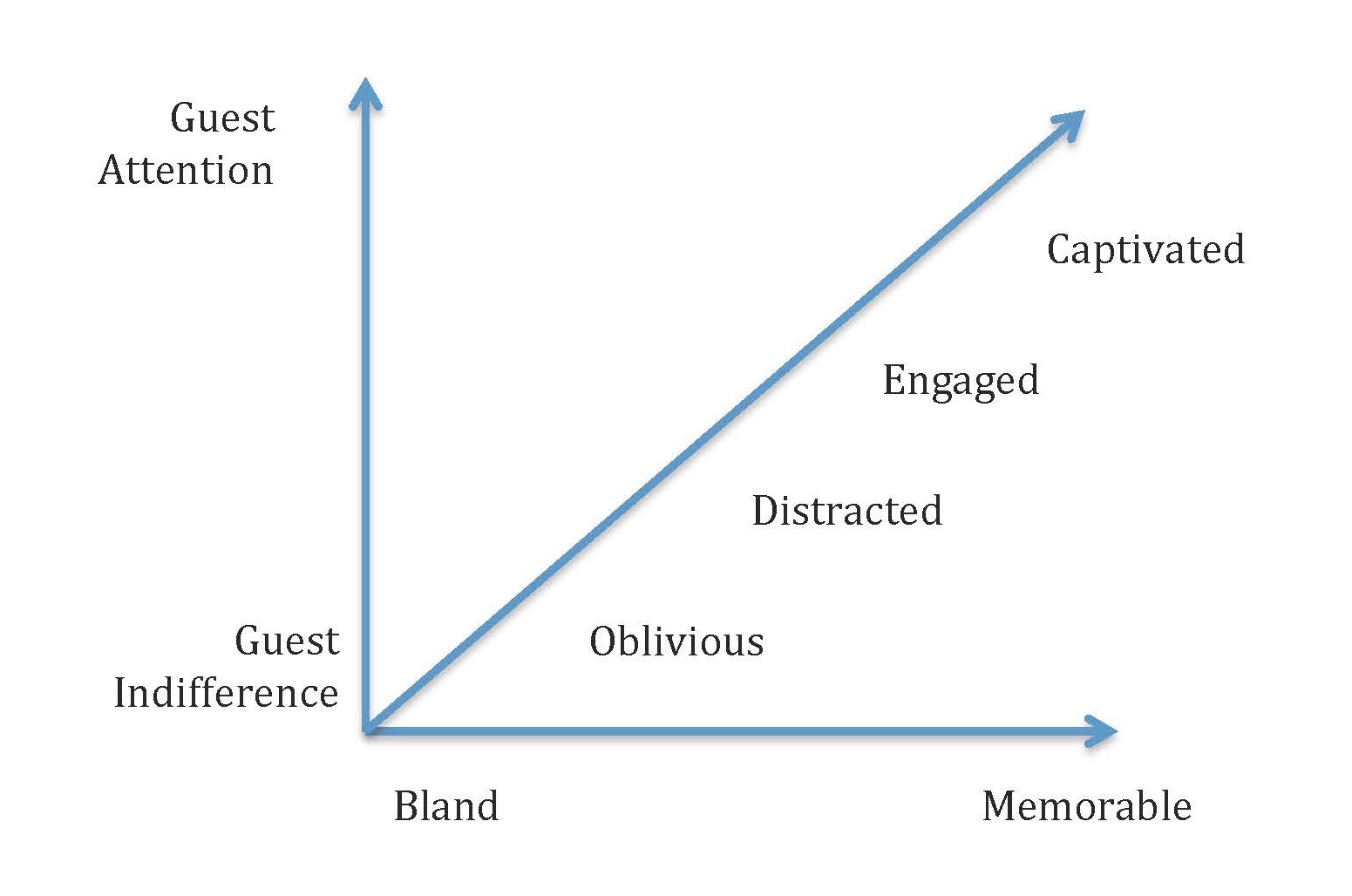
Beyond Philosophy discovered that there are four different levels of customer attention:

  • Oblivious
  • Distracted
  • Engaged
  • Captivated

Graphically it looks like this (modified to reflect Guest language):

Oblivious Guest Experiences

There are many organizations that try to grab your attention as a consumer – even in ChurchWorld – and yet you are oblivious to their advances. You haven’t seen their billboards, direct mail pieces, signs, bulletins, newsletters, worship guides, etc. You are exposed to thousands of “messages” every day, and yet you ignore most of them. Giving someone an oblivious Guest Experience costs organizations – like your church – a lot of money for nothing in return.

Distracted Guest Experiences

When you are distracted, you are not focused on the Guest Experience. For instance, a Guest may come to your church and wander around, thinking about other things. A greeter does not engage them. They do not see a special opportunity coming in two weeks. They aren’t challenged to take the next step. If you are not careful, they will slip in, be a spectator, and slip right out again. When this happens, organizations have not captivated or engaged the mind of the Guest, and they are distracted and indifferent enough to not pay attention to the Guest Experience being provided. Organizations that allow their Guest’s mind to wander and be distracted are losing a massive opportunity to build on future interactions.

Engaged Guest Experience

In the engaged stage you have 95 percent of your Guests’ attention, but it is not captivating, and therefore Guests can easily be distracted. There is a danger that their minds may wander and you may lost an opportunity to connect with them. For example, if your organization has wonderful connection points and eager people but not alignment of purpose, it would be easy for a Guest to lose their overall connection curiosity because they are literally inundated with messages. They may be engaged, but are eventually lost in an overwhelming amount of information or they find something else that pulls them away.

Captivating Guest Experiences

The goal is to create a captivating Guest Experience by capturing your Guest’s whole mind and thus ensure they give you their full and undivided attention. It is the stimulating of their senses to such a degree that positive emotions are evoked, rendering them captivated. Nothing stops them from focusing on your Guest Experience, and more importantly, nothing can distract them from it. They are so engrossed in your Guest Experience that nothing will pull them away from it. Your “share of mind”TM is total.

Captivating Guest Experiences are memorable by nature. Creating a memorable Guest Experience is important when considering the culture we live in. If your Guest Experience does not stand out, your organization will blend in, becoming part of the noise and blandness of this world.

Organizations must seize Guest’s attention from the first point of contact (often digital). Organizations must stimulate Guest senses (all 5 of them) to create a captivating Guest Experience, one that will evoke deep emotions – and create a connection that will allow the possibility of a transformed life.

This post is part of a journey translating Customer Experience learnings in the corporate world to Guest Experience in ChurchWorld. Material in today’s post was excerpted from “Revolutionize Your Customer Experience” by Colin Shaw.