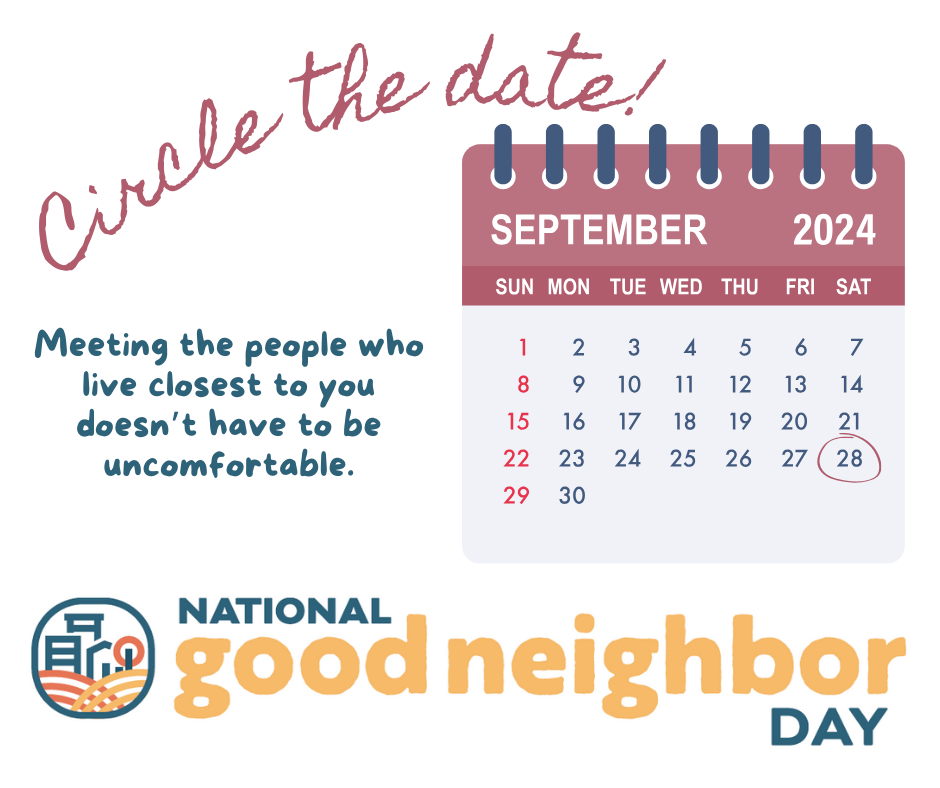
Picking up from the ideas over the last few weeks here, here, and here, consider these additional ways to celebrate National Good Neighbor Day on September 28:
1. Write Thank-You Notes: Express your gratitude to neighbors who’ve made a positive impact. A heartfelt note can go a long way in strengthening relationships.
2. Volunteer for a Community Project: Organize or participate in a local clean-up, tree-planting event, or food drive. This shows commitment to improving your shared space.
3. Host a Neighborhood Cook Out: Food brings people together. A casual cook out can be an excellent opportunity for neighbors to mingle and get to know each other better.
4. Start a Neighborhood Book Club: Promote intellectual engagement and regular social interaction by initiating a book club with your neighbors.
5. Create a Neighborhood Directory: With permission, compile contact information and special skills of willing neighbors. This can be invaluable during emergencies or when seeking local expertise.
6. Organize a Neighborhood Yard Sale: This event can help declutter homes while providing a fun, community-wide activity.
7. Initiate a “Random Acts of Kindness” Challenge: Encourage neighbors to perform small acts of kindness for one another throughout the day.
8. Host a Skills Exchange Workshop: Neighbors can teach each other various skills, from gardening to basic home repairs.
9. Create a Neighborhood Time Capsule: Collect items and messages representing your community to be opened in the future.
10. Plan a Neighborhood Walking Tour: For areas with historical significance, organize a tour to educate residents about local history.
Making It Happen
To bring these ideas to life:
Plan Ahead: Start organizing at least a few weeks in advance.
Communicate: Use social media, flyers, or door-to-door invitations to spread the word.
Be Inclusive: Ensure your activities are accessible to all neighbors, regardless of age or ability.
Follow Local Regulations: Obtain any necessary permits for larger gatherings or events.
Document the Day: Take photos and videos to commemorate the celebration.
Call to Action
We encourage you to share your National Good Neighbor Day plans and experiences on social media using the hashtag #GoodNeighborDay2024. By sharing your stories, you’ll inspire others and showcase the power of community spirit.
Remember, being a good neighbor isn’t limited to one day a year. Use National Good Neighbor Day as a springboard for ongoing community engagement and relationship-building. Together, we can create stronger, more connected neighborhoods that enrich all our lives.
The importance of a safe and supportive neighborhood cannot be overstated. As we celebrate National Good Neighbor Day, it’s the perfect time to reflect on our role in fostering a secure community environment. By working together, neighbors can significantly impact the safety and well-being of their local area.
Neighborhood safety is the cornerstone of a thriving community. When residents feel secure in their surroundings, they’re more likely to engage with one another, participate in local activities, and invest in their area’s well-being. A safe neighborhood not only reduces crime but also fosters a sense of belonging and trust among its inhabitants. By working together to implement safety measures and build strong community bonds, neighbors can create an environment where families can flourish, businesses can prosper, and individuals can enjoy a higher quality of life. Prioritizing neighborhood safety is an investment in the collective future of all who call it home.
The Power of Neighborhood Watch
One of the most effective ways to enhance community safety is through organized neighborhood watch programs. These initiatives bring residents together to act as extra eyes and ears for local law enforcement. Here’s how you can get involved:
Contact your local police department to learn about existing programs or how to start one.
Attend regular meetings to discuss community concerns and share information.
Learn to recognize and report suspicious activities without putting yourself in danger.
Use social media or community apps to stay connected and share updates.
Community Safety Tips
Beyond organized programs, there are many ways individuals can contribute to neighborhood safety:
Know your neighbors: Introduce yourself and exchange contact information.
Improve home security: Install proper lighting, secure locks, and consider security systems.
Look out for one another: Keep an eye on neighbors’ properties when they’re away.
Maintain your property: Well-kept homes deter criminal activity and improve neighborhood appeal.
Report issues promptly: Don’t hesitate to contact authorities about safety concerns.
Addressing Common Neighborhood Concerns
Every community faces unique challenges. Here are strategies to address some common issues:
Traffic safety: Work with local officials to implement speed bumps or increased signage in problem areas.
Property crimes: Organize community clean-ups and beautification projects to show an active presence.
Youth engagement: Create or support after-school programs and recreational activities for young residents.
Emergency preparedness: Develop a neighborhood emergency plan and conduct drills.
The Importance of Collaboration and Communication
A safe neighborhood is built on strong relationships and open dialogue. Consider these approaches:
Host regular community events to build connections among neighbors.
Create a neighborhood newsletter or online forum to share information and concerns.
Attend local government meetings to voice community needs and stay informed.
Establish a diverse neighborhood council to represent all resident demographics.
Call to Action
Your involvement is crucial in creating a safer and stronger neighborhood. Here’s how you can make a difference:
Join or start a neighborhood watch program in your area.
Attend the next community safety meeting or town hall.
Organize a block party to get to know your neighbors better.
Share your ideas for improving community security with local leaders.
Volunteer for community improvement projects.
A safe neighborhood is a collective effort. By working together and looking out for one another, we can create a community where everyone feels secure and supported. This National Good Neighbor Day, take the first step towards making your neighborhood a safer place for all.
What will you do to help make your neighborhood safer and stronger?
Check out these other “Good Neighbor Day” articles:
National Good Neighbor Day on September 28th is the perfect opportunity to bring your family and community together. This annual holiday encourages us to appreciate the people who live around us and find fun ways to connect. The best part? Involving the whole family makes it even more meaningful.
Whether you have young kids or teenagers, there are plenty of family-friendly activities that can help foster neighborhood camaraderie. One popular idea is hosting a neighborhood block party. Get everyone on your street involved by organizing a potluck dinner, outdoor games, and music. Encourage families to bring a favorite dish to share, and have the kids help set up a lemonade stand or face painting station. This gives everyone a chance to mingle, and the little ones will love being part of the festivities.
Another option is organizing a neighborhood picnic or field day at a local park. Set up relay races, three-legged races, or water balloon tosses that people of all ages can enjoy. You could even get creative with scavenger hunts that have clues about your community. This gets families working together and exploring the area in a fun way.
No matter which activity you choose, the key is getting the whole family involved. Assign children tasks like making signs, decorating, or managing game stations. Older kids can help with planning and outreach to get more neighbors to participate. Including everyone builds a sense of ownership and pride in the event.
After your National Good Neighbor Day celebration, be sure to share photos and stories on social media using the hashtag #GoodNeighborDay. Inspire others to organize similar events in their own communities and keep the neighborly spirit alive all year round.
So round up your family this September 28th and get ready to celebrate the people right next door. With a little planning and a lot of community spirit, you can create an event that brings everyone together for some old-fashioned fun.
What is a favorite neighborly activity that you have done in the past – or would like to do this year? Share in the comments below!
Check out these other “Good Neighbor Day” articles:
Let’s face it, life gets busy. Between work, family, and personal commitments, it can be challenging to find time for everything, let alone building strong neighborly relationships. But the good news is, fostering a great relationship with your neighbors doesn’t require a massive time commitment. Small, simple gestures can go a long way.
What if we took the time to get to know the people next to us and discovered that they aren’t so menacing after all? Perhaps we would find that the people on our block or floor are normal people just like us.
At the end of the day, they long for a place to belong, a place to be accepted and cared for.
Introduce Yourself – It might seem obvious, but simply introducing yourself to your neighbors can be a great starting point. A friendly hello, a brief conversation about the neighborhood, or even just exchanging names can lay the foundation for a positive relationship. You might be surprised how many people appreciate a warm welcome.
Share the Love (Literally) – Who doesn’t love a homemade treat? Baking is a classic way to show your appreciation. Whether it’s a batch of cookies, a loaf of bread, or a homemade jam, a small, delicious gift can be a wonderful icebreaker. It’s a simple gesture that can spark a conversation and create a positive impression.
Offer a Helping Hand – Small acts of kindness can go a long way. If you notice your neighbor struggling with groceries, offer to help carry them in. If you see their driveway needs shoveling after a snowstorm, lend a hand. These small gestures can make a big difference in someone’s day and strengthen your bond with your neighbor.
Mind Your Manners – Sometimes, the smallest actions can have the biggest impact. Be mindful of noise levels, especially during late hours. Respect shared spaces like sidewalks and lawns. These simple courtesies show that you care about your neighbors and their well-being.
Communicate Openly – If there’s an issue, address it directly and respectfully. Open communication is key to resolving conflicts and building trust. A friendly chat can often clear up misunderstandings and prevent larger problems from arising.
Remember, building strong neighborly relationships takes time and effort. But by incorporating these simple gestures into your daily life, you can create a more connected and supportive community without sacrificing too much of your own time. Small steps can lead to big rewards.
What are your favorite low-effort ways to connect with your neighbors? Share your tips in the comments below!
Check out these other “Good Neighbor Day” articles:
There’s something undeniably special about a good neighbor. They’re the folks who lend a helping hand, offer a friendly smile, and contribute to the overall fabric of a community. As we navigate increasingly busy lives, the significance of strong neighborly relationships often gets overlooked. But the truth is, good neighbors can make a world of difference.
A strong neighborhood is more than just a collection of houses; it’s a community. It’s a place where people look out for one another, share experiences, and build lasting bonds. When neighbors know and trust each other, it fosters a sense of security and belonging. Children grow up feeling safe and supported, while adults find companionship and camaraderie.
Beyond the emotional benefits, good neighbors can also contribute to a safer community. Studies have shown that areas with strong neighborly connections tend to have lower crime rates. When people know their neighbors, they’re more likely to report suspicious activity and be vigilant about protecting their community. A close-knit neighborhood also creates a sense of shared responsibility, encouraging everyone to work together to maintain a clean and attractive environment.
Moreover, good neighbors offer invaluable support during challenging times. Whether it’s a helping hand with yard work, a listening ear, or a casserole during a family crisis, neighbors can be a lifeline. These acts of kindness not only strengthen individual relationships but also reinforce the idea that we’re all in this together.
In today’s fast-paced world, it’s easy to become isolated and disconnected from our neighbors. But taking the time to build strong relationships can be incredibly rewarding. Whether it’s a simple wave hello or a more involved interaction, every effort to connect with your neighbors contributes to a happier, healthier, and more vibrant community.
So, as we approach National Good Neighbor Day on September 28th, let’s take a moment to appreciate the importance of good neighbors. Let’s reach out to our neighbors, offer a helping hand, and create a stronger sense of community together. After all, a good neighbor is a treasure worth cherishing.
What are your favorite qualities in a good neighbor? Share your thoughts in the comments below.
Check out these other “Good Neighbor Day” articles:
For the most part, the term “hospitality” has lost its moral dimension and, in the process, most Christians have lost touch with the amazingly rich and complex tradition of hospitality.
Christine D. Pohl
Although hospitality was central to Christian identity and practice in earlier centuries, our generation knows little about its life-giving character. Making Room revisits the Christian foundations of welcoming strangers and explores the necessity, difficulty, and blessing of hospitality today.
Combining rich biblical and historical research with extensive exposure to contemporary Christian communities – the Catholic Worker, L’Abri, L’Arche, and others – this book shows how understanding the key features of hospitality can better equip us to faithfully carry out the practical call of the gospel.
Making Room: Recovering Hospitality as a Christian Tradition by Christine D. Pohl explores the concept of hospitality from a Christian perspective, examining its significance both in historical and contemporary contexts. Pohl argues that hospitality is not just a peripheral activity but a central aspect of Christian life and tradition.
The book is divided into three main sections:
Biblical and Historical Foundations Pohl discusses how hospitality is rooted in biblical teachings and practices, drawing from both Old and New Testament examples. She highlights how early Christians practiced hospitality as a way to live out their faith and serve others, particularly the marginalized and the stranger.
Contemporary Challenges and Opportunities In this section, Pohl addresses the challenges that modern society poses to hospitality, such as increased mobility, urbanization, and a focus on individualism. She emphasizes that despite these challenges, there are still opportunities to practice and revive the spirit of hospitality in today’s world.
Practical Implications The final section provides practical suggestions for individuals and communities who wish to embrace and practice hospitality. Pohl offers guidance on how to incorporate hospitality into everyday life, stressing that it involves more than just welcoming guests; it is about creating spaces where people feel valued and cared for.
Making Room is a thoughtful and insightful exploration of hospitality within the Christian tradition. Christine D. Pohl successfully integrates theological reflection with practical advice, making the book both scholarly and accessible. Her examination of biblical and historical examples is thorough and provides a strong foundation for understanding the importance of hospitality in Christian life.
One of the strengths of the book is Pohl’s ability to connect historical practices with contemporary issues. She provides a clear-eyed analysis of how modern societal trends have affected the practice of hospitality, while also offering hope and concrete steps for re-engaging with this essential Christian practice.
The book’s structure is well-organized, with each section building upon the previous one, leading to a comprehensive understanding of the topic. Pohl’s writing is engaging and her arguments are well-supported by both scripture and historical evidence.
Making Room is particularly valuable for readers who are involved in church leadership or community service, as it provides actionable ideas for fostering a culture of hospitality. However, its relevance extends to anyone interested in deepening their understanding of Christian practice and improving their interpersonal relationships.
Overall, Christine D. Pohl’s Making Room is a significant contribution to the conversation about hospitality in the Christian tradition. It challenges readers to reconsider the role of hospitality in their lives and encourages them to make space for others in meaningful and transformative ways.
Key Themes and Recommendations
Embracing the Spirit of Hospitality: Pohl emphasizes that hospitality is not merely about hosting events or having guests over; it’s fundamentally about cultivating a welcoming and generous spirit. This means extending kindness, openness, and warmth in everyday interactions, not just in formal settings. It involves a mindset of valuing others, regardless of their background or status.
Creating Space for Others: The practical application of hospitality involves both physical and emotional space. Pohl suggests that creating a welcoming environment starts with one’s home or community space. This can include:
Intentional Design: Making physical spaces more inviting and accessible. This might mean rearranging furniture to encourage conversation or ensuring that spaces are inclusive and comfortable for all guests.
Generosity in Sharing: Being willing to share one’s home, resources, and time. For instance, inviting neighbors for meals or offering temporary accommodation to those in need can be practical expressions of hospitality.
Building Genuine Relationships:Pohl advocates for fostering genuine relationships as a core element of hospitality. This involves:
Listening and Empathy: Taking the time to listen to others’ stories and experiences, and showing empathy and understanding. This helps build trust and deeper connections.
Regular Interaction: Engaging in consistent, meaningful interactions rather than one-off gestures. Building relationships over time demonstrates a commitment to hospitality.
Serving the Marginalized and Vulnerable: A significant aspect of hospitality in Pohl’s view is extending care and welcome to the marginalized and vulnerable populations. Practical ways to do this include:
Community Outreach: Engaging in local service projects or supporting organizations that serve those in need, such as food banks or shelters.
Personal Involvement: Offering support directly to individuals in challenging circumstances, whether through volunteering time, providing resources, or simply offering companionship.
Overcoming Barriers to Hospitality: Pohl acknowledges that various barriers can make practicing hospitality challenging, such as busy schedules, financial constraints, or societal norms. She suggests:
Prioritizing Relationships: Making hospitality a priority despite a busy lifestyle by scheduling regular gatherings or setting aside time for meaningful interactions.
Creative Solutions: Finding creative ways to practice hospitality within one’s means. This could include potlucks instead of formal dinners or virtual meetings to connect with distant friends.
Cultivating a Hospitable Community: Finally, Pohl discusses the importance of fostering a hospitable culture within communities, such as churches or neighborhood groups. This involves:
Encouraging Participation: Creating opportunities for members of a community to practice hospitality, perhaps through organized events or service initiatives.
Modeling Hospitality: Leaders and influential members of a community can set an example by demonstrating hospitable behaviors and encouraging others to do the same.
As noted above, final section of Making Room offers a pragmatic and heartfelt approach to incorporating the principle of hospitality into everyday life. Christine D. Pohl’s recommendations are designed to help individuals and communities move beyond theoretical understanding to actual practice, emphasizing that hospitality is a lived experience that reflects the values of kindness, generosity, and inclusivity. The practical suggestions provided are meant to inspire readers to make hospitality a natural and integral part of their daily interactions and community engagement.
Celebrating National Good Neighbor Day September 28
National Good Neighbor Day is an annual observance in the United States that encourages people to build stronger relationships with their neighbors and foster a sense of community.
Here’s a brief overview of its history and background:
The day was created by Becky Mattson, a resident of Lakeside, Montana, who came up with the idea in the early 1970s. She believed that good neighbors were vital to the strength and well-being of communities and wanted to create a day that would recognize and encourage neighborly relationships.
Mattson began promoting the idea locally and then expanded her efforts to gain wider recognition. She successfully lobbied for the day to be recognized in her home state of Montana.
Encouraged by the state-level success, Mattson launched a campaign to have the day recognized nationally and her efforts caught the attention of members of Congress, who supported the idea.
In 1978, Mattson’s work culminated in success when President Jimmy Carter issued Proclamation 4601, officially designating the fourth Sunday in September as “National Good Neighbor Day.” In his proclamation, Carter stated, “Understanding, love, and respect build cohesive families and communities.”
In 2003, the observance was moved to a fixed date of September 28th each year. National Good Neighbor Day is sponsored and managed by The Hopeful Neighborhood Project.
Mattson’s grassroots effort to promote neighborliness and community spirit is a testament to how individual citizens can influence national observances. Her initiative has since inspired many communities across the United States to organize events and activities that foster better relationships between neighbors.
National Good Neighbor Day aims to promote kindness, consideration, and understanding between neighbors, recognizing the importance of strong community bonds.
As National Good Neighbor Day approaches, communities across the nation are gearing up to celebrate the spirit of neighborliness. This annual observance offers a perfect opportunity to strengthen bonds and create a more vibrant, connected neighborhood.
Here are some inspiring ways you can participate and make a difference in your community:
Bring the Neighborhood Together – Nothing fosters community spirit quite like sharing a meal. Consider organizing a block party, community potluck, or barbecue in your local park. These gatherings provide an excellent chance for neighbors to mingle, share stories, and create lasting connections.
Lend a Helping Hand – Good Neighbor Day is all about kindness. Why not offer to help an elderly neighbor with yard work or home maintenance? Baking treats to share or offering to pet-sit for a neighbor going on vacation are simple yet meaningful gestures that can brighten someone’s day.
Improve Your Surroundings – Take pride in your neighborhood by initiating community improvement projects. Organize a neighborhood clean-up, plant trees, or start a community garden. These activities not only beautify your area but also give neighbors a chance to work together towards a common goal.
Foster Social Connections – Launch a neighborhood watch program to enhance safety, or start a book club to bring together literature lovers. Setting up a community bulletin board can keep everyone informed about local news and events, fostering a sense of community.
Welcome New Faces – Make newcomers feel at home by creating a welcome committee. Greet new residents with welcome baskets filled with local goodies and information about the neighborhood. Offering a guided tour of the area can help them feel more connected to their new home.
Share Your Skills – Everyone has something to offer. Host workshops where neighbors can share their expertise, whether it’s cooking, home repair, or gardening. Consider setting up a tool-lending library to promote resource sharing within the community.
Celebrate Diversity – Organize multicultural potlucks or cultural performances to celebrate the diversity in your neighborhood. These events can foster understanding and appreciation for different cultures and traditions.
Give Back Together – Coordinate charitable activities like food or clothing drives for local charities. Volunteering as a group at local non-profits not only helps those in need but also strengthens neighborhood bonds.
Promote Health and Wellness – Organize group fitness activities like neighborhood walks or yoga in the park. Hosting health awareness seminars can also contribute to the overall well-being of your community.
Go Green – Initiate environmental projects such as coordinating neighborhood recycling efforts or organizing energy conservation challenges. These activities can bring neighbors together while making a positive impact on the environment.
Engage Youth – Set up mentoring programs or organize youth sports leagues to involve younger residents in community activities. This can help foster a sense of belonging and responsibility among the next generation.
Embrace Technology – Create neighborhood social media groups or websites to improve communication. Organizing digital literacy classes for older residents can help bridge generational gaps and keep everyone connected.
National Good Neighbor Day reminds us that strong communities are built on simple acts of kindness and connection. By participating in these activities, you’re not just celebrating a day – you’re contributing to a more cohesive, supportive, and vibrant neighborhood all year round. So why wait? Reach out to a neighbor today and start planning how you’ll make this Good Neighbor Day on September 28 special for your community.
Abandoned lots, litter-strewn pathways, or rows of green beans and pockets of wildflowers? Graffiti-marked walls and desolate bus stops, or shady refuges and comfortable seating? What transforms a dingy, inhospitable area into a dynamic gathering place?
How do individuals take back their neighborhood?
Neighborhoods decline when the people who live there lose their connection and no longer feel part of their community. Recapturing that sense of belonging and pride of place can be as simple as planting a civic garden or placing some benches in a park.
The Great Neighborhood Book explains how most struggling communities can be revived, not by vast infusions of cash, not by government, but by the people who live there. The author addresses such challenges as traffic control, crime, comfort and safety, and developing economic vitality. Using a technique called “placemaking”—the process of transforming public space—this exciting guide offers inspiring real-life examples that show the magic that happens when individuals take small steps and motivate others to make change.
The Great Neighborhood Book by Jay Walljasper is a comprehensive guide that offers practical strategies for revitalizing and strengthening local communities. This insightful work provides readers with a wealth of actionable ideas to transform their neighborhoods into vibrant, connected, and thriving spaces.
One of the key themes Walljasper emphasizes is the importance of fostering social connections. He suggests organizing regular community events such as block parties, potlucks, or outdoor movie nights. These gatherings create opportunities for neighbors to meet, interact, and build relationships, laying the foundation for a more cohesive community.
The book also highlights the value of creating shared spaces. Walljasper encourages readers to establish community gardens, which not only beautify the area but also provide a collaborative project for residents. He proposes converting vacant lots into pocket parks or playgrounds, giving neighbors a place to congregate and children a safe area to play.
Improving walkability is another crucial aspect Walljasper addresses. He advises advocating for wider sidewalks, better street lighting, and traffic-calming measures to make neighborhoods more pedestrian-friendly. This not only enhances safety but also encourages people to spend more time outdoors, increasing the likelihood of spontaneous interactions with neighbors.
Walljasper emphasizes the power of local businesses in creating a strong neighborhood identity. He suggests supporting existing local shops and working to attract new ones that cater to community needs. Farmers’ markets, for instance, can become weekly social hubs while promoting local agriculture and healthy eating habits.
The book also explores the concept of “placemaking” – the art of creating public spaces that promote people’s health, happiness, and well-being. Walljasper provides ideas for small-scale interventions like installing benches, creating public art, or setting up Little Free Libraries to make streets more inviting and foster a sense of place.
To address safety concerns, Walljasper advocates for community-based approaches. He suggests forming neighborhood watch groups, but also emphasizes the importance of simply being present and engaged in the community. The more people are out and about, the safer and more vibrant a neighborhood becomes.
Walljasper doesn’t overlook the power of nature in creating livable neighborhoods. He encourages tree-planting initiatives, the creation of wildlife habitats, and the incorporation of green spaces into urban design. These efforts not only improve the aesthetic appeal of a neighborhood but also contribute to environmental sustainability and residents’ well-being.
The book also delves into the realm of civic engagement, urging readers to participate in local government and community organizations. Walljasper provides guidance on how to effectively advocate for neighborhood improvements and navigate local bureaucracies to effect change.
Throughout The Great Neighborhood Book, Walljasper emphasizes that creating a great neighborhood is not solely the responsibility of city planners or elected officials. Instead, he empowers readers to take initiative and make positive changes themselves, often starting with small, achievable projects that can snowball into larger transformations.
By offering a mix of big-picture thinking and small-scale, doable actions, Walljasper’s book serves as both an inspiration and a practical toolkit for anyone looking to improve their local community. It reminds us that vibrant neighborhoods are built through the collective efforts of engaged residents who care about their shared spaces and each other.
Will Guidara was twenty-six when he took the helm of Eleven Madison Park, a struggling two-star brasserie that had never quite lived up to its majestic room. Eleven years later, EMP was named the best restaurant in the world.
How did Guidara pull off this unprecedented transformation?
Radical reinvention, a true partnership between the kitchen and the dining room – and memorable, over-the-top, bespoke hospitality. Guidara’s team surprised a family who had never seen snow with a magical sledding trip to Central Park after their dinner; they filled a private dining room with sand, complete with mai-tais and beach chairs, to console a couple with a cancelled vacation. And his hospitality extended beyond those dining at the restaurant to his own team, who learned to deliver praise and criticism with intention; why the answer to some of the most pernicious business dilemmas is to give more – not less; and the magic that can happen when a busser starts thinking like an owner.
Today, every business can choose to be a hospitality business – and we can all transform ordinary transactions into extraordinary experiences. Featuring sparkling stories of his journey through restaurants, with the industry’s most famous players like Daniel Boulud and Danny Meyer, Guidara urges us all to find the magic in what we do—for ourselves, the people we work with, and the people we serve.
In the world of high-end restaurants and luxury hotels, the concept of “unreasonable hospitality” has gained traction, championed by industry leaders like Will Guidara. But what if we could bring this ethos into our own homes, transforming everyday gatherings into extraordinary experiences? Let’s explore how to apply these principles to create unforgettable moments for our guests, right in our own living rooms and dining tables.
At its core, unreasonable hospitality is about going above and beyond expectations, creating moments of delight and connection that surprise and touch our guests. In a home setting, this doesn’t mean spending lavishly or stressing ourselves out. Rather, it’s about thoughtfulness, attention to detail, and a genuine desire to make others feel special.
Start by truly knowing your guests. Pay attention to their preferences, interests, and needs. Did your friend mention loving a particular type of tea? Have it ready when they visit. Is your nephew obsessed with dinosaurs? Create a dinosaur-themed place setting just for him. These small gestures show that you listen and care, making your guests feel truly seen and appreciated.
Create a welcoming atmosphere from the moment your guests arrive. This goes beyond a clean house – think about the sensory experience. Perhaps it’s the aroma of freshly baked cookies wafting through the air, or a carefully curated playlist that sets the right mood. Consider personalizing the entrance, maybe with a chalkboard sign welcoming your guests by name.
During the visit, be present and attentive. Put away your phone and give your full attention to your guests. Anticipate their needs before they arise – have extra blankets ready for movie night, or offer a cool drink before they even realize they’re thirsty. It’s these proactive touches that elevate hospitality from good to exceptional.
Don’t be afraid to surprise and delight. If you’re having a dinner party, consider an unexpected intermission with a palate cleanser or a quick, fun activity. Or end the night with personalized goodie bags filled with each guest’s favorite treats. These unexpected moments of joy are what people will remember long after the event.
Flexibility is key in unreasonable hospitality. Be prepared to pivot if things don’t go as planned. If the weather ruins your backyard barbecue plans, quickly transform it into an indoor picnic adventure. Your ability to handle hiccups with grace and creativity will impress your guests more than a perfectly executed but rigid plan.
Remember, the goal is to create meaningful connections and memories. Sometimes, this means breaking from tradition or expectations. If your book club usually sticks to discussing the book, surprise them with a themed experience based on the novel’s setting. Transform your living room into a Parisian café or an English garden, depending on the book’s locale.
Lastly, extend your hospitality beyond the visit itself. Follow up with a thoughtful message or small gift that references a moment from their time with you. This shows that their visit made an impact on you too, deepening the connection.
Bringing unreasonable hospitality into our homes isn’t about perfection or grandeur. It’s about infusing love, thoughtfulness, and creativity into every interaction with our guests. By focusing on creating moments of surprise, comfort, and genuine connection, we can transform ordinary gatherings into extraordinary experiences that nurture our relationships and create lasting memories.











 27gen.com