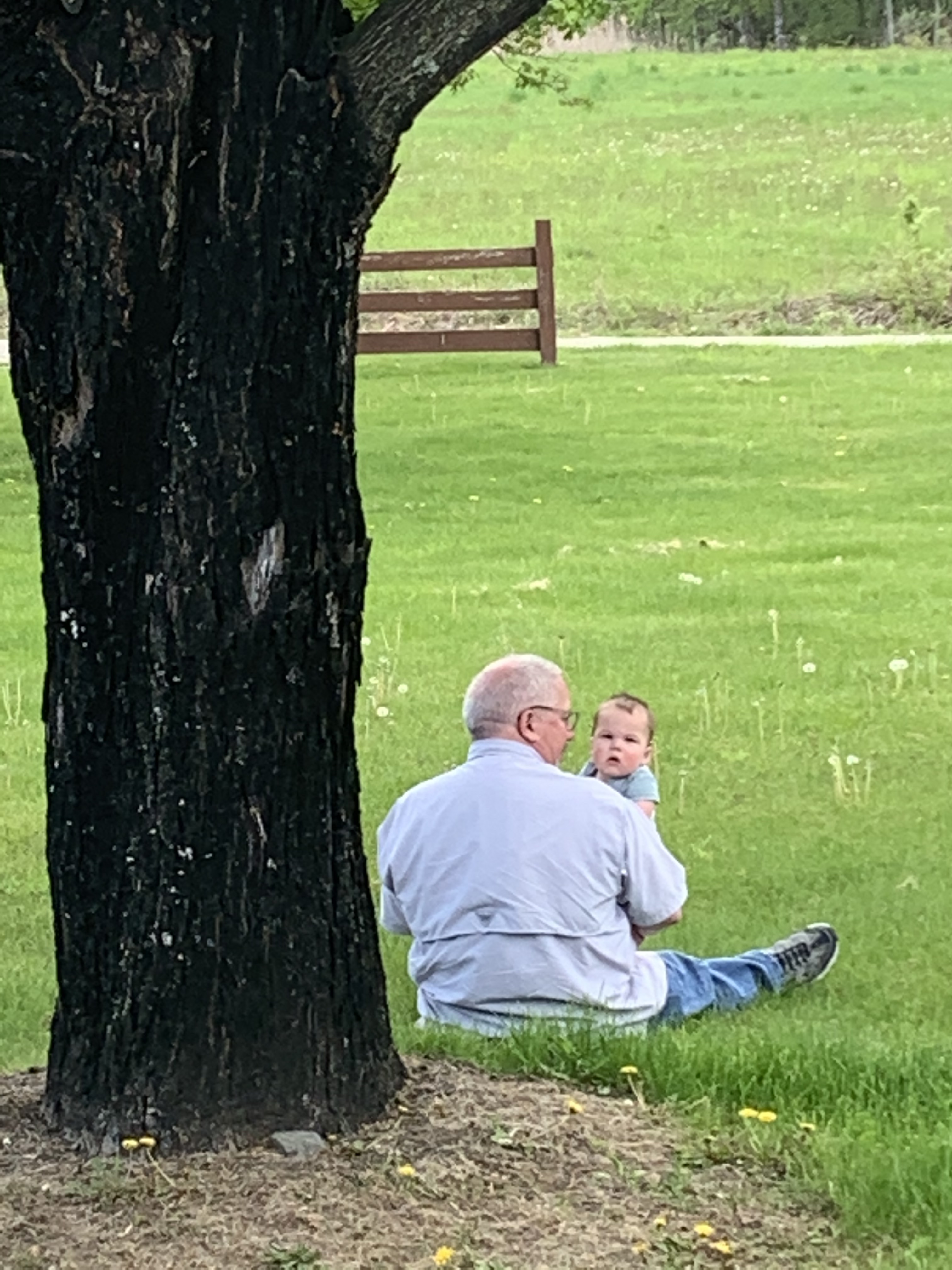
I first became a GrandBob at age 50 (relatively young, I think!).
Now, with my 8th grandchild firmly in hand (haha!), I think I’m getting the hang of it.
Of course, it also means grandchild #1 is a teenager…

I first became a GrandBob at age 50 (relatively young, I think!).
Now, with my 8th grandchild firmly in hand (haha!), I think I’m getting the hang of it.
Of course, it also means grandchild #1 is a teenager…
In recognition of National Beagle Day on April 22, and in remembrance of our funny, flop-eared friend Luke Skybarker. This post was originally written on 11/24/12.
11 years and one week ago today we brought home a flop-eared, six-week old beagle.
Today, after a week of increasingly failing health and a night I don’t soon want to repeat, we buried Luke Skybarker in his favorite outdoors place, our backyard overlooking North Mecklenburg Park.
The story in-between those two sentences is some of what life is all about.
In 2001, as our youngest son Aaron approached his 9th birthday, we heard the words many parents regret: “I’m getting older now; I think I’m ready for more responsibility – like a dog. “
Somehow I equated more responsibility to helping around the house, maybe a neighborhood job to start a college fund. But to Aaron, responsibility = a dog. And being the softy parents that Anita and I are, we agreed. After a little research, we located someone in Lincoln County that had two litters that were just about ready to wean, and we had our pick.
With parental veto power firmly in check, we let Aaron pick a small male, the runt of the litter. There was also a female that Aaron passed over, because his choice “was quiet.”
Not for long.
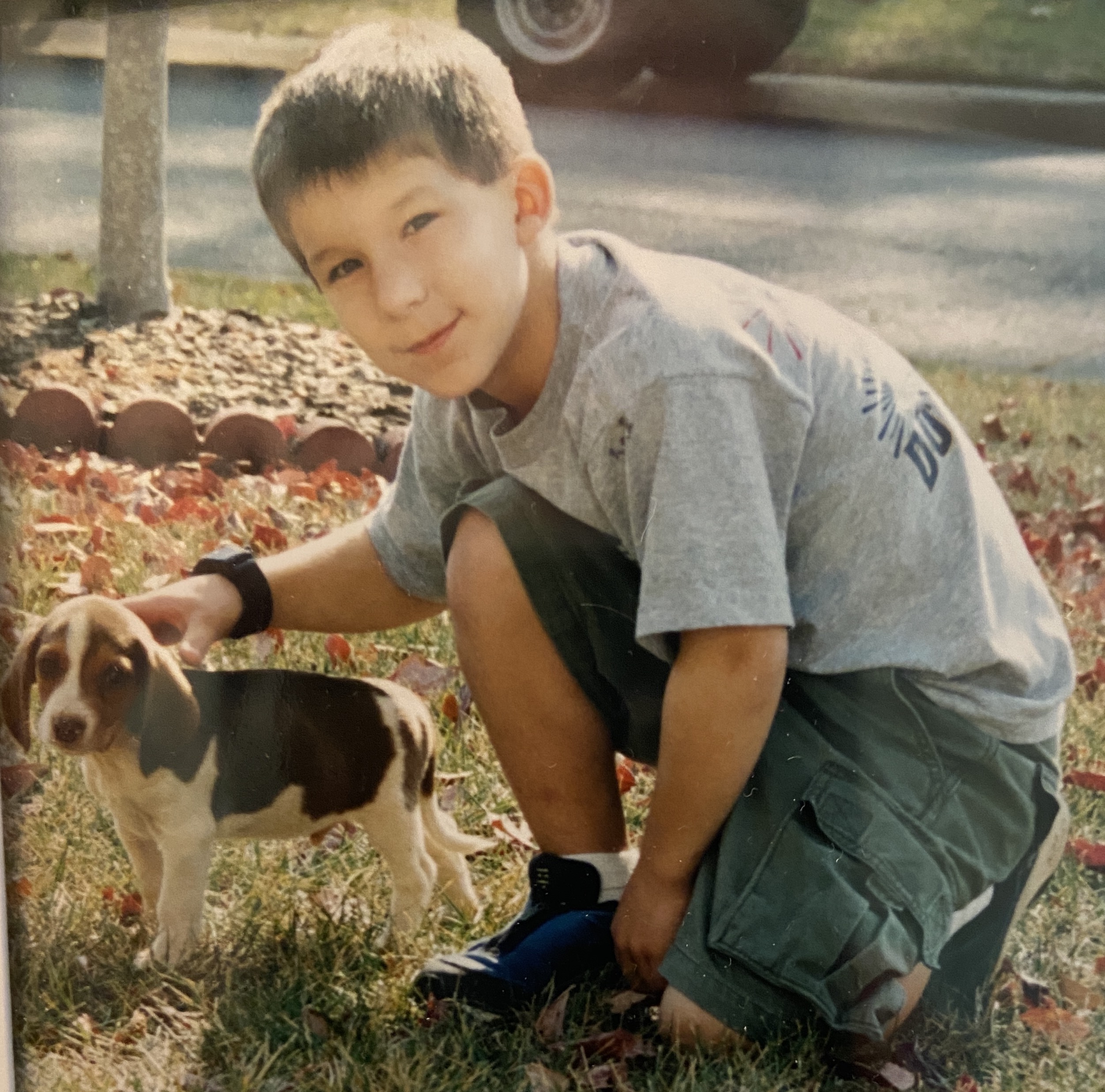
Shortly after arriving at our house, our new pet demonstrated his “quietness” with the first of countless howls that beagles are known for. And so began the saga of Luke Skybarker as a part of our family.
The name Luke Skybarker is homage to our family’s (well, at least the guys in our family) intense fondness for all things Star Wars. Over the years, we have seen all the movies (on opening night in theaters, then countless times on DVD, and now repeatedly on Disney+), acquired many LEGO sets of SW characters, read dozens of books about the series, and even dressed as SW characters at Halloween. So it’s no surprise that our howling new addition should be given the name Luke Skybarker.
After a short while, though, I was sure we had misnamed him. Due to his adorable cuteness but all puppy-like actions, we soon had a Bark Vader on our hands, because he definitely went over to the dark side.
Luke was actually an interior decorator, though we didn’t know it at first. Over a period of months, he: chewed up our couch legs and fabric; ate the bottom of several strips of wallpaper in the kitchen; chewed up several chair legs; ripped the carpet in several places, and ate big chunks out of the vinyl floor in the kitchen. I guess he operated on the “what doesn’t kill you makes you stronger” philosophy. We tolerated it, and over a period of time we replaced everything. So in a way I guess we owe some thanks to Luke for new hardwood floors, a new kitchen table and chairs, refinished walls in the kitchen, and so on.
It was one of those times when Luke began the first of many trips to a place he had a love/hate relationship with: LakeCross Veterinary Hospital. He met Dr. Donna on his first check-up, demonstrating that dogs can also have the white coat syndrome (and the staff doesn’t even wear white!). After one of his interior decorator attacks, AKA eating carpet, we decided to rip up all the carpet and put in laminate floors in most of the house. Shortly after we finished the project. Luke began acting strangely. He would act like he was in pain but we couldn’t pinpoint anything. At the vet, after a round of tests and examinations, Dr. Donna told us there was nothing physically wrong with Luke, but something was definitely causing his strange behavior. She asked us if we had made any changes in our home routine, and we mentioned the new floor. In her opinion, absent anything else, that was it: Luke was having a nervous reaction to the new floors. Personally I thought he was just missing the extra chew toys, but anyway he soon reverted back to normal.
Back to that responsibility thing – it didn’t last long (like I didn’t know it wouldn’t). And so I ended up with a new team member in my job (I worked out of a home office by then). As co-workers go, he was great most of the time. He rarely invaded my space (except for those seasons when the early morning sun tracked across my floor; he would follow it until it was no longer possible to soak up the sun). He was content to listen to an occasional rant about work without so much as a bark. As a sounding board, he always gave a paws up to my project ideas. I never had to worry about what to get him for parties – as long as it was bread, he was happy. I never had to worry about him taking over my job – it would have interfered with his sleep.
Somewhere along the way I had these visions of Luke being like the vet’s dog in “All Things Bright and Beautiful” – where the dog accompanied the vet on drives around town, etc. Early one Saturday morning, Luke accompanied me to the local farmer’s market to buy some veggies. After a fairly quiet time at the market, we left to go back home. Luke was sitting in the front seat of our van – until he dove out the window. Luckily, he had his chain on and we were not going too fast. I grabbed he chain just before it went out the window and hurriedly pulled over to the side of the road. With visions of the dog in National Lampoon’s “Vacation” movie in mind, I found a bloody Luke hanging by his collar. He had bounced off the front tire, tearing his right dew claw out and bleeding, but not in a lot of pain. When I came in the house cradling him with blood all over the place, everybody freaked. Off to the vet we went where he was bandaged up and given his own personal “collar of shame” to keep him from bothering the wound. So much for car trips…
Over the years, there would be many more trips to LakeCross. From Dr. Donna to Dr. Kay to Dr. Tom, all the vets and technicians and staff loved to have Luke Skybarker visit. He genuinely seemed to brighten their day, but I still haven’t figured out why. They loved him and fussed over him and gave him treats at every stop of the visit. About a year ago, Dr. Gretchen became our regular vet as much as possible. We began fighting a skin infection that soon became an indicator of Cushing’s Disease. All along the way, Dr. Gretchen tried so much to make Luke comfortable. We actually began to turn the corner with the Cushing’s but unfortunately it was something beyond our control that took Luke. Over the last week, he began having seizures that would cause him to fall over where he was. The X-rays yesterday confirmed the worst: a large mass around his heart and lungs, causing fluid buildup and other issues. Luke came home with us to see if he would last the weekend, but it was a very restless night (because of all our Thanksgiving company, Anita & I were sleeping in the great room sofa bed, and Luke was right at our feet by the fireplace). Several times I thought he slipped away, but it was evident his breathing was becoming more labored and painful. After taking Jason, Jaime and Lucy to the airport, we returned to get Aaron and Amy and headed to LakeCross one last time. As always, the staff could not have been kinder, and Dr. Kay eased Luke from a painful existence to peaceful rest.
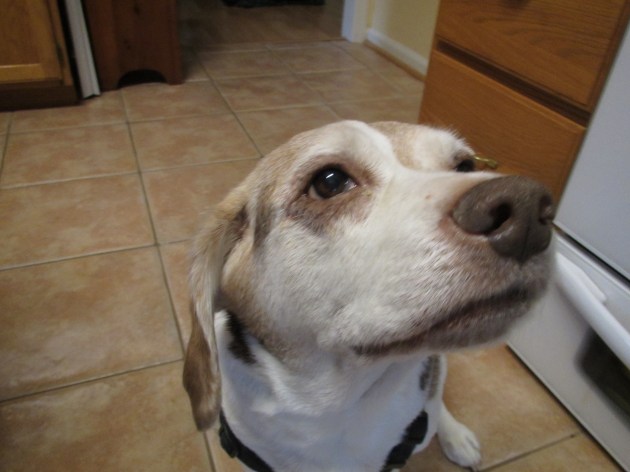
We are now in a house that is much too quiet – no toenails clicking along those hardwood floors, no built-in vacuum to get up food spills, no dog alarm when the front doorbell rings, no cold nose on your hands or feet.
We miss Luke, but we will always have the stories…
We discovered early on that you should not come between Luke and his Oreo’s. While fixing lunches for the kids one day, Anita dropped a bag with some Oreos in it. Quicker that I had ever seen him move, Luke grabbed the bag before Anita could pick it up. When she tried to get it from him he snapped at her. From that point on, we were careful about dropping things, but when we did, we let Luke have them (unless it would hurt him, at which point it became a wrestling match with teeth and snarls).
Luke loved his food and would fight for it, but when it came to defending his territory, he was all bark (and howl) and no bite. We always said Luke was one of the pets burglars feared most because they would trip over him in the dark and wake us up. It seems that he saved his most ferocious barks for other dogs who dared walk down “his” sidewalk. He would let them know – loud and long – but never take it past the bark. While he hated other dogs, he loved cats. Most of the neighborhood cats soon realized he was no threat to them and learned to taunt and tease him on walks. Luke was never the wiser.
As other animals go, Luke was a squirrel watcher. Our large kitchen window has a ledge that was just the right height for Luke to rest his chin and watch the squirrels run and play outside. He never barked at them – even when one jumped off the tree by the window and clung to the window screen before scampering away. They seemed to know it to, because when we would walk out in the back yard, they would run and scamper, but never seemed to fear him. It’s like they knew…
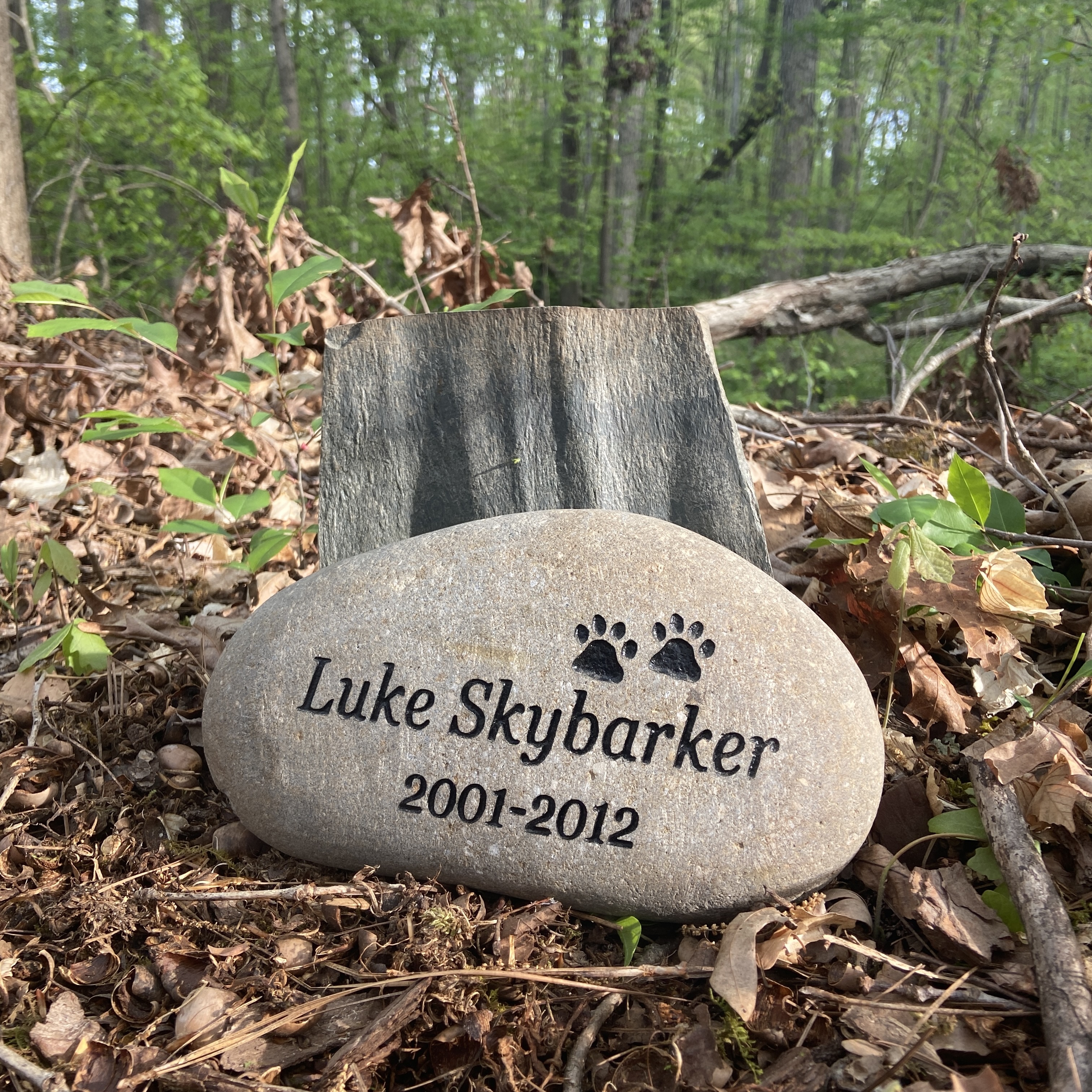
Maybe they know now, too. Luke’s final resting place is in the thick of the trees in our back yard. Overhead, the squirrels run and play.
I think he would have liked that.
Nine years ago this week was the celebration service and burial for my father, H.D. Adams.
As I reflected on his life this week, thoughts came to mind, and those thoughts brought me to words on a digital page, remembrances of him sprinkled in posts over the years.
From 2009, in a planning meeting with a church leadership team:
It was a long travel and office day with lots of “stuff” happening, but it ended on a very positive note from the church leadership team I was meeting with that night.
After over 2 1/2 hours of discussion, a remark was made something like this:
Your company’s information on the website and print say a lot, but your talk here tonight says the most. You may not realize it, but you’ve mentioned the influence of your father at least four times tonight, all in very positive ways. That speaks to your character and integrity, and that comes from a relationship that can’t be taught, but can be caught. That’s the kind of person we want to work with.
I was a little taken aback by the comment, but was very flattered. I did not realize that I was referencing my Dad that much, but evidently I was, and it was noticed.
Thanks, Dad, for modeling for me all the right things to do and say – even when I don’t realize I’m doing and saying them!
>From 2010, after a full day of play with my grandson:
Today’s visits to Discovery Place Kids and the park – just part of a busy day – reminded me in some ways of times with my grandfather and also how my dad played with his grandchildren.
My paternal grandfather died before I was born; my maternal grandfather lived in Missouri, so I only saw him about once a year until I was in my late teens. Then he moved into the small apartment next to my house, where he lived for several years until he passed away. Anyway, a lot of my memories are of “Pappy” teaching me guy things: mostly fishing, a little hunting, playing cards. My dad had already done this (except the cards); it was Pappy’s “job” since he had the time to expand on this “guy” knowledge.
My father was still working during my kids’ early years. Even so, trips to Grandpa’s house always included driving the mower; pumping gas at the gas station; feeding the birds; and reading books. Later when he retired and the kids were older those kinds of things continued.
So here I am in 2010, a GrandBob (twice) and it seems things are the same. The kids probably get more sugar, less sleep, and more attention than they should – but I don’t remember it permanently damaging me or my kids, so who am I to break with tradition?
Some things do change though: at the end of the day my 2 1/2 year-old grandson Skyped with his two week old cousin (well, pretty much Jack was doing the talking and watching; Lucy was sleeping most of the time). But he did get to see her and wish her a happy birthday (which is pretty astute for a 2 1/2 year-old, but hey, he’s my grandson).
>From 2011, when business travel was a regular occurrence, not a series of Zoom meetings:
Recently I went on a business trip that’s taken me through 5 airports, boarding 5 planes, and taking off and landing 5 times in 4 time zones. Along the way, I waited in lines, looked in a lot of faces, and heard lots of conversations. One conversation in particular stands out – two young women in their early 20s were behind me talking about another person. I wasn’t eavesdropping, but voices in a jet way are quite clear. The comment that stopped me? “Yeah, he’s 35 you know, and that’s like, you know, old.”
At more than two decades past the age of 35, I obviously have a different outlook on life than those two young women. Or do I?
I’m not normally the type that looks at myself in a mirror. But this comment, along with much more positive comments from my colleagues related to a change in hairstyle, made me look in the mirror in the hotel that night. Just who was that looking back at me?
The face I saw was that of my father. Instinctively, I know this was triggered by recent changes in his health. At 84, issues are beginning to arise. Emails indicated a gradual change in demeanor and lifestyle. Unexpected phone calls late at night recount hospital visits that begin bringing a new image to mind.
This morning, I looked long in the mirror and the vision I saw was that of my father, coming into focus like a picture being developed right in front of my eyes.
Thought of another way, however, that familiar face embedded in my mind morphed into my son’s and then into his son’s – my grandson. Like a modern day mashup, those collections of lives lived, and yet to live, offer a considerable span of history. A life in waning years, a life at halftime, a life in early adulthood, and a life just beginning – that’s quite a few faces in the mirror.
It doesn’t take a magic mirror to see the past in your own face, or wonder about the future in the face of your children and grandchildren.
Who knows when you will glance into a mirror and meet a past you hadn’t expected and weren’t ready for, or a future that is yet to come.
Look in the mirror – what do you see?
>From the 2012 eulogy to my father:
My memories of my father span the 54 years of my life – and each memory has a special significance. A father means one thing to a 3-year-old, another to a 13-year-old, and another to a 33-year-old. They are all special.
But today I remember my father in terms of being a grandfather. I am reminded of times with my grandfather and also how my dad played with his grandchildren.
Later on, after marriage and the start of my own family, since my father was still working during my kids’ early years, trips to Grandpa’s house always included driving the mower; pumping gas at the gas station; feeding the birds; and reading books. Later when he retired and the kids were older those kinds of things expanded, but he was always reflecting a spirit of giving to others.
So here I am in 2012, finding myself a grandfather – actually, a GrandBob – twice (now, 8 times!) and it seems things are the same. The kids probably get more sugar, less sleep, and more attention than they should – but I don’t remember it permanently damaging me or my kids, so who am I to break with tradition?
The point of all this long discourse: A lot has changed in the decades of grandparenting I’ve been a part of: first as a recipient, then as an observer, and now as a practitioner. But one thing remains the same.
Grandparents love their grandchildren, and through that love, cherish their children in a different way, as parents, and bearers of a legacy to a new generation.

I’m one of the original Star Wars fans (as in, I saw the first movie as soon as it showed up in Nashville, TN in early June 1977). It was the summer break after my freshman year of college, and I was working the factory line at Aladdin Industries, making Thermos bottles. My first “real” job, according to my father (after working at our family-owned gas station since age 6). Working the second shift, I was able to catch a late showing the day it came out.
The first time I saw it, I knew it was a game changer in so many ways. The next day, I came back and “watched” it with my eyes closed, just to listen to the music. A long-time lover of classical music, I was building a classical record library courtesy of a Columbia Music classical record subscription (remember those?).
Then I watched it five more times in the next week. And saw it again in theaters over the years. And bought it on VHS – then DVD, finally on Blu Ray. And I’ve watched it a bunch (cue eye roll by the wife) on Disney+ since November 2019.
The love of Star Wars runs deep in my family, from me to my children to my grandchildren. I have a 10-year old granddaughter I would put up against anyone in Star Wars trivia.
Oddly enough, though, I’ve only read two books with Star Wars stories. Those happened to be the first two, “Star Wars” and “Splinter of the Mind’s Eye,” both written by Alan Dean Foster (even though the first had George Lucas’ name on the cover), which I bought when they came out. And in the 44 years since…
Nada.
Of the hundreds of books available in the Star Wars universe, I’ve really only read those two. Which, given my family fandom, love of movies in general, and Star Wars fascination, is unusual.
To say nothing of my love of reading in general.

That changed this week, with the book “Light of the Jedi.” I preordered it for my Star Wars-loving, book-collecting son when it came out January 5. At the time, I told him I was also putting it on reserve at my library, and would read it when it came in so we could talk about it.
Which it did yesterday.
In the all-too brief period from December 11, 2020, to January 2, 2021, my mother-in-law Mary Grey Randolph went from living at home with a full-time caregiver to the hospital for surgery back to home for recovery, and then back to the hospital briefly, before moving to hospice care for two days, before passing on 1/2/21.
We shared a birthdate, and she often joked and wondered if I would ever catch up with her – and oh, by the way, she was planning on living to be 100.
Though she didn’t quite make it to her 100th birthday, she was living in her 100th year, so she gets full credit for that!
Mimmie, as she was affectionally known to our family, was the last of her generation in our extended family. Her husband passed away in 2015.

Much more than the titles of the great books by Tom Brokaw, Doc and Mary Grey nevertheless were the Greatest Generation, the likes of one which we have not seen since, and are likely not to see again – at least for awhile.
Mary Grey’s long life was marked by devotion to her God and church; love and nourishing her family; and compassion for others.
Mary Grey and W.L. “Doc” Randolph were married in 1943, lived apart for most of the war years, and began their family life in Goodlettsville, TN following the end of WW II.
Her vocational career included office management and bookkeeping responsibilities in several companies for over five decades. After retirement, her full-time occupation was keeping Doc in line, and as beloved “Mimmie” to her grandchildren.
Mary Grey was a long-time member at her church, and was involved in many activities and responsibilities over the years.
She and Doc, along with four other couples, personified friendship, care, and affection through the Sunday Night Bunch, which gathered weekly for over six decades.
She was devoted to her large family, and always took joy in hosting family gatherings from a single grandchild to dozens of family members for all occasions.
To me, that’s a pretty good definition of “greatest.”
The G.I. Generation, born 1901-1924, developed a special and good-kid reputation as the beneficiaries of new playgrounds, scouting clubs, vitamins, and child-labor restrictions. They came of age with the sharpest rise in schooling ever recorded. As young adults, their uniformed corps patiently endured the depression and heroically conquered foreign enemies. In a mid-life subsidized by the G.I. Bill, the build gleaming suburbs, invented miracle vaccines, plugged missile gaps, and launched moon rockets. Their unprecedented grip on the presidency began with a New Frontier, a Great Society, and Model Cities, but wore down through Vietnam, Watergate, deficits, and problems with “the vision thing.” As senior citizens, they safeguarded their own “entitlements” but had little influence over culture and values. Representatives of this generation include John Kennedy, Ronald Reagan, Walt Disney, Judy Garland, John Wayne, and Walter Cronkite.
William Strauss and Neil Howe, Generations
The event that not only named my in-laws’ generation, but shaped their character as young adults, was World War II. As recounted by Tom Brokaw, “There may never be again be a time when all the layers of our complex society are so completely absorbed in a monumental challenge as they were during WW II.”
Everyone had a role; everyone understood that the successful outcome of the war was critical to the continuing evolution of political and personal freedom.
The nation was infused with a sense of purpose and patriotism. Political leaders, the popular culture, advertising, newspapers, and radio cheered on the war effort once the fighting began. For many young men and women, that call to duty and the constant reminders of its importance in their lives and to the whole country marked their lives during the war and long after.
As I have written about a great deal on this site, I believe that our generations revolve in cycles. Interestingly, the premier researchers in this field, William Strauss and Neil Howe, believed that the generation that will most closely mimic the Greatest Generation in life events and achievements, is the Millennial generation.
The Millennials, those born 1982-2004, are the new “Greatest Generation” – not in name but in deed?
We face a much different type of “battle” today; one not against a named nation or group of nations, but against ourselves.
This cartoon, taken from decades of display on Mimmie’s fridge door, reflects both her life and attitude.

When two different groups view our objectives with a short-sighted and selfish nature, no one will be happy and we will both become quickly frustrated. We will tug and strain, and ultimately fail.
But if we come together and reason, give of ourselves and give up our selfish motives, we will succeed beyond our wildest dreams.
May it be so with the Millennials (Mimmie’s grandchildren), as it was with her Greatest Generation.
The second half of your marriage (when the kids leave home, and/or when you are helping with your own parent’s lifestyle decisions) can be a time of incredible fulfillment, no matter what challenges you previously faced.
It can be a time of learning about each other and about God’s long-term plans for your marriage. And a time of building together – sharing dreams, making commitments, and working towards a more satisfying union.
Having just celebrated my 38th anniversary on December 8, I sought out resources to help answer this question:
How can we make the second half of our marriage even better than the first?
David and Claudia Arp’s book “The Second Half of Marriage” has provided a lot of helpful guidance in starting out on the journey of the second half of marriage. Yesterday, I posted four strategies they outline in their book. Here, in their own words, are the final four:
In addition to the wealth of material in the book, the Arps provide additional resources through their Marriage Alive website.
And now for the whole picture of our wedding party – December 8, 1979, at First Baptist Church, Goodlettsville, TN.

It’s day 13,882 for Anita and me – and our journey together continues!
Happy Anniversary, Anita!
That question is always in the back of our mind as Anita and I celebrate our 38th anniversary today, December 8, 2017. Loosely defined, the second half of marriage comes when your kids have left home; it may also be marked by decisions a couple is making about their parent’s health and lifestyle.
I found a great resource to help begin charting this journey: David and Claudia Arp’s wonderful book The Second Half of Marriage. In their own words, here are the first four (of eight) strategies that will help every long-term couple make the most of their marriage:
Tomorrow, the other four strategies from “The Second Half of Marriage”, as well as some other resources and ideas.
But in the meantime, I have the most beautiful bride ever:

She still is!
Eulogy given at my father’s funeral, March 1, 2012. I usually repost it every year on the date of his birth, August 9. This year, a Facebook post sent to me by my wife and daughter reminded me of one of my dad’s favorite things to do for kids – so here it is again in his memory.
During the past few days I have been reminded in powerful ways that even though you may go away from a place, it’s always home.
Last night, over 750 guests came by to visit with my family. We saw friends of four years – and of four decades. Multiple generations of “customers” of my dad came by to pay their respects. From four to ninety-four, our family and friends came…
On behalf of my family, I want to thank all of you for your kind words, gestures, and acts of love. We are humbled by your actions, and thank you for honoring the memory of my father, Doc Adams.
My memories of my father span the 54 years of my life – and each memory has a special significance. A father means one thing to a 3-year-old, another to a 13-year-old, and another to a 33-year-old. They are all special.
But today I remember my father in terms of being a grandfather. I am reminded of times with my grandfather and also how my dad played with his grandchildren.
My paternal grandfather died when I was an infant; my maternal grandfather lived in Missouri. When he moved into the small apartment next to my house during my early teenage years, I remember fishing and hunting with “Pappy.” I think that established in me what grandfathers did.
Later on, after marriage and the start of my own family, since my father was still working during my kids’ early years, trips to Grandpa’s house always included driving the mower; pumping gas at the gas station; feeding the birds; and reading books. Later when he retired and the kids were older those kinds of things expanded, but he was always reflecting a spirit of giving to others.
So here I am in 2012, finding myself a grandfather – actually, a GrandBob – twice (now, 9 times!) and it seems things are the same. The kids probably get more sugar, less sleep, and more attention than they should – but I don’t remember it permanently damaging me or my kids, so who am I to break with tradition?
The point of all this long discourse: A lot has changed in the decades of grandparenting I’ve been a part of: first as a recipient, then as an observer, and now as a practitioner. But one thing remains the same.
Grandparents love their grandchildren, and through that love, cherish their children in a different way, as parents, and bearers of a legacy to a new generation.
That’s a legacy I cherish.
At my father’s celebration service, we showed a video clip that included him saying “I never made much money, but I made a lot of friends, and that’s what’s important.”
It reminded me of comments made by my dad when he would buy something for himself – which wasn’t very often: “I hope you don’t mind me spending your inheritance.”
When you put those two comments together, I think you have a perfect expression of what my father meant to our family – and to his church, community, and friends.
A huge difference exists between a legacy and an inheritance. Anyone can leave an inheritance. An inheritance is something you leave to your family or loved ones. A legacy is something you leave in your family and loved ones. While it hard work and success may lead to an inheritance, it takes courage through a lifetime to leave a legacy.
Inheritance
Legacy
What would you rather leave: an inheritance or a legacy?
I am reminded me of a quote attributed to Winston Churchill which I think reflects my father’s spirit and actions, and is backed up by the presence of hundreds at his celebration service today:
Giving is very much the legacy of my father, and what I want to leave with you today.
 (Family and friends leaving the celebration service were given a Dum Dum sucker.)
Your smiles in the audience tell me most of you know what this means; for those of you that don’t, it’s very simple.
Kids of all ages who came by my father’s gas station received a Dum Dum sucker from my father. It was just a simple act, but one that reverberates in my spirit to this day.
Enjoy the Dum Dum or give it away.
Either is okay: keep it for comfort or a memory of Doc, or give it to someone in memory of Doc.

That’s the legacy of Doc Adams that we all can pass on.

courtesy Paulin’a CC
Whose face do you see when you look in the mirror?
Recently I went on a business trip that’s took me through 4 airports, 3 rental cars, a subway ride, 3 hotels, and more lines than I care to recall. While I was waiting in those lines, I looked in a lot of faces, and heard lots of conversations. One conversation in particular stands out – two young women in their early 20s were behind me talking about another person. I wasn’t eavesdropping, but voices in a jet way are quite clear. The comment that stopped me? “Yeah, he’s 35 you know, and that’s like, you know, old.”
I’m over two decades past the age of 35, and I obviously have a different outlook on life than those two young women. Or do I?
I’m not normally the type that looks at myself in a mirror. But this comment, along with comments from my colleagues I had not seen in several months made me look in the mirror in the hotel that night. Just who was that looking back at me?
The face I saw was that of my father. Even though he passed away four years ago, I still have vivid memories of him. Going places he’d been, seeing things he had talked about, reading about things he was interested in – my memories are constant, and good.
This morning, I looked long in the mirror and the vision I saw was that of my father, coming into focus like a picture being developed right in front of my eyes.
Thought of another way, however, that familiar face embedded in my mind morphed into my son’s and then into his son’s – my grandson. Like a modern day mashup, those collections of lives lived, and yet to live, offer a considerable span of history. A long life lived, a life at halftime, a life in early adulthood, and a life just beginning – that’s quite a few faces in the mirror.
It doesn’t take a magic mirror to see the past in your own face, or wonder about the future in the face of your children and grandchildren.
Who knows when you will glance into a mirror and meet a past you hadn’t expected and weren’t ready for, or a future that is yet to come.
It‘s a week for marking educational milestones at the Adams’ house.

Our youngest son graduates from college this week, and that marks the end of “school” for our children. Anita and I have four children, who were born four years apart. From the beginning of kindergarten for our oldest son to graduation from college for our youngest, we have been in “school” for 29 years.
By the numbers:
Elementary and Secondary Schools
University and Graduate School
When we started our parenting journey in 1981, we didn’t set out to achieve these milestones. We didn’t know what was in store for us. Milestones are reached with small, consistent achievements that, when added up over a 29-year span, equal something big.
Our oldest son, now 34 and a father of 2 himself, started kindergarten in the fall of 1986. That was the first milestone in a long line. Parents and child alike look forward to those first days of school.
Now fast-forward to May 23, 2015. Our youngest son, now 22, will be graduating from college. In between were another son (now 30 and married with a 2 daughters) and a daughter (now 26 and married), who graduated from divinity school last year. Add it all together and you have consistent work along the way and before you know it – a milestone.
Milestones are accomplished over time from achievement after achievement. Showing up every day for class. Homework papers turned in. Quizzes and tests to study for. Projects, big and small, completed on time (most of the time).
I’m proud of all my kids. They finished school; now their education really begins.
 27gen.com