If you only read the books that everyone else is reading, you can only think what everyone else is thinking. Haruki Murakami, Norwegian Wood

Just saying’…

If you only read the books that everyone else is reading, you can only think what everyone else is thinking. Haruki Murakami, Norwegian Wood
…wrapping up this short throw-back series with the metaphor of a rockslide on I-40 on the NC/TN border that happened in 1997. That rockslide caused a lot of detours for months, and in the pre-GPS days, you had to pay attention to the road signs.
When a rockslide closes the highway, and you have to take a detour, you learn to rely a lot on road signs…
A “Yield” sign means I should stop and relinquish my progress to someone else. The last sign on this brief road trip is “yielding” our lives to God in worship.

courtesy highwaytrafficsupply.com
Worship is any activity in which believers experience God in a meaningful, spiritually transforming way. True worship should lead worshipers to a deeper appreciation for God, a better understanding of His ways, and to a deeper commitment to Him. Encountering God in worship transforms us more and more into His likeness.
Worship begins with God, and not people. Worship is not something people do because they want to influence God. Worship is not something people do just out of gratitude, love, or fear. Emotions do not control worship; God controls worship. God instructs us how to worship and how not to worship.
God is sovereign and holy. Worship must not be done according to our small notions of Him, our limited conceptions of what He wants, or what might please us. God is above all, and we are to worship Him in the manner He desires.
God is in charge of worship. He created us and redeems us at His pleasure. He gave forms of worship in the Old Testament to direct Israel’s worship and has given His Holy Spirit in the New Testament to give us liberty and guidance in how to worship Him for who He is and what He has done. The Spirit brings liberty and freedom to worship.
The purpose of worship is to come before the Lord in obedience to praise Him, to hear from Him, to confess Him, and to commit our lives to Him. Every worship service is to be an encounter with the Lord, transcending our feelings, desires, and even our abilities to perform.
So that’s end of this quick trip, looking for road signs to guide us in the journey:
These five functions of the church are vital signs that must be followed in balance if we are to complete our journey.
part of a series taken from presentations 16 years ago, introducing the Purpose Driven Church principles to a church leadership team
brought back today to connect to Auxano’s release of the first Team UP resource, featuring the Top 100 Quotes from Purpose Driven Church, with applications and exercises from Church Unique

…continuing this short throw-back series with the metaphor of a rockslide on I-40 on the NC/TN border that happened in 1997. That rockslide caused a lot of detours for months, and in the pre-GPS days, you had to pay attention to the road signs.
When a rockslide closes the highway, and you have to take a detour, you learn to rely a lot on road signs…
“Merging Traffic” means look out and be alert to join in with the traffic around you. You are all heading toward a common destination – work together and you will arrive in one piece. Ignore each other, trying to get ahead of someone else, and you will cause a wreck.

courtesy roadtrafficsigns.com
Fellowship does not happen by accident. It does not happen without the power of God working in individual believers and in the church body. As believers share with other their salvation experiences, practice Christ-like lives, and demonstrate their faith by serving others, fellowship flourishes as sure as summer follows spring.
Fellowship is more than just a feeling of goodwill in a congregation. Fellowship is a person-to-person relationship, and Christian fellowship also involves a relationship with God.
Fellowship is vital to a healthy church. Without warm, loving fellowship churches will not grow. People will not come where bickering , selfishness, coldness, and tensions prevail. People want to be where peace, love, joy and family relationships prevail.
A church whose fellowship is broken usually is a church that has lost sight of its other main functions: evangelism, discipleship, ministry and worship. Churches cannot have the kind of fellowship we want and our Lord expects unless they focus on evangelism, discipleship, ministry, and worship.
Fellowship follows naturally when a church heeds God’s call to practice the other four Kingdom functions.
Christ’s unity is a pattern for us to display and enjoy in the church. In John 17:21 we see the prayer of Jesus:
The goal is for all of them to become one heart and mind – just as you, Father are in me and I in you, so that they might be one heart and mind with us. Then the world might believe that you, in fact, sent me. (The Message)
The work of Christ and the Spirit in our lives gives us love for one another and a unity of purpose and vision. This results in fellowship.
part of a series taken from presentations 16 years ago, introducing the Purpose Driven Church principles to a church leadership team
brought back today to connect to Auxano’s release of the first Team UP resource, featuring the Top 100 Quotes from Purpose Driven Church, with applications and exercises from Church Unique
…continuing this short throw-back series with the metaphor of a rockslide on I-40 on the NC/TN border that happened in 1997. That rockslide caused a lot of detours for months, and in the pre-GPS days, you had to pay attention to the road signs.
When a rockslide closes the highway, and you have to take a detour, you learn to rely a lot on road signs…
“Men at Work” is a common sign on the road today. Actually, the signs should read “Men & Women at Work” because many road crews have several women on them.

courtesy roadtrafficsigns.com
Ministry is men and women at work, becoming ministers of God to His world.
Christian compassion and the principles of God’s Kingdom demands that we minister to all persons without regard to their race, religious affiliation, abilities, or circumstances. We meet the needs of others in response to the command of Christ. If we fail to minister, we fail to obey the Lord’s command. In eternity, we will find we have ministered to Jesus as we have ministered to needy, hurting, persons.
Whoever wants to be great must become a servant. Whosoever wants to be first among you must be your slave. That is what the Son of Man has done: He came to serve, not be served – and then to give his lie in exchange for the many who are held hostage. (Matthew 20:26-28, The Message)
Christians may view ministry as something they can do in their own power and with their own resources. We cannot save persons in our own power. Neither can we adequately meet their needs. Only God can provide the means to minister to the overwhelming needs of persons worldwide.
We desperately need God’s help and blessing in this huge task. We are to help the helpless and hurting persons and love them in the name of Christ with the resources He provides. The physical and spiritual needs of persons require our attention. God has chosen use us to meet those needs. With His help and power, we can do it.
The needs of churches and believers are constant and challenging. No one person can meet every need in the church alone, but serving together, with the power of the Holy Spirit, the needs can be met. The Lord will provide through His people and beyond His people the resources we need.
No church will be healthy unless it commits to minster as the Lord provides need and opportunities.
part of a series taken from presentations 16 years ago, introducing the Purpose Driven Church principles to a church leadership team
brought back today to connect to Auxano’s release of the first Team UP resource, featuring the Top 100 Quotes from Purpose Driven Church, with applications and exercises from Church Unique
…continuing this short throw-back series using the metaphor of a rockslide on I-40 on the NC/TN border that happened in 1997. That rockslide caused a lot of detours for months, and in the pre-GPS days, you had to pay attention to the road signs.
When a rockslide closes the highway, and you have to take a detour, you learn to rely a lot on road signs…
The School Zone sign signifies learning. “Learning” in the Bible is discipleship. Discipleship is a process that begins after conversion and continues throughout a believer’s life. Discipleship calls for our undivided attention and commitment to follow the commands of our Lord. Discipleship is not an option for any church or believer. Christ mandated it in the Great Commission. To disciple others is to obey our Lord’s command; to do otherwise is to disobey Him.

courtesy highwaytrafficsupply.com
To understand that discipleship is not an option for believers and that it involves taking up one’s cross daily to follow Christ is to begin to understand the work of each believer and the church.
Ephesians 4:11-13 perfectly expresses God’s will for every believer as He builds His kingdom:
He handed out gifts of apostle, prophet, evangelist, and pastor-teacher to train Christians in skilled servant work, working within Christ’s body, the church, until we’re all moving rhythmically and easily with each other, efficient and graceful in response to God’s Son, fully mature adults, fully developed within and without, fully alive like Christ. (The Message)
He calls and appoints persons with special gifts to equip the saints for their work in building up the body of Christ. Sadly, many churches do little to disciple believers when our Lord is ready and willing to guide and empower us to accomplish the task.
Maturing discipleship means that believers are living for the Lord in all areas of life. They take the Bible seriously and without question or compromise. The life of Christ is the center and focus of their lives.
Discipleship is God’s plan for maturing His children. We are saved by God through His grace and given to the church for care and obedience. Discipling believers requires commitment, patience, obedience, because growing and maturing believers requires time.
part of a series taken from presentations 16 years ago, introducing the Purpose Driven Church principles to a church leadership team
brought back today to connect to Auxano’s release of the first Team UP resource, featuring the Top 100 Quotes from Purpose Driven Church, with applications and exercises from Church Unique
Yesterday I introduced this short throw-back series with the story of a rock slide on I-40 on the NC/TN border that happened in 1997. That rock slide caused a lot of detours for months, and in the pre-GPS days, you had to pay attention to the road signs.
At the same time, the church I was serving was going through a “rock slide” of its own: the sudden resignation of the senior pastor, with practically no warning to anyone – including his staff! Our leadership teams had just begun working through Rick Warren’s Purpose Driven Church. I had just returned from a PDC seminar at Saddleback.
Isn’t it amazing how we think we are in control and have it all together with our plans – until we encounter a rock slide!
One Way is a most appropriate sign for evangelism. Christian evangelism is believers sharing the gospel with persons who aren’t believers. It is asking them to repent of their sins, to put their faith in Christ for the forgiveness of their sins and the free gift of eternal life, and to follow Him forever as Lord. Evangelism is the good news spoken by believers and lived out in their lives.

courtesy roadtrafficsigns.com
We must never replace evangelism with anything else. Everything we do individually and corporately in the church ultimately should b a witness to lost people and work toward making them disciples. When this is not the case, the church is not healthy, no matter how busy we are and how much we seem to accomplish.
Every Christian is responsible for declaring the good news of Christ’s coming and his death, burial, resurrection, and return. If we do not, we will give an account to the Father. The manner of delivering the message is not the crucial point. The responsibility for delivering the message is the decisive issue.
Evangelism under the lordship of Chris is the only way to make disciples. Whatever else churches do, they must make disciples. Evangelism is unique in that the need for the gospel is universal and the message is universal and effective in all cultures. Evangelism is believers sharing the gospel with a non-believer in ways both understand.
We are God’s method for evangelizing the world. He has no other. We are His plan, and our obedience means growth in the kingdom and the churches where we worship and serve. God save us to send us into the world to speak, live and show His good news of salvation to persons separated from Him.
That is what evangelism is all about. That is the “one way.”
part of a series taken from presentations 16 years ago, introducing the Purpose Driven Church principles to a church leadership team
brought back today to connect to Auxano’s release of the first Team UP resource, featuring the Top 100 Quotes from Purpose Driven Church, with applications and exercises from Church Unique

As the Vision Room Curator for Auxano, one of the exciting things I am a part of is creating new resources for church leaders. In addition to the daily curated resources of the Vision Room itself, there is the biweekly release of Sums, our leadership book summaries. Both of these resources are free, requiring only an email registration available here.
Two weeks ago, we rolled out Auxano Founder and Team Leader Will Mancini’s latest book Innovating for Discipleship. It is Volume 1 of The Church Unique Intentional Leadership Series.
We also released Issue #3 of the Unique 19 series – a look at vision-saturated churches you’ve probably never heard of. We call it the “list for the rest of us.”
Last week, we released the first of a new line of free resources called Team UP. In this inaugural release, we’ve taken our favorite 100 quotes from Rick Warren’s best-selling book, The Purpose Driven Church, and organized them for team discussion and vision implementation in your own church.
Enjoy this free resource and be inspired all over again by these timeless quotes here.
As I was doing the preliminary work during the summer on this resource (reading Purpose Driven Church again, selecting 150 quotes for our team to weed down to 100), I was reminded by the powerful influence this book has had on the church over the years. That was one of the reasons we chose it, and yet in the rereading I was taken back over 16 years to the first time I introduced PDC to the leadership team at the church I was the associate pastor for.
Earlier this summer during the infamous garage cleaning out, I had come across some of the files I had used, and a quick trip down memory lane uncovered the following:
When you look back with 20-20 hindsight, the inevitable will always happen.
The condition had existed for a long time. Actually, it started small but continued to grow. Everybody knew about it but no one really talked about it. As a matter of fact, it was easy to overlook. After all, things were going so well, and the future was bright. But trouble came just the same.
Throughout the entire area, the slopes of the mountains are filled with what geologists call “wedge failures.” That’s when wedges of rock are separated by a fault, fracture, or other weakness. That’s nature’s part.
Then man stepped in and built a road through the wedge failure areas. The road that was blasted through the mountains intersected the wedge failures. Weakened by the cuts made for the road, it was only a matter of time.
Add some rain as a lubricant, and whole sides of mountains can come crashing down on the highway. On July 1, 1997, a section of mountainside 800 feet high by 200 feet wider tumbled down onto I-40 near the TN/NC state line, closing all four lanes. Hundreds of tons of mountainside covered the highway; the rock that didn’t fall remained fragile and unstable.
Set up road signs; put up guideposts. Take note of the highway, the road that you take. Jeremiah 31:21
Isn’t it amazing how we think we are in control and have it all together with our plans – until we encounter a rock slide!
Tomorrow: What a rock slide has to do with Purpose Driven Church
Today my family and I mark a sobering moment as our son, an Airman in the U.S. Air Force, deploys for his first tour of duty overseas in a combat zone.
In his honor, we are now displaying this on our front door:

The Blue Star represents an immediate family member serving in the Armed Forces during any period of war or hostilities.
The Service Flag has a long and distinguished history. The banner was designed in 1917 by United States Army Captain Robert L. Queisser of the Fifth Ohio Infantry, in honor of his two sons who were serving in World War I. It was quickly adopted by the public and by government officials. On September 24, 1917, an Ohio congressman read into the Congressional Record:
The mayor of Cleveland, the Chamber of Commerce and the Governor of Ohio have adopted this service flag. The world should know of those who give so much for liberty. The dearest thing in all the world to a father and mother – their children.
I’m grateful for my son’s service to our country. When he first talked with my wife and me about military service upon graduation from high school, we were affirming but also wanted him to get a college degree first. When he did, and revisited the question several years later, we encouraged him to move forward. We were proud parents at his graduation from Basic Training and remain so at every step of his career advancement. Realizing this is a necessary part of that advancement, we prayerfully send him on his way today.
I’m also humbled by the sacrifices his wife and daughters are making. As the daughter of an Air Force Colonel (retired), she is no stranger to these goodbyes and separations. As a wife and mother, though, it has to be different. She handles the responsibilities with tremendous patience and poise.
During the past few days, our conversations have been both light-hearted and serious. In the late night hours last night, I was reminded of my father’s graveside service and military traditions. As Americans, we have probably never disagreed more about things than we currently are – but we all need to remember why we have the opportunities we do – including disagreeing with one another.
I hope you will join me today – and everyday – in a prayer of safety for my son and the thousands of other members of the Armed Forces he is joining today as they stand in harm’s way for our freedoms.

It is important to remember that Starbucks started as a single store and that anything is possible if we take the lessons learned from Starbucks as a nudge to think about how we can innovate and expand our products, services, social media tools, technologies, and channels. The leaders at Starbucks also demonstrate what is possible when you foster product passion, teach your people the importance of human connections, seek operational excellence and efficiency, and engage in a never-ending pursuit of relevance. – Joseph Michelli, Leading the Starbucks Way
The first session of the Fall Term of the 2013 GsD is wrapping up with today’s post. Organizational consultant Joseph Michelli’s latest book Leading the Starbucks Way has been the primary resource for this session.
Michelli uses over two years of research with dozens of leaders in the Starbucks organization to develop five actionable principles that forge emotional connections that drive innovation, grow new business product lines, and foster employee and customer loyalty. These principles are “brief and clear, and put the customers, products, and experiences at the purposeful center of Starbucks.” Here are the five principles:
In order to help you evaluate mastery of the material as well as apply independent thinking skills to your own setting, here are a few summary thoughts based on the five principles above.
It is important to remember that, at its heart, Starbucks is in the people business serving coffee. Place, Process, and Product are all important, but the foundation and core of Starbucks success is its People.
Take a look at this brief video and you will have a better understanding of what I mean:

The M.U.G. Award referred to in the video allows partners to recognize co-workers for “Moves of Uncommon Greatness” that help them achieve their goals. It’s a way of saying, “Thanks for helping me out. I couldn’t have done it without you!”
Part 9 of a series in the 2013 GsD Fall Term
Leading the Starbucks Way: Information, Insights, and Analysis Needed to Create a High-Performance Guest-Oriented Organization
inspired by and adapted from Leading The Starbucks Way, by Joseph Michelli
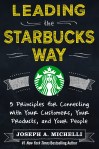
In late 2007, Starbucks was not doing well, and the future looked bleak. To address the emerging problems, former CEO Howard Schultz, who had stepped aside almost eight years earlier to become chairman of the board, did something unexpected: he returned as CEO to oversee day-to-day operations.
Schultz came back to Starbucks with a passion and a plan, and over the next two years, Starbucks returned to sustainable, profitable growth.
Here’s what Schultz had to say in looking back to early 2008:
If not checked, success has a way of covering up small failures, and when many of us at Starbucks became swept up in the company’s success, it had unintended effects. We ignored, or maybe we just failed to notice, shortcomings.
We were so intent upon building more stores fast to meet each quarter’s projected sales growth that, too often, we picked bad locations or didn’t adequately train newly hired baristas. Sometimes we transferred a good store manager to oversee a new store, but filled the old post by promoting a barista before he or she was properly trained.
courtesy nbcnews.com
As the years passed, enthusiasm morphed into a sense of entitlement, at least from my perspective. Confidence became arrogance and, at some point, confusion as some of our people stepped back and began to scratch their heads, wondering what Starbucks stood for.
In the early years at Starbucks, I liked to say that a partner’s job at Starbucks was to “deliver on the unexpected” for customers. Now, many partners’ energies seemed to be focused on trying to deliver the expected – mostly for Wall Street.
Great organizations foster a productive tension between continuity and change. On the one hand, they adhere to the principles that produce success in the first place, yet on the other hand, they continually evolve, modifying their approach with creative improvements and intelligent adaptation.
When organizations fail to distinguish between current practices and the enduring principles of their success, and mistakenly fossilize around their practices, they’ve set themselves up for decline.
By confusing what and why, Starbucks found itself at a dangerous crossroads. Which direction would they go?
In Leading the Starbucks Way, organizational consultant Joseph Michelli uses two years of research with dozens of leaders in the Starbucks organization to develop five actionable principles that forge emotional connections that drive innovation, grow new business product lines, and foster employee and customer loyalty. These principles are “brief and clear, and put the customers, products, and experiences at the purposeful center of Starbucks.”
Leadership Principle #5: Cherish and Challenge Your Legacy
“Cherish and challenge your legacy” is all about encouraging you to define the legacy you wish to leave and evaluate your leadership performance, in part, based on your progress toward that legacy. – Joseph Michelli, Leading the Starbucks Way
A key element in the success of the Starbucks transformation results from an alignment between leaders who are charged with driving change and those who are responsible for ensuring consistent operations.
Our challenge has been to produce innovations that improve operations, drive growth, enhance the partner and customer experience, and increase profitability. That’s a tall order, but it often occurs in the most subtle ways. – Craig Russell, Starbucks senior vice president, Global Coffee
Ultimate success in driving innovation hinges on the alignment of those who foster change and those who maintain stability.
ChurchWorld Application
Any organization, small or large, consumer or otherwise, that is going to embrace the status quo as an operating principle is just going to be dead…The need for constant innovation and pushing forward has never been greater than it is today. – Howard Schultz, CEO, Starbucks
Part 8 of a series in the 2013 GsD Fall Term
Leading the Starbucks Way: Information, Insights, and Analysis Needed to Create a High-Performance Guest-Oriented Organization
inspired by and adapted from Leading The Starbucks Way, by Joseph Michelli

 27gen.com