
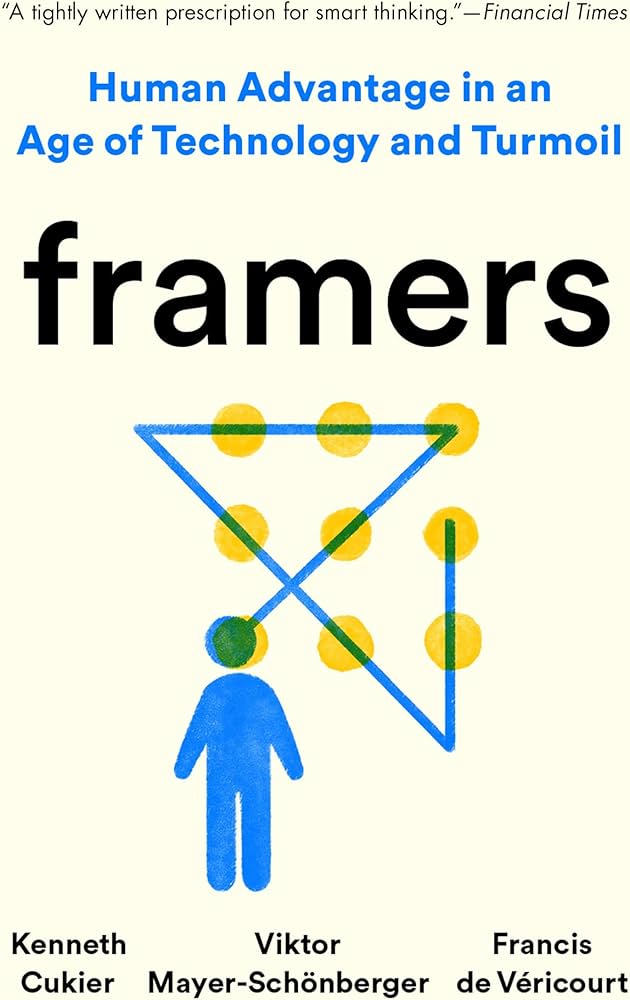
From pandemics to populism, AI to ISIS, wealth inequity to climate change, humanity faces unprecedented challenges that threaten our very existence. The essential tool that will enable humanity to find the best way forward is defined in Framers by internationally renowned authors Kenneth Cukier, Viktor Mayer-Schönberger, and Francis de Véricourt.
To frame is to make a mental model that enables us to make sense of new situations. Frames guide the decisions we make and the results we attain. People have long focused on traits like memory and reasoning, leaving framing all but ignored. But with computers becoming better at some of those cognitive tasks, framing stands out as a critical function—and only humans can do it. This book is the first guide to mastering this human ability.
Illustrating their case with compelling examples and the latest research, authors Cukier, Mayer-Schönberger, and de Véricourt examine:
– Why advice to “think outside the box” is useless
– How Spotify beat Apple by reframing music as an experience
– How the #MeToo twitter hashtag reframed the perception of sexual assault
– The disaster of framing Covid-19 as equivalent to seasonal flu, and how framing it akin to SARS delivered New Zealand from the pandemic
Framers shows how framing is not just a way to improve how we make decisions in the era of algorithms—but why it will be a matter of survival for humanity in a time of societal upheaval and machine prosperity
KEY LEARNINGS
Concept 1: Framing Effects
Framing effects demonstrate how the way information is presented can significantly influence people’s decisions and perceptions. This concept teaches non-profits to strategically choose the language and context they use to frame their mission, projects, and messages. By emphasizing certain aspects and downplaying others, non-profits can shape how their audiences interpret and respond to their initiatives.
Application: Non-profits can tailor their communication to align with the values and emotions of their target audience. For instance, when discussing a social issue, the application suggests using positive and empathetic language to evoke support and engagement.
Concept 2: Cognitive Biases
Cognitive biases are inherent mental shortcuts that affect how individuals perceive and process information. Non-profits can leverage an understanding of these biases to optimize their messaging and campaigns. By recognizing biases such as confirmation bias and availability heuristic, organizations can craft messages that resonate with audiences more effectively.
Application: The application provides guidance on crafting messages that counteract common cognitive biases. For instance, non-profits can present balanced and evidence-based information to counter confirmation bias and employ vivid stories to overcome the availability heuristic.
Concept 3: Narrative Power
The power of narrative lies in its ability to connect emotionally with audiences and make information memorable. Non-profits can harness the impact of storytelling to convey complex issues in relatable ways, making their cause more compelling and accessible. Effective storytelling can create a sense of empathy and urgency, encouraging individuals to take action.
Application: Non-profits can learn to incorporate personal stories of individuals affected by their initiatives. The application offers strategies for weaving narratives into campaigns, emphasizing the human impact of their work to inspire empathy and drive support.
Concept 4: Perception Management
Perception management involves shaping how people perceive certain information, often by influencing the context in which it is presented. Non-profits can apply this concept to reframe challenges as opportunities and emphasize the progress made, fostering a positive outlook among supporters.
Application: The application suggests strategies for positioning setbacks as learning experiences and highlighting successes in measurable terms. By guiding non-profits to manage perceptions effectively, the application helps maintain stakeholder confidence and support.
Concept 5: Contextual Communication
Contextual communication recognizes the importance of adapting messages to different cultural, social, and economic contexts. Non-profits can enhance their impact by tailoring their communication strategies to resonate with diverse audiences. This approach demonstrates respect for the unique perspectives of various communities.
Application: To facilitate contextual communication, the application provides guidelines for researching and understanding the values and norms of different target audiences. By demonstrating cultural sensitivity, non-profits can establish deeper connections and foster inclusive engagement.

Kenneth Cukier, Viktor Mayer-Schönberger, and Francis de Véricourt’s Framers offers a thought-provoking exploration of the uniquely human ability to frame problems and solutions. The authors argue that in a world increasingly dominated by technology, this ability remains indispensable.
The Power of Framing
Framing, as the authors define it, is the process of creating mental models that allow us to see patterns, predict outcomes, and make sense of new situations. These mental models, or frames, guide our decisions, shape our perceptions, and ultimately determine our success.
The Human Edge
While machines excel at certain tasks, such as data analysis and pattern recognition, they lack the ability to frame problems in the same way that humans do. Humans possess a unique ability to synthesize information, draw connections, and create narratives that give meaning to complex situations. This ability, the authors argue, is essential for effective problem-solving, innovation, and leadership.
Examples of Framing in Action
The book is rich with examples that illustrate the power of framing. One particularly striking example is the story of the Wright brothers. The Wright brothers were not the first to experiment with flight, but they were the first to succeed. Their success can be attributed, in part, to their ability to frame the problem of flight in a new way. By focusing on the challenge of controlling an aircraft in flight, rather than simply building a heavier-than-air machine, the Wright brothers were able to develop a revolutionary new approach to aviation.
The Dangers of Poor Framing
The authors also explore the negative consequences of poor framing. For example, the initial framing of COVID-19 as equivalent to a seasonal flu contributed to the mishandling of the pandemic. By downplaying the seriousness of the virus, policymakers and the public were unprepared for the challenges that lay ahead.
Practical Implications
Framers offers practical advice on how individuals and organizations can improve their framing skills. The authors emphasize the importance of cultivating curiosity, seeking diverse perspectives, and practicing empathy. They also argue that it is essential to be aware of the biases that can influence our framing.
Limitations and Ethical Considerations
While Framers offers a compelling argument for the importance of human framing, it is not without its limitations. Some readers may find the book’s focus on individual agency somewhat narrow. While the authors acknowledge the role of societal factors and systemic biases in shaping our frames, they primarily emphasize the power of individual choice and action.
Additionally, the book could have benefited from a more in-depth discussion of the potential ethical implications of framing. In particular, the authors could have explored the ways in which framing can be used to manipulate public opinion and promote harmful ideologies.
Framers is a valuable contribution to our understanding of the human mind and its place in the technological age. By highlighting the unique ability of humans to frame problems and solutions, the authors offer a hopeful message about our potential to thrive in a world increasingly dominated by machines.
Framers explores the power of framing, perception, and communication in influencing decision-making. By integrating these concepts, leaders can enhance their messaging, outreach, and impact.

 27gen.com