
Embark on a journey that will change your perspective on community and individual well-being. In The Great Good Place, Ray Oldenburg gave the term “third places,” where people gather for the pleasure of good company and conversation, and explained just how important they are.
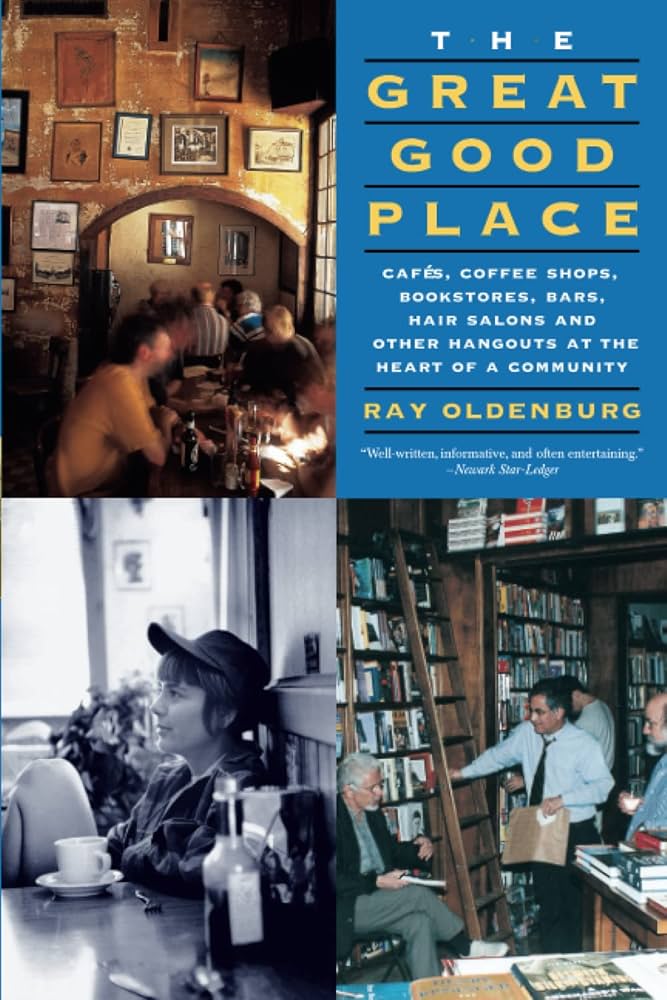
Discover the benefits of informal public and civic life and how it contributes to community health and individual well-being.
Explore how third places have been, and still are, vital to grassroots democracy.
Experience the power of third places and how they bring people together, fostering a sense of belonging and connection.
Allow this book to inspire you to create and revitalize your own third places, from coffee houses to community centers, and make a positive impact on your community.
Learn from real-life examples around the world, and see how third places have transformed and revitalized communities.
Gain a deeper understanding of the history and evolution of third places, from coffee houses to bookstores, and how they continue to play a vital role in our society.
Discover the power and potential of third places and how they can change your community and your life. Don’t miss out on this new edition of the original, groundbreaking The Great Good Place.
Ray Oldenburg’s The Great Good Place (1989) has had a profound influence on urban sociology and the study of social spaces. His work introduces the concept of the “third place,” referring to informal gathering places that are neither home (the first place) nor work (the second place). This idea has become crucial in understanding community dynamics, social interaction, and the structure of public life. Oldenburg’s book not only underscores the importance of these spaces in fostering a sense of community, but also highlights the negative consequences of their decline in contemporary society. This article will offer a brief summary of The Great Good Place, examine its impact on the concept of the third place, and discuss its lasting influence on urban planning, sociology, and community development.
Brief Summary of The Great Good Place
In The Great Good Place, Oldenburg argues that third places – such as cafes, bars, libraries, parks, and community centers – are essential for maintaining the social fabric of a community. These are places where people can meet informally, share experiences, and engage in discussions with others outside of their usual social circles. The essence of these spaces is that they are accessible, welcoming, and neutral, fostering a sense of inclusivity and belonging.
Oldenburg identifies several characteristics that define a third place:
1. Neutral Ground: Third places are not bound by the rules and formalities of home or work environments. People can come and go freely.
2. Leveling Spaces: Social hierarchies often dissipate in third places, allowing people from diverse backgrounds to interact on equal footing.
3. Conversation as the Main Activity: These spaces are conversation-centric, encouraging informal dialogue and exchanges.
4. Accessibility and Accommodation: Third places are easy to access, often with low or no cost, and open to all members of the community.
5. Regulars and Newcomers: While some people become regular patrons of third places, these spaces are also welcoming to newcomers, who can integrate into the social atmosphere.
6. Playfulness: Third places often have a relaxed, playful environment that contrasts with the seriousness of home or work life.
7. Home Away from Home: Many people develop a sense of comfort and belonging in third places, viewing them as extensions of their personal space.
Oldenburg’s analysis is a direct response to what he sees as the declining presence of third places in the United States, particularly in suburban areas where people are increasingly isolated in private homes and vehicles. He laments that modern urban planning and commercial interests have prioritized privatized, consumer-centric spaces over communal gathering points. The decline of such spaces, Oldenburg argues, contributes to a loss of community cohesion, weakening social bonds.
Impact on the Concept of the Third Place
Oldenburg’s work introduced the terminology of “third place” into the academic and popular lexicon, fundamentally reshaping how urban planners, sociologists, and community organizers think about public spaces. Before *The Great Good Place*, there was no widely accepted framework for understanding informal social gathering places as a distinct and critical part of human social life. Oldenburg synthesized a diverse range of examples, from European cafes to American bars, creating a theoretical framework that was broadly applicable across different cultures and contexts.
The concept of the third place has particular importance in understanding urban development and the social consequences of suburbanization. In the early 20th century, many cities around the world had thriving public spaces where people could gather and socialize informally. With the rise of suburban living and the growth of car-dependent societies, however, many of these spaces were either lost or commercialized, turning into malls or large chain establishments that lacked the organic, community-centered atmosphere of traditional third places. Oldenburg’s work illuminated this shift, highlighting how the decline of these spaces led to greater social isolation and a loss of community cohesion.
Characteristics and Evolution of Third Places
Oldenburg’s third places are dynamic spaces where conversation flows freely, hierarchies dissolve, and social interaction thrives. Historically, cafes in Europe, pubs in the UK, and diners in the US have all exemplified third places, where regular patrons and newcomers alike could engage in community life. Oldenburg’s book revitalized interest in these environments, but also called attention to their disappearance in the face of modernization and commercialization.
Not all third places are alike, however. While some may be primarily about fostering conversation, others serve as locations where cultural norms and behaviors can be challenged. For example, coffeehouses in 18th-century England were often sites of intellectual debate, while American taverns have historically been places of political organization and community activism.
In contemporary society, the proliferation of digital technologies and social media has created new potential third places online. However, these virtual spaces lack many of the characteristics Oldenburg celebrates, such as physical presence, unstructured interaction, and a sense of local community. While online spaces offer connection, the embodied experience of third places remains unique and irreplaceable, making their physical presence still vitally important in modern life.
Lasting Impact of The Great Good Place
Oldenburg’s The Great Good Place has had a lasting influence on several fields, including urban planning, sociology, community development, and even commercial architecture. Its impact is particularly notable in how it shifted the focus of urban planners and developers toward creating public spaces that encourage informal socialization.
1. Urban Planning and Design
Urban planners and designers now pay greater attention to the importance of fostering third places in communities. The book has inspired the development of mixed-use neighborhoods that prioritize walkability, communal spaces, and local businesses over the isolated, car-dependent structures typical of suburban sprawl. Public parks, community centers, and local businesses have increasingly become focal points in city planning efforts to encourage vibrant social interactions and stronger community ties.
In more recent years, efforts to develop “complete streets” and walkable urban centers have directly responded to Oldenburg’s concerns about suburban isolation. Municipalities have begun designing public spaces that promote a sense of community, integrating plazas, green spaces, and pedestrian-friendly infrastructure into neighborhoods.
2. Sociology and Community Studies
Oldenburg’s analysis has broadened the scope of sociological studies concerning social capital, community interaction, and public spaces. Sociologists now regularly refer to third places when discussing how communities bond and form social ties. The book has become a foundational text in community studies, sparking research on how different types of third places contribute to social cohesion and collective identity.
3. Business and Commercial Spaces
The rise of “third places” as a business concept has been particularly impactful, with companies like Starbucks explicitly positioning themselves as third places. By offering comfortable seating, free Wi-Fi, and a welcoming atmosphere, many coffee shops, cafes, and bookstores have adopted the third-place model to attract customers seeking informal gathering spaces. While some argue that this commercialization dilutes the true essence of the third place, the integration of Oldenburg’s ideas into business strategy has nonetheless expanded the role of social spaces in contemporary life.
4. Community Development and Revitalization
Community organizers have also drawn from The Great Good Place to advocate for the revitalization of social spaces, particularly in underserved or marginalized communities. The creation of accessible, welcoming third places has become a priority in community development initiatives aimed at reducing social isolation and fostering neighborhood engagement. In this sense, Oldenburg’s ideas have had a direct impact on social policy, particularly concerning public health and community well-being.

Ray Oldenburg’s The Great Good Place introduced a transformative concept that reshaped our understanding of informal gathering spaces. By emphasizing the importance of third places in fostering community ties and social capital, Oldenburg’s work challenged urban developers, sociologists, and community organizers to rethink how public spaces are structured and utilized. The lasting impact of The Great Good Place is evident in the renewed focus on creating vibrant, accessible, and inclusive spaces where people can come together, fostering a greater sense of community in an increasingly fragmented world.

 27gen.com