
Somewhere along the way we drifted apart from our next-door neighbors, and now we’re not sure we can get back together again. We lack a clear vision for showing and sharing Jesus’ love with them and how his countercultural values might transform our neighborhoods, including us.
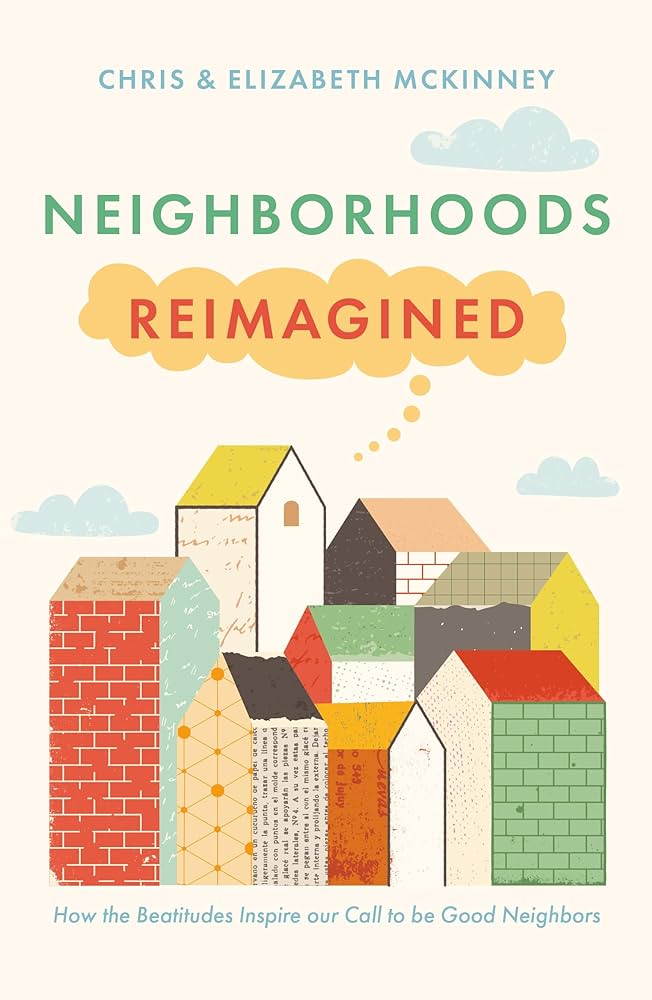
But just imagine. Imagine a neighborhood where people are connected rather than isolated, where wrongs are righted, where mercy brings fences down, and where we become agents in seeing God’s kingdom come.
Believing the beatitudes are Jesus’ invitation into neighborhood flourishing, Neighborhoods Reimagined envisions how these upside-down values can turn our corners right-side-up.
Chris and Elizabeth McKinney never set out to write a book on neighboring (much less two – they released Placed for a Purpose in 2020). They were fine hunkering down like everyone else – except they were’t fine.
Their neediness prompted them to consider connecting with those in proximity, moving them from side-by-side strangers to acquaintances Over time, those casual connections evolved into deeper friendships that could bear weightier conversations.
In time, both Chris and Elizabeth became convinced that the Beatitudes were a “roadway Jesus gives for our flourishing and for living as salt and light in our dark and flavorless world.”
At some juncture, our societal relationship with our immediate neighbors underwent a significant shift. It wasn’t a sudden or intentional breakup; rather, it seemed to occur gradually, almost inadvertently. We might characterize it as mutual, though it was never explicitly acknowledged. Our lives became increasingly busy, our work more demanding, and in the midst of it all, we simply drifted apart, ultimately losing touch for years.
This divergence in neighborly connections is not just a feeling; it’s substantiated by data. A study conducted by Georgetown University in 2005 revealed that nearly half of Americans were unfamiliar with their neighbors. Thirteen years later, in 2018, this figure rose to 68 percent, indicating a substantial decline in neighborly acquaintance. Undoubtedly, the events of the post-2020 era have further exacerbated this trend.

While we claim there’s no animosity, the reality suggests otherwise. There exists a level of mistrust that has developed as our social bonds weakened. This erosion of trust has reached a point where a knock at the door can induce panic. We’ve responded by installing larger peepholes, sophisticated doorbells equipped with cameras, and smart speakers for added security.
Research validates these emerging trust issues. Surveys indicate that less than half of us trust our neighbors, with the youngest demographic, aged 18-29, exhibiting an even higher rate of distrust at 61 percent. Without the buffer of introductions and established relationships, navigating the differences between urban and suburban life becomes awkward, leading us to retreat to our inner circles and online tribes.
The current political and social climate exacerbates these divisions. Our entrenched viewpoints make it exhausting to entertain alternative perspectives. Political discourse, once casual, now feels fraught with tension, prompting the erection of metaphorical fences that inhibit meaningful interaction. In essence, societal norms seem to suggest that maintaining distance and minding our own business is preferable to engaging with neighbors.
Though we may not label our neighbors as adversaries, our collective indifference speaks volumes. Jesus highlighted this tendency in his parable of the Good Samaritan, illustrating how even the most religious individuals can neglect those they don’t truly care for. So, what’s the solution?
Jesus offers a radical alternative through his teachings in the Sermon on the Mount, particularly in the Beatitudes. These statements outline the qualities and blessings bestowed upon those who embody his vision. While applicable to all aspects of life, in Neighborhoods Reimagined, the McKinneys explore how applying the Beatitudes to our neighborhoods could foster significant change.
How could the Beatitudes turn your neighborhood upside down?
Chris and Elizabeth McKinney
Jesus presents a counter-cultural perspective, challenging conventional wisdom with a vision for a renewed humanity rooted in love and compassion. Though seemingly impractical, his teachings offer a transformative pathway for neighborhoods to thrive.
By embracing Jesus’ upside-down kingdom and embodying the Beatitudes, we can cultivate a renewed sense of community and neighborliness. Imperfect though we may be, the transformative power of Jesus’ teachings can reshape our neighborhoods, one relationship at a time.
I first met and talked with the McKinneys after the publication of their first book. Later we had additional conversations as they expanded their network and began a podcast. When I learned they were working on this book, I could not wait to dive into it – and it has surpassed my expectations! With a warm, personable writing style, Chris and Elizabeth invite the reader to pull up a chair and join them on their journey of living out the Beatitudes in their neighborhood, warts and all. I found the end of chapter Reflection and Discussion sections helpful to really let the content sink in and work out how I might apply it in my own neighboring journey. If you are ready to have your neighborhood turned upside down, by all means let Chris and Elizabeth come alongside of you through Neighborhoods Reimagined.

 27gen.com