Honoring My Airman

Today my family and I mark a sobering moment as our son, an Airman in the U.S. Air Force, deploys for his first tour of duty overseas in a combat zone.

In his honor, we are now displaying this on our front door:

BlueStarFlag

The Blue Star represents an immediate family member serving in the Armed Forces during any period of war or hostilities.

The Service Flag has a long and distinguished history. The banner was designed in 1917 by United States Army Captain Robert L. Queisser of the Fifth Ohio Infantry, in honor of his two sons who were serving in World War I. It was quickly adopted by the public and by government officials. On September 24, 1917, an Ohio congressman read into the Congressional Record:

The mayor of Cleveland, the Chamber of Commerce and the Governor of Ohio have adopted this service flag. The world should know of those who give so much for liberty. The dearest thing in all the world to a father and mother – their children.

I’m grateful for my son’s service to our country. When he first talked with my wife and me about military service upon graduation from high school, we were affirming but also wanted him to get a college degree first. When he did, and revisited the question several years later, we encouraged him to move forward. We were proud parents at his graduation from Basic Training and remain so at every step of his career advancement. Realizing this is a necessary part of that advancement, we prayerfully send him on his way today.

I’m also humbled by the sacrifices his wife and daughters are making. As the daughter of an Air Force Colonel (retired), she is no stranger to these goodbyes and separations. As a wife and mother, though, it has to be different. She handles the responsibilities with tremendous patience and poise.

During the past few days, our conversations have been both light-hearted and serious. In the late night hours last night, I was reminded of my father’s graveside service and military traditions. As Americans, we have probably never disagreed more about things than we currently are – but we all need to remember why we have the opportunities we do – including disagreeing with one another.

I hope you will join me today – and everyday – in a prayer of safety for my son and the thousands of other members of the Armed Forces he is joining today as they stand in harm’s way for our freedoms.

33rdSpecialOperationsSquadron

Starbucks: A Significant & Purposeful Business Anchored in Engaging & Compassionate Leadership Practices

It is important to remember that Starbucks started as a single store and that anything is possible if we take the lessons learned from Starbucks as a nudge to think about how we can innovate and expand our products, services, social media tools, technologies, and channels. The leaders at Starbucks also demonstrate what is possible when you foster product passion, teach your people the importance of human connections, seek operational excellence and efficiency, and engage in a never-ending pursuit of relevance.     – Joseph Michelli, Leading the Starbucks Way

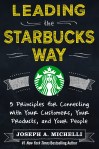
The first session of the Fall Term of the 2013 GsD is wrapping up with today’s post. Organizational consultant Joseph Michelli’s latest book Leading the Starbucks Way has been the primary resource for this session.

Michelli uses over two years of research with dozens of leaders in the Starbucks organization to develop five actionable principles that forge emotional connections that drive innovation, grow new business product lines, and foster employee and customer loyalty. These principles are “brief and clear, and put the customers, products, and experiences at the purposeful center of Starbucks.” Here are the five principles:

  1. Savor and elevate
  2. Love to be loved
  3. Reach for common ground
  4. Mobilize the connection
  5. Cherish and challenge your legacy

In order to help you evaluate mastery of the material as well as apply independent thinking skills to your own setting, here are a few summary thoughts based on the five principles above.

  • When frontline team members are passionate about your Guest Experience, they build interest and excitement on the part of your Guests.
  • Evaluate every strategy to ensure that it aligns with your core values, reinforces your purpose, and stimulates continued progress toward your aspirations.
  • Well-designed experiences involve a willingness to see the environment and process from your Guests’ perspective.
  • If your Guests view your organization as being competent and having integrity, you have created the environment for trust. Trust is a gateway emotion on a journey to greater levels of emotional engagement.
  • Listening is not a passive pursuit; listening is synonymous with connecting discovering, understanding, empathizing, and responding.
  • Good leaders provide uplifting moments for those who uplift Guests.
  •  One of the most powerful opportunities for building a relationship occurs after your Guests’ visit, with your team members offering a warm farewell, and inviting Guests into future opportunities to connect.
  • Observe your Guests, then adopt, adapt, and extrapolate new ideas that will connect both locally and globally.
  • Technology should support the mission, not the reverse.
  • Complacency and inertia are challenges to innovation for your organization.
  • There is typically a strong interdependence among a organization’s performance, its values, and the impact it has on the communities it serves.
  • Passionate team members have a magnetically positive impact when it comes to turning Guests into attenders and future team members.

It is important to remember that, at its heart, Starbucks is in the people business serving coffee. Place, Process, and Product are all important, but the foundation and core of Starbucks success is its People.

Take a look at this brief video and you will have a better understanding of what I mean:

SBPartner1

The M.U.G. Award referred to in the video allows partners to recognize co-workers for “Moves of Uncommon Greatness” that help them achieve their goals. It’s a way of saying, “Thanks for helping me out. I couldn’t have done it without you!”

Can your team members say the same thing?

Part 9 of a series in the 2013 GsD Fall Term

Leading the Starbucks Way: Information, Insights, and Analysis Needed to Create a High-Performance Guest-Oriented Organization

inspired by and adapted from Leading The Starbucks Way, by Joseph Michelli

Print

Leaders Honor the Past – But Aren’t Trapped There

In late 2007, Starbucks was not doing well, and the future looked bleak. To address the emerging problems, former CEO Howard Schultz, who had stepped aside almost eight years earlier to become chairman of the board, did something unexpected: he returned as CEO to oversee day-to-day operations.

Schultz came back to Starbucks with a passion and a plan, and over the next two years, Starbucks returned to sustainable, profitable growth.

Here’s what Schultz had to say in looking back to early 2008: 

If not checked, success has a way of covering up small failures, and when many of us at Starbucks became swept up in the company’s success, it had unintended effects. We ignored, or maybe we just failed to notice, shortcomings.

We were so intent upon building more stores fast to meet each quarter’s projected sales growth that, too often, we picked bad locations or didn’t adequately train newly hired baristas. Sometimes we transferred a good store manager to oversee a new store, but filled the old post by promoting a barista before he or she was properly trained. 

courtesy nbcnews.com

courtesy nbcnews.com

As the years passed, enthusiasm morphed into a sense of entitlement, at least from my perspective. Confidence became arrogance and, at some point, confusion as some of our people stepped back and began to scratch their heads, wondering what Starbucks stood for. 

In the early years at Starbucks, I liked to say that a partner’s job at Starbucks was to “deliver on the unexpected” for customers. Now, many partners’ energies seemed to be focused on trying to deliver the expected – mostly for Wall Street. 

Great organizations foster a productive tension between continuity and change. On the one hand, they adhere to the principles that produce success in the first place, yet on the other hand, they continually evolve, modifying their approach with creative improvements and intelligent adaptation.

When organizations fail to distinguish between current practices and the enduring principles of their success, and mistakenly fossilize around their practices, they’ve set themselves up for decline.

By confusing what and why, Starbucks found itself at a dangerous crossroads. Which direction would they go?

In Leading the Starbucks Way, organizational consultant Joseph Michelli uses two years of research with dozens of leaders in the Starbucks organization to develop five actionable principles that forge emotional connections that drive innovation, grow new business product lines, and foster employee and customer loyalty. These principles are “brief and clear, and put the customers, products, and experiences at the purposeful center of Starbucks.”

Leadership Principle #5: Cherish and Challenge Your Legacy

“Cherish and challenge your legacy” is all about encouraging you to define the legacy you wish to leave and evaluate your leadership performance, in part, based on your progress toward that legacy.     – Joseph Michelli, Leading the Starbucks Way

A key element in the success of the Starbucks transformation results from an alignment between leaders who are charged with driving change and those who are responsible for ensuring consistent operations.

Our challenge has been to produce innovations that improve operations, drive growth, enhance the partner and customer experience, and increase profitability. That’s a tall order, but it often occurs in the most subtle ways.     – Craig Russell, Starbucks senior vice president, Global Coffee

Ultimate success in driving innovation hinges on the alignment of those who foster change and those who maintain stability.

ChurchWorld Application

  1. What are the strengths of your organization that have been most instrumental to the success you have achieved?
  2. How might those success drivers inadvertently become traps that could constrain future growth?
  3. How aligned are the “operators” and the “innovators” in your organization? Would you say that both groups share an “operational innovation” mindset?

Any organization, small or large, consumer or otherwise, that is going to embrace the status quo as an operating principle is just going to be dead…The need for constant innovation and pushing forward has never been greater than it is today.    – Howard Schultz, CEO, Starbucks

Leaders must honor the past but not be trapped in it.


Part 8 of a series in the 2013 GsD Fall Term

Leading the Starbucks Way: Information, Insights, and Analysis Needed to Create a High-Performance Guest-Oriented Organization

inspired by and adapted from Leading The Starbucks Way, by Joseph Michelli

Print


Growing Connections Through Technology

I’m writing this post sitting in an airport, waiting on my flight. I drove to the airport from my client’s location, navigating via my smart phone. Along the way, I was updated by the airline with a flight time change. Arriving at the airport, I checked in with a boarding pass on my phone. Waiting for the flight, I checked email, websites, and participated in a conference call – all on my mobile phone.

Mobile technology has changed the world, and that includes ChurchWorld.

courtesy mobilecommercedaily.com

courtesy mobilecommercedaily.com

In Leading the Starbucks Way, organizational consultant Joseph Michelli uses two years of research with dozens of leaders in the Starbucks organization to develop five actionable principles that forge emotional connections that drive innovation, grow new business product lines, and foster employee and customer loyalty. These principles are “brief and clear, and put the customers, products, and experiences at the purposeful center of Starbucks.”

Leadership Principle #4: Mobilize the Connection

This principle looks at how Starbucks strengthens the relationships formed in Starbucks stores and extends them into the home, office, and supermarket experiences of customers. It also examines how Starbucks leaders leverage technology to integrate a multichannel relationship with their customer base.

Great leaders continually seek to leverage the options that are emerging through technology and to position their businesses on social platforms more effectively and strategically.     – Joseph Michelli, Leading the Starbucks Way

ChurchWorld Application

  1. How would you assess your success in forging a digital connection of trust and relevance?
  2. Do you have a multi-pronged and integrated strategy concerning digital and mobile solutions?

Two key elements in the Starbucks social media strategy are authenticity and interesting content. Starbucks is committed to making friends, not offers. They feel that Twitter and Facebook are about connecting – there are more appropriate settings for selling and closing.

ChurchWorld Application

  1. How strategic are your decisions concerning the social media platforms through which your brand will engage?
  2. Have you dedicated resources to commit time to thinking about the platform that fits your organization and guest and member interfaces?

Technology will serve our mission, and we will deploy our strategies to engage our partners and customers wherever they spend their time. We will seek to stay relevant to them and uplift them through human connection.     – Alex Wheeler, vice president, Starbucks Global Digital Marketing

SBFacebookpage

A few of the highlights of this principle:

  • Twitter and Facebook approaches should focus on consistent but not overwhelming levels of communication, delivered for the purpose of connecting.
  • No matter the size of the organization, its leaders should designate someone to be in charge of social media strategy.
  • Technology is powerful when you view it as a way to enhance the human connection rather than seeing it as inevitably leading to impersonalization.
  • Technology should not be provided for “users,” but instead should be seen as a tool for serving and connecting with your “people” and your “Guests.”


Part 7 of a series in the 2013 GsD Fall Term

Leading the Starbucks Way: Information, Insights, and Analysis Needed to Create a High-Performance Guest-Oriented Organization

inspired by and adapted from Leading The Starbucks Way, by Joseph Michelli

Print